



 Chat with AI
Exam 27: Bacteria and Archaea

Exam 1: Introduction: Evolution and Themes of Biology77 Questions
Exam 2: The Chemical Context of Life98 Questions
Exam 3: Water and Life92 Questions
Exam 4: Carbon and the Molecular Diversity of Life86 Questions
Exam 5: The Structure and Function of Large Biological Molecules131 Questions
Exam 6: A Tour of the Cell111 Questions
Exam 7: Membrane Structure and Function88 Questions
Exam 8: An Introduction to Metabolism92 Questions
Exam 9: Cellular Respiration and Fermentation128 Questions
Exam 10: Photosynthesis103 Questions
Exam 11: Cell Communication85 Questions
Exam 12: The Cell Cycle98 Questions
Exam 13: Meiosis and Sexual Life Cycles90 Questions
Exam 14: Mendel and the Gene Idea92 Questions
Exam 15: The Chromosomal Basis of Inheritance75 Questions
Exam 16: The Molecular Basis of Inheritance84 Questions
Exam 17: From Gene to Protein106 Questions
Exam 18: Regulation of Gene Expression116 Questions
Exam 19: Viruses71 Questions
Exam 20: DNA Tools and Biotechnology78 Questions
Exam 21: Genomes and Their Evolution64 Questions
Exam 22: Descent with Modification: A Darwinian View of Life68 Questions
Exam 23: The Evolution of Populations92 Questions
Exam 24: The Origin of Species76 Questions
Exam 25: The History of Life on Earth89 Questions
Exam 26: Phylogeny and the Tree of Life91 Questions
Exam 27: Bacteria and Archaea96 Questions
Exam 28: Protists82 Questions
Exam 29: Plant Diversity I: How Plants Colonized Land93 Questions
Exam 30: Plant Diversity II: The Evolution of Seed Plants119 Questions
Exam 31: Fungi105 Questions
Exam 32: An Overview of Animal Diversity93 Questions
Exam 33: An Introduction to Invertebrates111 Questions
Exam 34: The Origin and Evolution of Vertebrates126 Questions
Exam 35: Plant Structure,Growth,and Development82 Questions
Exam 36: Resource Acquisition and Transport in Vascular Plants100 Questions
Exam 37: Soil and Plant Nutrition99 Questions
Exam 38: Angiosperm Reproduction and Biotechnology107 Questions
Exam 39: Plant Responses to Internal and External Signals137 Questions
Exam 40: Basic Principles of Animal Form and Function98 Questions
Exam 41: Animal Nutrition87 Questions
Exam 42: Circulation and Gas Exchange112 Questions
Exam 43: The Immune System123 Questions
Exam 44: Osmoregulation and Excretion91 Questions
Exam 45: Hormones and the Endocrine System92 Questions
Exam 46: Animal Reproduction104 Questions
Exam 47: Animal Development106 Questions
Exam 48: Neurons,Synapses,and Signalling93 Questions
Exam 49: Nervous Systems85 Questions
Exam 50: Sensory and Motor Mechanisms106 Questions
Exam 51: Animal Behaviour91 Questions
Exam 52: An Introduction to Ecology and the Biosphere90 Questions
Exam 53: Population Ecology89 Questions
Exam 54: Community Ecology97 Questions
Exam 55: Ecosystems and Restoration Ecology98 Questions
Exam 56: Conservation Biology and Global Change90 Questions
Select questions type


We have overwhelming evidence that Bacteria and Archaea are masters of adaptation.Which key characteristic enables these prokaryotes to occupy almost every habitat on earth?

Free
(Multiple Choice)
4.8/5  (72)
(72) Correct Answer: Verified
C
While antibiotics have saved millions of lives,antibiotic use also
Free
(Multiple Choice)
4.9/5 (88)
(88) Correct Answer:Verified
VerifiedE
Which species is most likely to be found both in sewage treatment plants and in the guts of cattle?
Free
(Multiple Choice)
4.8/5 (89)
(89) Correct Answer:Verified
VerifiedB
Use the following information to answer the questions below.
Nitrogenase,the enzyme that catalyzes nitrogen fixation,is inhibited whenever free O₂ reaches a critical concentration.Consequently,nitrogen fixation cannot occur in cells wherein photosynthesis produces free O₂.Consider the colonial aquatic cyanobacterium,Anabaena,whose heterocytes are described as having "…a thickened cell wall that restricts entry of O₂ produced by neighbouring cells.Intracellular connections allow heterocysts to transport fixed nitrogen to neighbouring cells in exchange for carbohydrates."
-Given that the enzymes that catalyze nitrogen fixation are inhibited by oxygen,what are two "strategies" that nitrogen-fixing prokaryotes might use to protect these enzymes from oxygen?
1)couple them with photosystem II (the photosystem that splits water molecules)
2)package them in membranes that are impermeable to all gases
3)be obligate anaerobes
4)be strict aerobes
5)package these enzymes in specialized cells or compartments that inhibit oxygen entry
(Multiple Choice)
4.8/5 (85)
(85) Though plants,fungi,and prokaryotes all have cell walls,we place them in different taxa.Which of these observations comes closest to explaining the basis for placing these organisms in different taxa,well before relevant data from molecular systematics became available?
(Multiple Choice)
4.9/5 (80)
(80) Bacteria can infect fish both externally and internally.Which is the most likely point of entry of bacteria that will cause an internal infection?
(Multiple Choice)
4.8/5 (84)
(84) Bacteria perform each of the following ecological roles.Which role typically does not involve a symbiosis?
(Multiple Choice)
4.9/5 (87)
(87) Use the following information to answer the questions below.
Nitrogenase,the enzyme that catalyzes nitrogen fixation,is inhibited whenever free O₂ reaches a critical concentration.Consequently,nitrogen fixation cannot occur in cells wherein photosynthesis produces free O₂.Consider the colonial aquatic cyanobacterium,Anabaena,whose heterocytes are described as having "…a thickened cell wall that restricts entry of O₂ produced by neighbouring cells.Intracellular connections allow heterocysts to transport fixed nitrogen to neighbouring cells in exchange for carbohydrates."
-Which two questions below arise from a careful reading of this quotation,and are most important for understanding how N₂ enters heterocysts,and how O₂ is kept out of heterocysts?
1)If carbohydrates can enter the heterocysts from neighbouring cells via the "intracellular connections," how is it that O₂ doesn't also enter via this route?
2)If the cell walls of Anabaena's photosynthetic cells are permeable to O₂ and CO₂,are they also permeable to N₂?
3)If the nuclei of the photosynthetic cells contain the genes that code for nitrogen fixation,how can these cells fail to perform nitrogen fixation?
4)If the nuclei of the heterocysts contain the genes that code for photosynthesis,how can these cells fail to perform photosynthesis?
5)If the cell walls of Anabaena's heterocysts are permeable to N₂,how is it that N₂ doesn't diffuse out of the heterocysts before it can be fixed?
6)If the thick cell walls of the heterocysts exclude entry of oxygen gas,how is it that they don't also exclude the entry of nitrogen gas?
(Multiple Choice)
4.7/5 (80)
(80) Which two species might be expected to cooperate metabolically,perhaps forming a biofilm wherein one species surrounds cells of the other species?
(Multiple Choice)
4.7/5 (76)
(76) In a bacterium that possesses antibiotic resistance and the potential to persist through very adverse conditions,such as freezing,drying,or high temperatures,DNA should be located within,or be part of,which structures?
1)nucleoid region
2)endospore
3)fimbriae
4)plasmids
(Multiple Choice)
4.8/5 (97)
(97) The following table depicts characteristics of five prokaryotic species (A-E).Use the information in the table to answer the following questions.
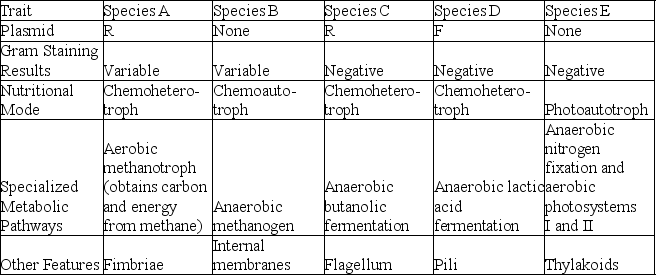 -Which two species should have much more phospholipid,in the form of bilayers,in their cytoplasms than most other bacteria?
 (Multiple Choice)
4.9/5 (75)
(75) Use the following information to answer the question(s)below.
The most recently discovered phylum in the animal kingdom (1995)is the phylum Cycliophora.It includes three species of tiny organisms that live in large numbers on the outsides of the mouthparts and appendages of lobsters.The feeding stage permanently attaches to the lobster via an adhesive disk and collects scraps of food from its host's feeding by capturing the scraps in a current created by a ring of cilia.The body is sac-like and has a U-shaped intestine that brings the anus close to the mouth.Cycliophorans are coelomates,do not molt (though their host does),and their embryos undergo spiral cleavage.
-If harboring large populations of cycliophorans neither helps nor harms their lobster hosts,then cycliophorans can be properly considered to be ________.
1)parasites
2)mutualists
3)commensals
4)symbionts
5)endosymbionts
(Multiple Choice)
4.9/5 (69)
(69) The following table depicts characteristics of five prokaryotic species (A-E).Use the information in the table to answer the following questions.
-Which species should be able to respond most readily to taxes (plural of taxis)?
-Which species should be able to respond most readily to taxes (plural of taxis)? (Multiple Choice)
4.9/5 (91)
(91) E.coli cells typically make most of their ATP by metabolizing glucose.Under the conditions of this experiment,what should be true of E.coli's generation time (especially early in the course of the experiment,but less so later on)?
(Multiple Choice)
4.9/5 (81)
(81) In a hypothetical situation,a bacterium lives on the surface of a leaf,where it obtains nutrition from the leaf's nonliving,waxy covering while inhibiting the growth of other microbes that are plant pathogens.If this bacterium gains access to the inside of a leaf,however,it causes a fatal disease in the plant.Once the plant dies,the bacterium and its offspring decompose the plant.What is the correct sequence of ecological roles played by the bacterium in the situation described here? Use only those that apply.
1)nutrient recycler
2)mutualist
3)commensal
4)parasite
5)primary producer
(Multiple Choice)
4.9/5 (87)
(87) For several decades now,amphibian species worldwide have been in decline.A significant proportion of the decline seems to be due to the spread of the chytrid fungus,Batrachochytrium dendrobatidis (Bd).Chytrid sporangia reside within the epidermal cells of infected animals,animals that consequently show areas of sloughed skin.They can also be lethargic,which is expressed through failure to hide and failure to flee.The infection cycle typically takes four to five days,at the end of which zoospores are released from sporangia into the environment.In some amphibian species,mortality rates approach 100%; other species seem able to survive the infection.
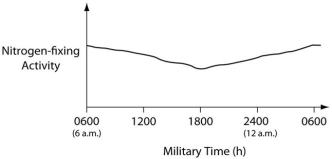
-Data were collected from the heterocysts of a nitrogen-fixing cyanobacterium inhabiting equatorial ponds.Study the following graph and choose the most likely explanation for the shape of the curve.
(Multiple Choice)
4.9/5 (86)
(86) 
Filters
- Essay(0)
- Multiple Choice(0)
- Short Answer(0)
- True False(0)
- Matching(0)