



 Chat with AI
Exam 27: Bacteria and Archaea

Exam 1: Introduction: Evolution and Themes of Biology77 Questions
Exam 2: The Chemical Context of Life98 Questions
Exam 3: Water and Life92 Questions
Exam 4: Carbon and the Molecular Diversity of Life86 Questions
Exam 5: The Structure and Function of Large Biological Molecules131 Questions
Exam 6: A Tour of the Cell111 Questions
Exam 7: Membrane Structure and Function88 Questions
Exam 8: An Introduction to Metabolism92 Questions
Exam 9: Cellular Respiration and Fermentation128 Questions
Exam 10: Photosynthesis103 Questions
Exam 11: Cell Communication85 Questions
Exam 12: The Cell Cycle98 Questions
Exam 13: Meiosis and Sexual Life Cycles90 Questions
Exam 14: Mendel and the Gene Idea92 Questions
Exam 15: The Chromosomal Basis of Inheritance75 Questions
Exam 16: The Molecular Basis of Inheritance84 Questions
Exam 17: From Gene to Protein106 Questions
Exam 18: Regulation of Gene Expression116 Questions
Exam 19: Viruses71 Questions
Exam 20: DNA Tools and Biotechnology78 Questions
Exam 21: Genomes and Their Evolution64 Questions
Exam 22: Descent with Modification: A Darwinian View of Life68 Questions
Exam 23: The Evolution of Populations92 Questions
Exam 24: The Origin of Species76 Questions
Exam 25: The History of Life on Earth89 Questions
Exam 26: Phylogeny and the Tree of Life91 Questions
Exam 27: Bacteria and Archaea96 Questions
Exam 28: Protists82 Questions
Exam 29: Plant Diversity I: How Plants Colonized Land93 Questions
Exam 30: Plant Diversity II: The Evolution of Seed Plants119 Questions
Exam 31: Fungi105 Questions
Exam 32: An Overview of Animal Diversity93 Questions
Exam 33: An Introduction to Invertebrates111 Questions
Exam 34: The Origin and Evolution of Vertebrates126 Questions
Exam 35: Plant Structure,Growth,and Development82 Questions
Exam 36: Resource Acquisition and Transport in Vascular Plants100 Questions
Exam 37: Soil and Plant Nutrition99 Questions
Exam 38: Angiosperm Reproduction and Biotechnology107 Questions
Exam 39: Plant Responses to Internal and External Signals137 Questions
Exam 40: Basic Principles of Animal Form and Function98 Questions
Exam 41: Animal Nutrition87 Questions
Exam 42: Circulation and Gas Exchange112 Questions
Exam 43: The Immune System123 Questions
Exam 44: Osmoregulation and Excretion91 Questions
Exam 45: Hormones and the Endocrine System92 Questions
Exam 46: Animal Reproduction104 Questions
Exam 47: Animal Development106 Questions
Exam 48: Neurons,Synapses,and Signalling93 Questions
Exam 49: Nervous Systems85 Questions
Exam 50: Sensory and Motor Mechanisms106 Questions
Exam 51: Animal Behaviour91 Questions
Exam 52: An Introduction to Ecology and the Biosphere90 Questions
Exam 53: Population Ecology89 Questions
Exam 54: Community Ecology97 Questions
Exam 55: Ecosystems and Restoration Ecology98 Questions
Exam 56: Conservation Biology and Global Change90 Questions
Select questions type


Which two structures play direct roles in permitting bacteria to adhere to each other,or to other surfaces?
1)capsules
2)endospores
3)fimbriae
4)plasmids
5)flagella
(Multiple Choice)
4.8/5  (77)
(77) Which of the following involves metabolic cooperation among prokaryotic cells?
(Multiple Choice)
5.0/5 (71)
(71) Chloramphenicol is an antibiotic that targets prokaryotic (70S)ribosomes,but not eukaryotic (80S)ribosomes.Which of these questions stems from this observation,plus an understanding of eukaryotic origins?
(Multiple Choice)
4.8/5 (80)
(80) The figure below depicts changes to the amount of DNA present in a recipient cell that is engaged in conjugation with an Hfr cell.Hfr cell DNA begins entering the recipient cell at Time A.Assume that reciprocal crossing over occurs (in other words,a fragment of the recipient's chromosome is exchanged for a homologous fragment from the Hfr cell's DNA).Use this figure to answer the following questions.
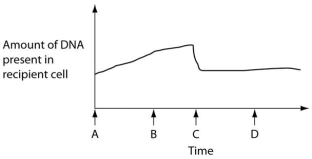 -What is occurring at Time C that is decreasing the DNA content?
 (Multiple Choice)
4.9/5 (83)
(83) Assuming that each of these possesses a cell wall,which prokaryotes should be expected to be most strongly resistant to plasmolysis in hypertonic environments?
(Multiple Choice)
4.9/5 (84)
(84) Which question,arising from the results depicted in the above figure,is most interesting from a genetic perspective,and has the greatest potential to increase our knowledge base?
(Multiple Choice)
4.7/5 (74)
(74) Biologists sometimes divide living organisms into two groups: autotrophs and heterotrophs.These two groups differ in ________.
(Multiple Choice)
4.9/5 (81)
(81) Genetic variation in bacterial populations cannot result from
(Multiple Choice)
4.8/5 (65)
(65) Carl Woese and collaborators identified two major branches of prokaryotic evolution.What was the basis for dividing prokaryotes into two domains?
(Multiple Choice)
4.8/5 (66)
(66) If the vertical axis of the above figure refers to "Darwinian fitness," then which of the following is the most valid and accurate measure of fitness?
(Multiple Choice)
4.9/5 (86)
(86) The predatory bacterium,Bdellovibrio bacteriophorus,drills into a prey bacterium and,once inside,digests it.In an attack upon a gram-negative bacterium that has a slimy cell covering,what is the correct sequence of structures penetrated by B.bacteriophorus on its way to the prey's cytoplasm?
1)membrane composed mostly of lipopolysaccharide
2)membrane composed mostly of phospholipids
3)peptidoglycan
4)capsule
(Multiple Choice)
4.8/5 (82)
(82) Match the numbered terms to the description that follows.Choose all appropriate terms.
1)autotroph
2)heterotroph
3)phototroph
4)chemotroph
Description: an organism that obtains both carbon and energy by ingesting prey
(Multiple Choice)
4.9/5 (77)
(77) Which species is most self-sustaining in terms of obtaining nutrition in environments containing little fixed nitrogen or carbon?
(Multiple Choice)
4.9/5 (76)
(76) Use the information in the following paragraph to answer the next few questions.
A hypothetical bacterium swims among human intestinal contents until it finds a suitable location on the intestinal lining.It adheres to the intestinal lining using a feature that also protects it from phagocytes,bacteriophages,and dehydration.Fecal matter from a human in whose intestine this bacterium lives can spread the bacterium,even after being mixed with water and boiled.The bacterium is not susceptible to the penicillin family of antibiotics.It contains no plasmids and relatively little peptidoglycan.
-Adherence to the intestinal lining by this bacterium is due to its possession of
(Multiple Choice)
4.8/5 (79)
(79) Which of the following is an important source of endotoxin in gram-negative species?
(Multiple Choice)
4.9/5 (84)
(84) 
Filters
- Essay(0)
- Multiple Choice(0)
- Short Answer(0)
- True False(0)
- Matching(0)