



 Chat with AI
Exam 27: Bacteria and Archaea

Exam 1: Introduction: Evolution and Themes of Biology77 Questions
Exam 2: The Chemical Context of Life98 Questions
Exam 3: Water and Life92 Questions
Exam 4: Carbon and the Molecular Diversity of Life86 Questions
Exam 5: The Structure and Function of Large Biological Molecules131 Questions
Exam 6: A Tour of the Cell111 Questions
Exam 7: Membrane Structure and Function88 Questions
Exam 8: An Introduction to Metabolism92 Questions
Exam 9: Cellular Respiration and Fermentation128 Questions
Exam 10: Photosynthesis103 Questions
Exam 11: Cell Communication85 Questions
Exam 12: The Cell Cycle98 Questions
Exam 13: Meiosis and Sexual Life Cycles90 Questions
Exam 14: Mendel and the Gene Idea92 Questions
Exam 15: The Chromosomal Basis of Inheritance75 Questions
Exam 16: The Molecular Basis of Inheritance84 Questions
Exam 17: From Gene to Protein106 Questions
Exam 18: Regulation of Gene Expression116 Questions
Exam 19: Viruses71 Questions
Exam 20: DNA Tools and Biotechnology78 Questions
Exam 21: Genomes and Their Evolution64 Questions
Exam 22: Descent with Modification: A Darwinian View of Life68 Questions
Exam 23: The Evolution of Populations92 Questions
Exam 24: The Origin of Species76 Questions
Exam 25: The History of Life on Earth89 Questions
Exam 26: Phylogeny and the Tree of Life91 Questions
Exam 27: Bacteria and Archaea96 Questions
Exam 28: Protists82 Questions
Exam 29: Plant Diversity I: How Plants Colonized Land93 Questions
Exam 30: Plant Diversity II: The Evolution of Seed Plants119 Questions
Exam 31: Fungi105 Questions
Exam 32: An Overview of Animal Diversity93 Questions
Exam 33: An Introduction to Invertebrates111 Questions
Exam 34: The Origin and Evolution of Vertebrates126 Questions
Exam 35: Plant Structure,Growth,and Development82 Questions
Exam 36: Resource Acquisition and Transport in Vascular Plants100 Questions
Exam 37: Soil and Plant Nutrition99 Questions
Exam 38: Angiosperm Reproduction and Biotechnology107 Questions
Exam 39: Plant Responses to Internal and External Signals137 Questions
Exam 40: Basic Principles of Animal Form and Function98 Questions
Exam 41: Animal Nutrition87 Questions
Exam 42: Circulation and Gas Exchange112 Questions
Exam 43: The Immune System123 Questions
Exam 44: Osmoregulation and Excretion91 Questions
Exam 45: Hormones and the Endocrine System92 Questions
Exam 46: Animal Reproduction104 Questions
Exam 47: Animal Development106 Questions
Exam 48: Neurons,Synapses,and Signalling93 Questions
Exam 49: Nervous Systems85 Questions
Exam 50: Sensory and Motor Mechanisms106 Questions
Exam 51: Animal Behaviour91 Questions
Exam 52: An Introduction to Ecology and the Biosphere90 Questions
Exam 53: Population Ecology89 Questions
Exam 54: Community Ecology97 Questions
Exam 55: Ecosystems and Restoration Ecology98 Questions
Exam 56: Conservation Biology and Global Change90 Questions
Select questions type


Use the following information to answer the question(s)below.
The most recently discovered phylum in the animal kingdom (1995)is the phylum Cycliophora.It includes three species of tiny organisms that live in large numbers on the outsides of the mouthparts and appendages of lobsters.The feeding stage permanently attaches to the lobster via an adhesive disk and collects scraps of food from its host's feeding by capturing the scraps in a current created by a ring of cilia.The body is sac-like and has a U-shaped intestine that brings the anus close to the mouth.Cycliophorans are coelomates,do not molt (though their host does),and their embryos undergo spiral cleavage.
-Bacteria perform each of the following ecological roles.Which role typically does not involve symbiosis?
(Multiple Choice)
4.9/5  (72)
(72) All of the following are potential causes that may have contributed to the introduction and spread of the infection in the two tanks,with the exception of
(Multiple Choice)
4.8/5 (83)
(83) Which of the following is least associated with the others?
(Multiple Choice)
4.7/5 (81)
(81) Which two processes are responsible for the shape of the curve at Time B?
1)transduction
2)entry of single-stranded Hfr DNA
3)rolling circle replication of single-stranded Hfr DNA
4)activation of DNA pumps in plasma membrane
(Multiple Choice)
4.8/5 (78)
(78) If all prokaryotes on Earth suddenly vanished,which of the following would be the most likely and most direct result?
(Multiple Choice)
4.8/5 (78)
(78) Jams,jellies,preserves,honey,and other foodstuffs with high sugar content hardly ever become contaminated by bacteria,even when the food containers are left open at room temperature.This is because bacteria that encounter such an environment
(Multiple Choice)
4.7/5 (98)
(98) Although not present in all bacteria,this cell covering often enables cells that possess it to resist the defences of host organisms,especially their phagocytic cells.
(Multiple Choice)
4.9/5 (73)
(73) Which species is probably an important contributor to the base of aquatic food chains as a primary producer?
(Multiple Choice)
4.8/5 (79)
(79) Broad-spectrum antibiotics inhibit the growth of most intestinal bacteria.Consequently,assuming that nothing is done to counter the reduction of intestinal bacteria,a hospital patient who is receiving broad-spectrum antibiotics is most likely to become
(Multiple Choice)
4.8/5 (81)
(81) If new genetic variation in the experimental populations arose solely by spontaneous mutations,then the most effective process for subsequently increasing the prevalence of the beneficial mutations in the population over the course of generations is
(Multiple Choice)
4.7/5 (71)
(71) In a hypothetical situation,the genes for sex pilus construction and for tetracycline resistance are located together on the same plasmid within a particular bacterium.If this bacterium readily performs conjugation involving a copy of this plasmid,then the result should be
(Multiple Choice)
4.9/5 (70)
(70) Which of the following factors does not contribute to genetic diversity in prokaryotes?
(Multiple Choice)
4.8/5 (86)
(86) The following questions refer to the information and figure below.
In this eight-year experiment,12 populations of E.coli,each begun from a single cell,were grown in low-glucose conditions for 20 000 generations.Each culture was introduced to fresh growth medium every 24 hours.Occasionally,samples were removed from the populations,and their fitness in low-glucose conditions was tested against that of members sampled from the ancestral (common ancestor)E.coli population.
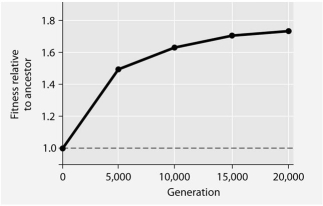 -Which term best describes what has occurred among the experimental populations of cells over this eight-year period?
 (Multiple Choice)
4.9/5 (83)
(83) Which of the following obtain energy by oxidizing inorganic substances-energy that is used,in part,to fix CO₂?
(Multiple Choice)
5.0/5 (82)
(82) The thermoacidophile Sulfolobus acidocaldarius lacks peptidoglycan,but still possesses a cell wall.What is likely to be true of this species?
1)It is a bacterium.
2)It is an archaean.
3)The optimal pH of its enzymes will lie above pH 7.
4)The optimal pH of its enzymes will lie below pH 7.
5)It could inhabit certain hydrothermal springs.
6)It could inhabit alkaline hot springs.
(Multiple Choice)
4.9/5 (88)
(88) 
Filters
- Essay(0)
- Multiple Choice(0)
- Short Answer(0)
- True False(0)
- Matching(0)