



 Chat with AI
Exam 27: Bacteria and Archaea

Exam 1: Introduction: Evolution and Themes of Biology77 Questions
Exam 2: The Chemical Context of Life98 Questions
Exam 3: Water and Life92 Questions
Exam 4: Carbon and the Molecular Diversity of Life86 Questions
Exam 5: The Structure and Function of Large Biological Molecules131 Questions
Exam 6: A Tour of the Cell111 Questions
Exam 7: Membrane Structure and Function88 Questions
Exam 8: An Introduction to Metabolism92 Questions
Exam 9: Cellular Respiration and Fermentation128 Questions
Exam 10: Photosynthesis103 Questions
Exam 11: Cell Communication85 Questions
Exam 12: The Cell Cycle98 Questions
Exam 13: Meiosis and Sexual Life Cycles90 Questions
Exam 14: Mendel and the Gene Idea92 Questions
Exam 15: The Chromosomal Basis of Inheritance75 Questions
Exam 16: The Molecular Basis of Inheritance84 Questions
Exam 17: From Gene to Protein106 Questions
Exam 18: Regulation of Gene Expression116 Questions
Exam 19: Viruses71 Questions
Exam 20: DNA Tools and Biotechnology78 Questions
Exam 21: Genomes and Their Evolution64 Questions
Exam 22: Descent with Modification: A Darwinian View of Life68 Questions
Exam 23: The Evolution of Populations92 Questions
Exam 24: The Origin of Species76 Questions
Exam 25: The History of Life on Earth89 Questions
Exam 26: Phylogeny and the Tree of Life91 Questions
Exam 27: Bacteria and Archaea96 Questions
Exam 28: Protists82 Questions
Exam 29: Plant Diversity I: How Plants Colonized Land93 Questions
Exam 30: Plant Diversity II: The Evolution of Seed Plants119 Questions
Exam 31: Fungi105 Questions
Exam 32: An Overview of Animal Diversity93 Questions
Exam 33: An Introduction to Invertebrates111 Questions
Exam 34: The Origin and Evolution of Vertebrates126 Questions
Exam 35: Plant Structure,Growth,and Development82 Questions
Exam 36: Resource Acquisition and Transport in Vascular Plants100 Questions
Exam 37: Soil and Plant Nutrition99 Questions
Exam 38: Angiosperm Reproduction and Biotechnology107 Questions
Exam 39: Plant Responses to Internal and External Signals137 Questions
Exam 40: Basic Principles of Animal Form and Function98 Questions
Exam 41: Animal Nutrition87 Questions
Exam 42: Circulation and Gas Exchange112 Questions
Exam 43: The Immune System123 Questions
Exam 44: Osmoregulation and Excretion91 Questions
Exam 45: Hormones and the Endocrine System92 Questions
Exam 46: Animal Reproduction104 Questions
Exam 47: Animal Development106 Questions
Exam 48: Neurons,Synapses,and Signalling93 Questions
Exam 49: Nervous Systems85 Questions
Exam 50: Sensory and Motor Mechanisms106 Questions
Exam 51: Animal Behaviour91 Questions
Exam 52: An Introduction to Ecology and the Biosphere90 Questions
Exam 53: Population Ecology89 Questions
Exam 54: Community Ecology97 Questions
Exam 55: Ecosystems and Restoration Ecology98 Questions
Exam 56: Conservation Biology and Global Change90 Questions
Select questions type


Gram-variable prokaryotes are,sometimes,those without any peptidoglycan.Which two species are most likely to be archaeans?
(Multiple Choice)
4.9/5  (75)
(75) Use the information in the following paragraph to answer the next few questions.
A hypothetical bacterium swims among human intestinal contents until it finds a suitable location on the intestinal lining.It adheres to the intestinal lining using a feature that also protects it from phagocytes,bacteriophages,and dehydration.Fecal matter from a human in whose intestine this bacterium lives can spread the bacterium,even after being mixed with water and boiled.The bacterium is not susceptible to the penicillin family of antibiotics.It contains no plasmids and relatively little peptidoglycan.
-This bacterium's ability to survive in a human who is taking penicillin pills may be due to the presence of
1)penicillin-resistance genes.
2)a secretory system that removes penicillin from the cell.
3)a gram-positive cell wall.
4)a gram-negative cell wall.
5)an endospore.
(Multiple Choice)
4.8/5 (91)
(91) In Fred Griffith's experiments,harmless R strain pneumococcus became lethal S strain pneumococcus as the result of which of the following?
1)horizontal gene transfer
2)transduction
3)conjugation
4)transformation
5)genetic recombination
(Multiple Choice)
4.7/5 (83)
(83) Hershey and Chase performed an elegant experiment that convinced most biologists that DNA,rather than protein,was the genetic material.This experiment subjected bacteria to the same gene transfer mechanism as occurs in
(Multiple Choice)
5.0/5 (76)
(76) If the experimental population of E.coli lacks an F factor or F plasmid,and if bacteriophages are excluded from the bacterial cultures,then which of these is (are)means by which beneficial mutations might be transmitted horizontally to other E.coli cells?
(Multiple Choice)
4.8/5 (85)
(85) The following questions refer to the information and figure below.
In this eight-year experiment,12 populations of E.coli,each begun from a single cell,were grown in low-glucose conditions for 20 000 generations.Each culture was introduced to fresh growth medium every 24 hours.Occasionally,samples were removed from the populations,and their fitness in low-glucose conditions was tested against that of members sampled from the ancestral (common ancestor)E.coli population.
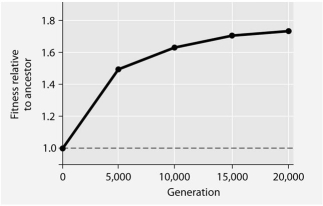 -Which of the following,if it occurs in the absence of any other type of adaptation listed here,is least reasonable in terms of promoting bacterial survival over evolutionary time in a low-glucose environment?
 (Multiple Choice)
4.9/5 (80)
(80) Which statement about the genomes of prokaryotes is correct?
(Multiple Choice)
4.7/5 (65)
(65) In general,what is the primary ecological role of prokaryotes?
(Multiple Choice)
4.9/5 (72)
(72) Foods can be preserved in many ways by slowing or preventing bacterial growth.Which of these methods should be least effective at inhibiting bacterial growth?
(Multiple Choice)
4.8/5 (74)
(74) Prokaryotic ribosomes differ from those present in eukaryotic cytosol.Because of this,which of the following is correct?
(Multiple Choice)
4.8/5 (75)
(75) During which two times can the recipient accurately be described as "recombinant: due to the sequence of events portrayed in the above figure?
(Multiple Choice)
4.7/5 (73)
(73) The termite gut protist,Mixotricha paradoxa,has at least two kinds of bacteria attached to its outer surface.One kind is a spirochete that propels its host through the termite gut.A second type of bacteria synthesizes ATP,some of which is used by the spirochetes.The locomotion provided by the spirochetes introduces the ATP-producing bacteria to new food sources.Which term(s)is (are)applicable to the relationship between the two kinds of bacteria?
1)mutualism
2)parasitism
3)symbiosis
4)metabolic cooperation
(Multiple Choice)
5.0/5 (92)
(92) The figure below depicts changes to the amount of DNA present in a recipient cell that is engaged in conjugation with an Hfr cell.Hfr cell DNA begins entering the recipient cell at Time A.Assume that reciprocal crossing over occurs (in other words,a fragment of the recipient's chromosome is exchanged for a homologous fragment from the Hfr cell's DNA).Use this figure to answer the following questions.
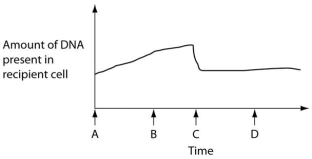 -How is the recipient cell different at Time D than it was at Time A?
 (Multiple Choice)
4.8/5 (90)
(90) For several decades now,amphibian species worldwide have been in decline.A significant proportion of the decline seems to be due to the spread of the chytrid fungus,Batrachochytrium dendrobatidis (Bd).Chytrid sporangia reside within the epidermal cells of infected animals,animals that consequently show areas of sloughed skin.They can also be lethargic,which is expressed through failure to hide and failure to flee.The infection cycle typically takes four to five days,at the end of which zoospores are released from sporangia into the environment.In some amphibian species,mortality rates approach 100%; other species seem able to survive the infection.
-If infection primarily involves the outermost layers of adult amphibian skin,and if the chytrids use the skin as their sole source of nutrition,then which term best applies to the chytrids?
(Multiple Choice)
4.7/5 (79)
(79) Match the numbered terms to the description that follows.Choose all appropriate terms.
1)autotroph
2)heterotroph
3)phototroph
4)chemotroph
Description: an organism that relies on photons to excite electrons within its membranes
(Multiple Choice)
5.0/5 (95)
(95) Some of the proteins that allow this bacterium to swim are related (in an evolutionary sense)to proteins that
(Multiple Choice)
4.9/5 (82)
(82) Mycoplasmas are bacteria that lack cell walls.On the basis of this structural feature,which statement concerning mycoplasmas should be true?
(Multiple Choice)
4.9/5 (70)
(70) If a bacterium regenerates from an endospore that did not possess any of the plasmids that were contained in its original parent cell,the regenerated bacterium will probably also
(Multiple Choice)
4.7/5 (82)
(82) 
Filters
- Essay(0)
- Multiple Choice(0)
- Short Answer(0)
- True False(0)
- Matching(0)