



 Chat with AI
Exam 13: Meiosis and Sexual Life Cycles

Exam 1: Introduction: Evolution and Themes of Biology77 Questions
Exam 2: The Chemical Context of Life98 Questions
Exam 3: Water and Life92 Questions
Exam 4: Carbon and the Molecular Diversity of Life86 Questions
Exam 5: The Structure and Function of Large Biological Molecules131 Questions
Exam 6: A Tour of the Cell111 Questions
Exam 7: Membrane Structure and Function88 Questions
Exam 8: An Introduction to Metabolism92 Questions
Exam 9: Cellular Respiration and Fermentation128 Questions
Exam 10: Photosynthesis103 Questions
Exam 11: Cell Communication85 Questions
Exam 12: The Cell Cycle98 Questions
Exam 13: Meiosis and Sexual Life Cycles90 Questions
Exam 14: Mendel and the Gene Idea92 Questions
Exam 15: The Chromosomal Basis of Inheritance75 Questions
Exam 16: The Molecular Basis of Inheritance84 Questions
Exam 17: From Gene to Protein106 Questions
Exam 18: Regulation of Gene Expression116 Questions
Exam 19: Viruses71 Questions
Exam 20: DNA Tools and Biotechnology78 Questions
Exam 21: Genomes and Their Evolution64 Questions
Exam 22: Descent with Modification: A Darwinian View of Life68 Questions
Exam 23: The Evolution of Populations92 Questions
Exam 24: The Origin of Species76 Questions
Exam 25: The History of Life on Earth89 Questions
Exam 26: Phylogeny and the Tree of Life91 Questions
Exam 27: Bacteria and Archaea96 Questions
Exam 28: Protists82 Questions
Exam 29: Plant Diversity I: How Plants Colonized Land93 Questions
Exam 30: Plant Diversity II: The Evolution of Seed Plants119 Questions
Exam 31: Fungi105 Questions
Exam 32: An Overview of Animal Diversity93 Questions
Exam 33: An Introduction to Invertebrates111 Questions
Exam 34: The Origin and Evolution of Vertebrates126 Questions
Exam 35: Plant Structure,Growth,and Development82 Questions
Exam 36: Resource Acquisition and Transport in Vascular Plants100 Questions
Exam 37: Soil and Plant Nutrition99 Questions
Exam 38: Angiosperm Reproduction and Biotechnology107 Questions
Exam 39: Plant Responses to Internal and External Signals137 Questions
Exam 40: Basic Principles of Animal Form and Function98 Questions
Exam 41: Animal Nutrition87 Questions
Exam 42: Circulation and Gas Exchange112 Questions
Exam 43: The Immune System123 Questions
Exam 44: Osmoregulation and Excretion91 Questions
Exam 45: Hormones and the Endocrine System92 Questions
Exam 46: Animal Reproduction104 Questions
Exam 47: Animal Development106 Questions
Exam 48: Neurons,Synapses,and Signalling93 Questions
Exam 49: Nervous Systems85 Questions
Exam 50: Sensory and Motor Mechanisms106 Questions
Exam 51: Animal Behaviour91 Questions
Exam 52: An Introduction to Ecology and the Biosphere90 Questions
Exam 53: Population Ecology89 Questions
Exam 54: Community Ecology97 Questions
Exam 55: Ecosystems and Restoration Ecology98 Questions
Exam 56: Conservation Biology and Global Change90 Questions
Select questions type


Which of the following best describes a karyotype?

Free
(Multiple Choice)
4.8/5  (102)
(102) Correct Answer: Verified
B
How many different combinations of maternal and paternal chromosomes can be packaged in gametes made by an organism with a diploid number of 8 (2n = 8)?
Free
(Multiple Choice)
4.8/5 (86)
(86) Correct Answer:Verified
VerifiedD
A karyotype results from which of the following?
Free
(Multiple Choice)
4.8/5 (83)
(83) Correct Answer:Verified
VerifiedC
Refer to the drawings below of a single pair of homologous chromosomes as they might appear during various stages of either mitosis or meiosis,and answer the following questions.
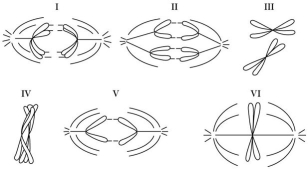 -Which diagram represents anaphase I of meiosis?
 (Multiple Choice)
4.9/5 (87)
(87) Use the following information to answer the questions below.
A species of lizard has been discovered that reproduces asexually.
-A human cell containing 22 autosomes and a Y chromosome is
(Multiple Choice)
4.8/5 (79)
(79) If a horticulturist breeding gardenias succeeds in having a single plant with a particularly desirable set of traits,which of the following would be her most probable and efficient route to establishing a line of such plants?
(Multiple Choice)
4.8/5 (81)
(81) Which of the following is an example of alternation of generations?
(Multiple Choice)
5.0/5 (66)
(66) In sexual reproduction,the reduction division stage is known as
(Multiple Choice)
4.9/5 (90)
(90) If a cell has completed the first meiotic division and is just beginning meiosis II,which of the following is an appropriate description of its contents?
(Multiple Choice)
4.7/5 (77)
(77) Which of the following is true regarding homologous chromosomes?
(Multiple Choice)
4.9/5 (91)
(91) What is a major difference between mitosis and meiosis I in a diploid organism?
(Multiple Choice)
4.9/5 (73)
(73) The somatic cells of a particular shrub (the privet shrub)each contain 46 chromosomes.They are obviously very different than human cells,yet have the same number of chromosomes.Which of the following is true?
(Multiple Choice)
4.9/5 (63)
(63) The human genome is minimally contained in which of the following?
(Multiple Choice)
4.8/5 (76)
(76) If meiosis produces haploid cells,how is the diploid number restored for those organisms that spend most of their life cycle in the diploid state?
(Multiple Choice)
4.9/5 (81)
(81) Refer to the life cycles illustrated in the figure below to answer the following questions.
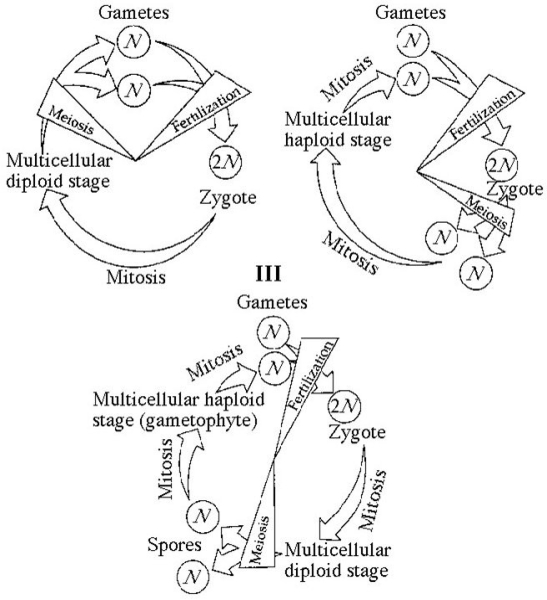 -Which of the life cycles is typical for plants and some algae?
 (Multiple Choice)
4.9/5 (81)
(81) A given organism has 46 chromosomes in its karyotype.We can therefore conclude which of the following?
(Multiple Choice)
4.9/5 (74)
(74) If the DNA content of a diploid cell in the G₁ phase of the cell cycle is x,then the DNA content of the same cell at metaphase of meiosis I would be
(Multiple Choice)
4.8/5 (78)
(78) 
Filters
- Essay(0)
- Multiple Choice(0)
- Short Answer(0)
- True False(0)
- Matching(0)