



 Chat with AI
Exam 13: Meiosis and Sexual Life Cycles

Exam 1: Introduction: Evolution and Themes of Biology77 Questions
Exam 2: The Chemical Context of Life98 Questions
Exam 3: Water and Life92 Questions
Exam 4: Carbon and the Molecular Diversity of Life86 Questions
Exam 5: The Structure and Function of Large Biological Molecules131 Questions
Exam 6: A Tour of the Cell111 Questions
Exam 7: Membrane Structure and Function88 Questions
Exam 8: An Introduction to Metabolism92 Questions
Exam 9: Cellular Respiration and Fermentation128 Questions
Exam 10: Photosynthesis103 Questions
Exam 11: Cell Communication85 Questions
Exam 12: The Cell Cycle98 Questions
Exam 13: Meiosis and Sexual Life Cycles90 Questions
Exam 14: Mendel and the Gene Idea92 Questions
Exam 15: The Chromosomal Basis of Inheritance75 Questions
Exam 16: The Molecular Basis of Inheritance84 Questions
Exam 17: From Gene to Protein106 Questions
Exam 18: Regulation of Gene Expression116 Questions
Exam 19: Viruses71 Questions
Exam 20: DNA Tools and Biotechnology78 Questions
Exam 21: Genomes and Their Evolution64 Questions
Exam 22: Descent with Modification: A Darwinian View of Life68 Questions
Exam 23: The Evolution of Populations92 Questions
Exam 24: The Origin of Species76 Questions
Exam 25: The History of Life on Earth89 Questions
Exam 26: Phylogeny and the Tree of Life91 Questions
Exam 27: Bacteria and Archaea96 Questions
Exam 28: Protists82 Questions
Exam 29: Plant Diversity I: How Plants Colonized Land93 Questions
Exam 30: Plant Diversity II: The Evolution of Seed Plants119 Questions
Exam 31: Fungi105 Questions
Exam 32: An Overview of Animal Diversity93 Questions
Exam 33: An Introduction to Invertebrates111 Questions
Exam 34: The Origin and Evolution of Vertebrates126 Questions
Exam 35: Plant Structure,Growth,and Development82 Questions
Exam 36: Resource Acquisition and Transport in Vascular Plants100 Questions
Exam 37: Soil and Plant Nutrition99 Questions
Exam 38: Angiosperm Reproduction and Biotechnology107 Questions
Exam 39: Plant Responses to Internal and External Signals137 Questions
Exam 40: Basic Principles of Animal Form and Function98 Questions
Exam 41: Animal Nutrition87 Questions
Exam 42: Circulation and Gas Exchange112 Questions
Exam 43: The Immune System123 Questions
Exam 44: Osmoregulation and Excretion91 Questions
Exam 45: Hormones and the Endocrine System92 Questions
Exam 46: Animal Reproduction104 Questions
Exam 47: Animal Development106 Questions
Exam 48: Neurons,Synapses,and Signalling93 Questions
Exam 49: Nervous Systems85 Questions
Exam 50: Sensory and Motor Mechanisms106 Questions
Exam 51: Animal Behaviour91 Questions
Exam 52: An Introduction to Ecology and the Biosphere90 Questions
Exam 53: Population Ecology89 Questions
Exam 54: Community Ecology97 Questions
Exam 55: Ecosystems and Restoration Ecology98 Questions
Exam 56: Conservation Biology and Global Change90 Questions
Select questions type


You have isolated DNA from cells in different stages of meiosis within one species.You have determined the relative DNA content for each type,and plotted the results on the graph shown below.Refer to the graph to answer the following questions.
 -If the species were known to be haploid,which sample might represent a zygote?
 (Multiple Choice)
4.8/5  (69)
(69) A certain gene found in a diploid species is known to have 18 alleles (variants).Any given organism of that species can/must have which of the following?
(Multiple Choice)
4.7/5 (82)
(82) The karyotype of one species of primate has 48 chromosomes.In a particular female,cell division goes awry and she produces one of her eggs with an extra chromosome (25).The most probable source of this error would be a mistake in which of the following?
(Multiple Choice)
4.9/5 (89)
(89) Refer to the drawings below of a single pair of homologous chromosomes as they might appear during various stages of either mitosis or meiosis,and answer the following questions.
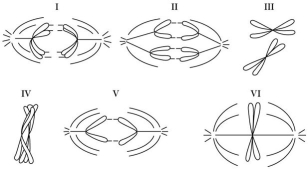 -Which diagram(s)represent anaphase II of meiosis?
 (Multiple Choice)
4.9/5 (72)
(72) How do cells at the completion of meiosis compare with cells that have replicated their DNA and are just about to begin meiosis?
(Multiple Choice)
5.0/5 (67)
(67) When an individual chromosome carries DNA from two different parents,it is said to be
(Multiple Choice)
4.8/5 (74)
(74) You have isolated DNA from cells in different stages of meiosis within one species.You have determined the relative DNA content for each type,and plotted the results on the graph shown below.Refer to the graph to answer the following questions.
-Which sample might represent an animal cell which is at the end of meiosis II?
-Which sample might represent an animal cell which is at the end of meiosis II? (Multiple Choice)
4.7/5 (80)
(80) Refer to the information and figure below to answer the following question(s).
A certain (hypothetical)organism is diploid,has either blue or orange wings as the consequence of one of its genes on chromosome 12,and has either long or short antennae as the result of a second gene on chromosome 19,as shown in the figure.
 -A certain female's number 12 chromosomes both have the blue gene,and number 19 chromosomes both have the long gene.As cells in her ovaries undergo meiosis,her resulting eggs (ova)may have which of the following?
 (Multiple Choice)
4.8/5 (82)
(82) Refer to the information and figure below to answer the following question(s).
A certain (hypothetical)organism is diploid,has either blue or orange wings as the consequence of one of its genes on chromosome 12,and has either long or short antennae as the result of a second gene on chromosome 19,as shown in the figure.
-A female with a paternal set of one orange and one long gene chromosome and a maternal set comprised of one blue and one short gene chromosome is expected to produce which of the following types of eggs after meiosis?
-A female with a paternal set of one orange and one long gene chromosome and a maternal set comprised of one blue and one short gene chromosome is expected to produce which of the following types of eggs after meiosis? (Multiple Choice)
4.8/5 (75)
(75) 
Filters
- Essay(0)
- Multiple Choice(0)
- Short Answer(0)
- True False(0)
- Matching(0)