



 Chat with AI
Exam 56: Conservation Biology and Global Change

Exam 1: Introduction: Evolution and Themes of Biology77 Questions
Exam 2: The Chemical Context of Life98 Questions
Exam 3: Water and Life92 Questions
Exam 4: Carbon and the Molecular Diversity of Life86 Questions
Exam 5: The Structure and Function of Large Biological Molecules131 Questions
Exam 6: A Tour of the Cell111 Questions
Exam 7: Membrane Structure and Function88 Questions
Exam 8: An Introduction to Metabolism92 Questions
Exam 9: Cellular Respiration and Fermentation128 Questions
Exam 10: Photosynthesis103 Questions
Exam 11: Cell Communication85 Questions
Exam 12: The Cell Cycle98 Questions
Exam 13: Meiosis and Sexual Life Cycles90 Questions
Exam 14: Mendel and the Gene Idea92 Questions
Exam 15: The Chromosomal Basis of Inheritance75 Questions
Exam 16: The Molecular Basis of Inheritance84 Questions
Exam 17: From Gene to Protein106 Questions
Exam 18: Regulation of Gene Expression116 Questions
Exam 19: Viruses71 Questions
Exam 20: DNA Tools and Biotechnology78 Questions
Exam 21: Genomes and Their Evolution64 Questions
Exam 22: Descent with Modification: A Darwinian View of Life68 Questions
Exam 23: The Evolution of Populations92 Questions
Exam 24: The Origin of Species76 Questions
Exam 25: The History of Life on Earth89 Questions
Exam 26: Phylogeny and the Tree of Life91 Questions
Exam 27: Bacteria and Archaea96 Questions
Exam 28: Protists82 Questions
Exam 29: Plant Diversity I: How Plants Colonized Land93 Questions
Exam 30: Plant Diversity II: The Evolution of Seed Plants119 Questions
Exam 31: Fungi105 Questions
Exam 32: An Overview of Animal Diversity93 Questions
Exam 33: An Introduction to Invertebrates111 Questions
Exam 34: The Origin and Evolution of Vertebrates126 Questions
Exam 35: Plant Structure,Growth,and Development82 Questions
Exam 36: Resource Acquisition and Transport in Vascular Plants100 Questions
Exam 37: Soil and Plant Nutrition99 Questions
Exam 38: Angiosperm Reproduction and Biotechnology107 Questions
Exam 39: Plant Responses to Internal and External Signals137 Questions
Exam 40: Basic Principles of Animal Form and Function98 Questions
Exam 41: Animal Nutrition87 Questions
Exam 42: Circulation and Gas Exchange112 Questions
Exam 43: The Immune System123 Questions
Exam 44: Osmoregulation and Excretion91 Questions
Exam 45: Hormones and the Endocrine System92 Questions
Exam 46: Animal Reproduction104 Questions
Exam 47: Animal Development106 Questions
Exam 48: Neurons,Synapses,and Signalling93 Questions
Exam 49: Nervous Systems85 Questions
Exam 50: Sensory and Motor Mechanisms106 Questions
Exam 51: Animal Behaviour91 Questions
Exam 52: An Introduction to Ecology and the Biosphere90 Questions
Exam 53: Population Ecology89 Questions
Exam 54: Community Ecology97 Questions
Exam 55: Ecosystems and Restoration Ecology98 Questions
Exam 56: Conservation Biology and Global Change90 Questions
Select questions type


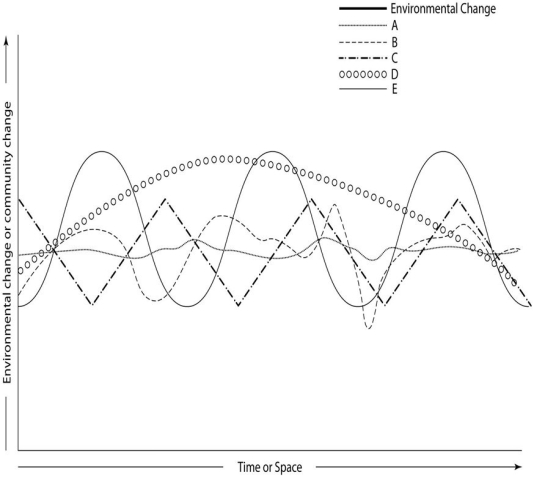 -Based on what you know about ecosystem stability and the information provided in the graph,which community (A-E)would likely support the most biodiversity?
Free
(Multiple Choice)
4.8/5  (83)
(83) Correct Answer: Verified
A
Overexploitation encourages extinction and is most likely to affect
Free
(Multiple Choice)
4.8/5 (80)
(80) Correct Answer:Verified
VerifiedB
Suppose you attend a town meeting at which some experts tell the audience that they have performed a cost-benefit analysis of a proposed transit system that would probably reduce overall air pollution and fossil fuel consumption.The analysis,however,reveals that ticket prices will not cover the cost of operating the system when fuel,wages,and equipment are taken into account.As a biologist,you know that if ecosystem services had been included in the analysis the experts might have arrived at a different answer.Why are ecosystem services rarely included in economic analyses?
Free
(Multiple Choice)
4.9/5 (77)
(77) Correct Answer:Verified
VerifiedA
One characteristic that distinguishes a population in an extinction vortex from most other populations is that
(Multiple Choice)
4.7/5 (77)
(77) For the following questions,match the statement with the appropriate term/phrase.
-This causes an increase in the intensity of UV radiation reaching Earth.
(Multiple Choice)
4.9/5 (77)
(77) Which of the following is true about the current research regarding forest fragmentation?
(Multiple Choice)
4.9/5 (81)
(81) Which of the following statements regarding extinction is (are)correct?
I.Only a small percentage of species is immune from extinction.
II.Extinction occurs whether humans interfere or not.
III.Extinctions can even be caused indirectly by humans.
(Multiple Choice)
4.8/5 (86)
(86) The long-term problem with red-cockaded woodpecker habitat intervention in the southwest United States is
(Multiple Choice)
4.7/5 (80)
(80) Small populations are most vulnerable to ________ and ________.
(Multiple Choice)
5.0/5 (88)
(88) Which of the following is a type of research in which a conservation biologist would be involved?
(Multiple Choice)
4.7/5 (74)
(74) Which of the following examples poses the greatest potential threat to biodiversity?
(Multiple Choice)
4.8/5 (68)
(68) Your friend is wary of environmentalists' claims that global warming could lead to major biological change on Earth.Which of the following statements can you use in response to your friend's suspicions?
(Multiple Choice)
4.8/5 (84)
(84) Researchers have been studying a rare population of eighty-seven voles in an isolated area.Ten voles from a larger population were added to this isolated population.Besides having ten additional animals,what benefits are there to importing individuals?
(Multiple Choice)
4.8/5 (89)
(89) Of the following ecosystem types,which have been impacted the most by humans?
(Multiple Choice)
4.8/5 (79)
(79) For the following questions,match the statement with the appropriate term/phrase.
-This causes extremely high levels of toxic chemicals in fish-eating birds.
(Multiple Choice)
4.9/5 (63)
(63) Extinction is a natural phenomenon.It is estimated that 99% of all species that ever lived are now extinct.Why then do we say that we are now experiencing an extinction (loss of biodiversity)crisis?
(Multiple Choice)
4.8/5 (83)
(83) The following statements are correct,with the exception of:
(Multiple Choice)
4.8/5 (76)
(76) According to the U.S.Endangered Species Act (ESA),the difference between an endangered species and a threatened one is that
(Multiple Choice)
4.9/5 (80)
(80) 
Filters
- Essay(0)
- Multiple Choice(0)
- Short Answer(0)
- True False(0)
- Matching(0)