



 Chat with AI
Exam 56: Conservation Biology and Global Change

Exam 1: Introduction: Evolution and Themes of Biology77 Questions
Exam 2: The Chemical Context of Life98 Questions
Exam 3: Water and Life92 Questions
Exam 4: Carbon and the Molecular Diversity of Life86 Questions
Exam 5: The Structure and Function of Large Biological Molecules131 Questions
Exam 6: A Tour of the Cell111 Questions
Exam 7: Membrane Structure and Function88 Questions
Exam 8: An Introduction to Metabolism92 Questions
Exam 9: Cellular Respiration and Fermentation128 Questions
Exam 10: Photosynthesis103 Questions
Exam 11: Cell Communication85 Questions
Exam 12: The Cell Cycle98 Questions
Exam 13: Meiosis and Sexual Life Cycles90 Questions
Exam 14: Mendel and the Gene Idea92 Questions
Exam 15: The Chromosomal Basis of Inheritance75 Questions
Exam 16: The Molecular Basis of Inheritance84 Questions
Exam 17: From Gene to Protein106 Questions
Exam 18: Regulation of Gene Expression116 Questions
Exam 19: Viruses71 Questions
Exam 20: DNA Tools and Biotechnology78 Questions
Exam 21: Genomes and Their Evolution64 Questions
Exam 22: Descent with Modification: A Darwinian View of Life68 Questions
Exam 23: The Evolution of Populations92 Questions
Exam 24: The Origin of Species76 Questions
Exam 25: The History of Life on Earth89 Questions
Exam 26: Phylogeny and the Tree of Life91 Questions
Exam 27: Bacteria and Archaea96 Questions
Exam 28: Protists82 Questions
Exam 29: Plant Diversity I: How Plants Colonized Land93 Questions
Exam 30: Plant Diversity II: The Evolution of Seed Plants119 Questions
Exam 31: Fungi105 Questions
Exam 32: An Overview of Animal Diversity93 Questions
Exam 33: An Introduction to Invertebrates111 Questions
Exam 34: The Origin and Evolution of Vertebrates126 Questions
Exam 35: Plant Structure,Growth,and Development82 Questions
Exam 36: Resource Acquisition and Transport in Vascular Plants100 Questions
Exam 37: Soil and Plant Nutrition99 Questions
Exam 38: Angiosperm Reproduction and Biotechnology107 Questions
Exam 39: Plant Responses to Internal and External Signals137 Questions
Exam 40: Basic Principles of Animal Form and Function98 Questions
Exam 41: Animal Nutrition87 Questions
Exam 42: Circulation and Gas Exchange112 Questions
Exam 43: The Immune System123 Questions
Exam 44: Osmoregulation and Excretion91 Questions
Exam 45: Hormones and the Endocrine System92 Questions
Exam 46: Animal Reproduction104 Questions
Exam 47: Animal Development106 Questions
Exam 48: Neurons,Synapses,and Signalling93 Questions
Exam 49: Nervous Systems85 Questions
Exam 50: Sensory and Motor Mechanisms106 Questions
Exam 51: Animal Behaviour91 Questions
Exam 52: An Introduction to Ecology and the Biosphere90 Questions
Exam 53: Population Ecology89 Questions
Exam 54: Community Ecology97 Questions
Exam 55: Ecosystems and Restoration Ecology98 Questions
Exam 56: Conservation Biology and Global Change90 Questions
Select questions type


According to most conservation biologists,the single greatest threat to global biodiversity is
(Multiple Choice)
4.9/5  (79)
(79) The biggest challenge that Costa Rica will likely face in its dedication to conservation and restoration in the future is
(Multiple Choice)
5.0/5 (72)
(72) On Easter Island,data show that it was once covered by massive palm trees.How can an ecosystem collapse from removal of just one species of large tree?
I.Without large trees,soil erosion increases and reduces productivity.
II.Species of plants needing shade no longer have it.
III.Large trees are habitats for many species.
(Multiple Choice)
4.9/5 (75)
(75) Which of the following nations has become a world leader in the establishment of zoned reserves?
(Multiple Choice)
4.9/5 (79)
(79) Use the following figure to answer the questions below.
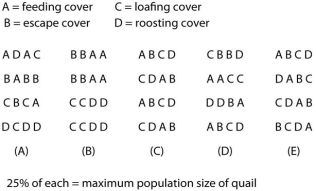 -Study the information above about quail habitats.Which of these represents the best quail habitat in terms of fragmentation and edge?
 (Multiple Choice)
4.9/5 (91)
(91) Agricultural lands frequently require nutrient augmentation because
(Multiple Choice)
4.8/5 (74)
(74) Introduced species can have deleterious effects on biological communities by
(Multiple Choice)
4.8/5 (72)
(72) The use of DDT as an insecticide in the United States has been outlawed since 1971,yet is still a problem for certain top-level carnivores in the United States.Which of the following choices best explains this apparent incongruity?
(Multiple Choice)
5.0/5 (68)
(68) Which of the following is a consequence of biological magnification?
(Multiple Choice)
5.0/5 (82)
(82) Philippe Bouchet and colleagues conducted a massive survey of marine molluscs on the west coast of New Caledonia.Twenty percent of the species found were represented by a single specimen.What does that suggest about the diversity of molluscs in this area?
(Multiple Choice)
5.0/5 (77)
(77) Which of the following is a (are)potential disadvantage(s)of movement corridors for wildlife?
(Multiple Choice)
4.9/5 (70)
(70) What term did E.O.Wilson coin for our innate appreciation of wild environments and living organisms?
(Multiple Choice)
4.9/5 (75)
(75) Biodiversity hot spots are not necessarily the best choice for nature preserves because
(Multiple Choice)
4.9/5 (79)
(79) Use the graph and information provided in the paragraph below to answer the following questions.
Flycatcher birds that migrate from Africa to Europe feed their nestlings a diet that is almost exclusively moth caterpillars.The graph below shows the mean dates of arrival,bird hatching,and peak caterpillar season for the years 1980 and 2000.
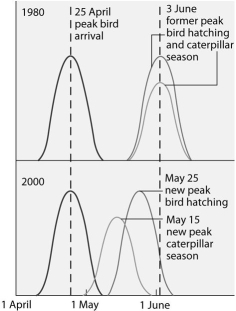 -The shift in the peak of caterpillar season is most likely due to
 (Multiple Choice)
4.9/5 (88)
(88) Elevated carbon dioxide levels have been shown to contribute to the greenhouse effect,resulting in an increase in mean global temperature.Ecosystems where the largest warming has already occurred include snow-covered northern coniferous forests,tundra,and arctic sea ice habitats.Which statement best explains how the elimination of ice-covered ecosystems affects the rise or fall in global temperature?
(Multiple Choice)
4.7/5 (83)
(83) Which of the following ecological locations has the greatest species diversity?
(Multiple Choice)
4.9/5 (76)
(76) You are trying to determine if a particular species will become invasive in your province.You know there are common attributes of invasive species; which attribute would be least applicable to invasive species?
(Multiple Choice)
4.9/5 (73)
(73) To better comprehend the magnitude of current extinctions,it will be necessary to
(Multiple Choice)
4.7/5 (66)
(66) 
Filters
- Essay(0)
- Multiple Choice(0)
- Short Answer(0)
- True False(0)
- Matching(0)