



 Chat with AI
Exam 56: Conservation Biology and Global Change

Exam 1: Introduction: Evolution and Themes of Biology77 Questions
Exam 2: The Chemical Context of Life98 Questions
Exam 3: Water and Life92 Questions
Exam 4: Carbon and the Molecular Diversity of Life86 Questions
Exam 5: The Structure and Function of Large Biological Molecules131 Questions
Exam 6: A Tour of the Cell111 Questions
Exam 7: Membrane Structure and Function88 Questions
Exam 8: An Introduction to Metabolism92 Questions
Exam 9: Cellular Respiration and Fermentation128 Questions
Exam 10: Photosynthesis103 Questions
Exam 11: Cell Communication85 Questions
Exam 12: The Cell Cycle98 Questions
Exam 13: Meiosis and Sexual Life Cycles90 Questions
Exam 14: Mendel and the Gene Idea92 Questions
Exam 15: The Chromosomal Basis of Inheritance75 Questions
Exam 16: The Molecular Basis of Inheritance84 Questions
Exam 17: From Gene to Protein106 Questions
Exam 18: Regulation of Gene Expression116 Questions
Exam 19: Viruses71 Questions
Exam 20: DNA Tools and Biotechnology78 Questions
Exam 21: Genomes and Their Evolution64 Questions
Exam 22: Descent with Modification: A Darwinian View of Life68 Questions
Exam 23: The Evolution of Populations92 Questions
Exam 24: The Origin of Species76 Questions
Exam 25: The History of Life on Earth89 Questions
Exam 26: Phylogeny and the Tree of Life91 Questions
Exam 27: Bacteria and Archaea96 Questions
Exam 28: Protists82 Questions
Exam 29: Plant Diversity I: How Plants Colonized Land93 Questions
Exam 30: Plant Diversity II: The Evolution of Seed Plants119 Questions
Exam 31: Fungi105 Questions
Exam 32: An Overview of Animal Diversity93 Questions
Exam 33: An Introduction to Invertebrates111 Questions
Exam 34: The Origin and Evolution of Vertebrates126 Questions
Exam 35: Plant Structure,Growth,and Development82 Questions
Exam 36: Resource Acquisition and Transport in Vascular Plants100 Questions
Exam 37: Soil and Plant Nutrition99 Questions
Exam 38: Angiosperm Reproduction and Biotechnology107 Questions
Exam 39: Plant Responses to Internal and External Signals137 Questions
Exam 40: Basic Principles of Animal Form and Function98 Questions
Exam 41: Animal Nutrition87 Questions
Exam 42: Circulation and Gas Exchange112 Questions
Exam 43: The Immune System123 Questions
Exam 44: Osmoregulation and Excretion91 Questions
Exam 45: Hormones and the Endocrine System92 Questions
Exam 46: Animal Reproduction104 Questions
Exam 47: Animal Development106 Questions
Exam 48: Neurons,Synapses,and Signalling93 Questions
Exam 49: Nervous Systems85 Questions
Exam 50: Sensory and Motor Mechanisms106 Questions
Exam 51: Animal Behaviour91 Questions
Exam 52: An Introduction to Ecology and the Biosphere90 Questions
Exam 53: Population Ecology89 Questions
Exam 54: Community Ecology97 Questions
Exam 55: Ecosystems and Restoration Ecology98 Questions
Exam 56: Conservation Biology and Global Change90 Questions
Select questions type


If all individuals in the last remaining population of a particular bird species were all highly related,which type of diversity would be of greatest concern when planning to keep the species from going extinct?
I.genetic diversity
II.species diversity
III.ecosystem diversity
(Multiple Choice)
4.8/5  (85)
(85) A land developer and several ecologists are discussing how a parcel of private land should be developed while saving twenty hectares as natural habitat.The land developer suggests that the twenty hectares be divided into twenty separate one-hectare areas.The ecologists suggest that it would be better to have one intact parcel of twenty hectares.What is the significance of these different arrangements of the twenty hectares?
(Multiple Choice)
4.9/5 (75)
(75) If the nestlings of flycatchers are to benefit from the shift in peak caterpillar season from June 3,1980 to May 15,2000,in which direction should the May 25,2000 peak bird hatching date move?
(Multiple Choice)
4.9/5 (86)
(86) For the following questions,match the statement with the appropriate term/phrase.
-This term refers to the reflecting and absorption of infrared radiation by atmospheric methane,carbon dioxide,and water.
(Multiple Choice)
4.9/5 (70)
(70) Which of the following life history traits can potentially influence effective population size (Ne)?
(Multiple Choice)
4.8/5 (83)
(83) How might the extinction of some Pacific Island bats called "flying foxes" threaten the survival of over 75% of the tree species in those islands?
(Multiple Choice)
4.9/5 (79)
(79) The greatest cause of the biodiversity crisis,the one which includes all of the others,is
(Multiple Choice)
4.7/5 (84)
(84) Atmospheric carbon dioxide has risen dramatically during the past century.Some global implications of climate change include all the following,with the exception of
(Multiple Choice)
4.9/5 (80)
(80) Of the following statements about protected areas that have been established to preserve biodiversity,which one is not correct?
(Multiple Choice)
4.8/5 (87)
(87) If the sex ratio in a population is significantly different from 50:50,then which of the following will always be true?
(Multiple Choice)
5.0/5 (93)
(93) The primary difference between the small-population approach (S-PA)and the declining-population approach (D-PA)to biodiversity recovery is
(Multiple Choice)
4.8/5 (67)
(67) We should care about loss in biodiversity in the populations of other species because of
(Multiple Choice)
4.9/5 (77)
(77) The word triage originated during World War I and was first used by French doctors in prioritizing patients based on the severity of their wounds,because there were more wounded soldiers in need of urgent care than there were resources to treat them.Conservation biologists have to make similar determinations with degraded ecosystems.Which of the following is the most important consideration when it comes to managing for maintenance of biodiversity?
(Multiple Choice)
4.9/5 (75)
(75) Eutrophication is often caused by excess limiting nutrient runoff from agricultural fields into aquatic ecosystems.This results in massive algal blooms,which eventually die and decompose,ultimately depleting the dissolved oxygen and killing large numbers of fish and other aquatic organism.Predict which of the following human actions would best address the problem of eutrophication near agricultural areas?
(Multiple Choice)
4.8/5 (87)
(87) Relatively small geographic areas with high concentrations of endemic species and a large number of endangered and threatened species are known as
(Multiple Choice)
4.9/5 (75)
(75) Some populations of sea turtles and Galápagos tortoises are maintained by people who collect their eggs and hatch/rear the young in captivity.Why is this practice supported by conservationists?
(Multiple Choice)
4.8/5 (85)
(85) Use the following figure to answer the questions below.
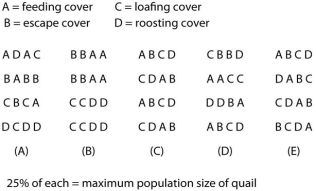 -Study the information above about quail habitats.Assuming that only one quail can occupy a habitat where all cover requirements are met,what is the maximum number of quail that could inhabit any of the hypothetical plots shown?
 (Multiple Choice)
4.9/5 (76)
(76) 
Filters
- Essay(0)
- Multiple Choice(0)
- Short Answer(0)
- True False(0)
- Matching(0)