



 Chat with AI
Exam 34: The Origin and Evolution of Vertebrates

Exam 1: Introduction: Evolution and Themes of Biology77 Questions
Exam 2: The Chemical Context of Life98 Questions
Exam 3: Water and Life92 Questions
Exam 4: Carbon and the Molecular Diversity of Life86 Questions
Exam 5: The Structure and Function of Large Biological Molecules131 Questions
Exam 6: A Tour of the Cell111 Questions
Exam 7: Membrane Structure and Function88 Questions
Exam 8: An Introduction to Metabolism92 Questions
Exam 9: Cellular Respiration and Fermentation128 Questions
Exam 10: Photosynthesis103 Questions
Exam 11: Cell Communication85 Questions
Exam 12: The Cell Cycle98 Questions
Exam 13: Meiosis and Sexual Life Cycles90 Questions
Exam 14: Mendel and the Gene Idea92 Questions
Exam 15: The Chromosomal Basis of Inheritance75 Questions
Exam 16: The Molecular Basis of Inheritance84 Questions
Exam 17: From Gene to Protein106 Questions
Exam 18: Regulation of Gene Expression116 Questions
Exam 19: Viruses71 Questions
Exam 20: DNA Tools and Biotechnology78 Questions
Exam 21: Genomes and Their Evolution64 Questions
Exam 22: Descent with Modification: A Darwinian View of Life68 Questions
Exam 23: The Evolution of Populations92 Questions
Exam 24: The Origin of Species76 Questions
Exam 25: The History of Life on Earth89 Questions
Exam 26: Phylogeny and the Tree of Life91 Questions
Exam 27: Bacteria and Archaea96 Questions
Exam 28: Protists82 Questions
Exam 29: Plant Diversity I: How Plants Colonized Land93 Questions
Exam 30: Plant Diversity II: The Evolution of Seed Plants119 Questions
Exam 31: Fungi105 Questions
Exam 32: An Overview of Animal Diversity93 Questions
Exam 33: An Introduction to Invertebrates111 Questions
Exam 34: The Origin and Evolution of Vertebrates126 Questions
Exam 35: Plant Structure,Growth,and Development82 Questions
Exam 36: Resource Acquisition and Transport in Vascular Plants100 Questions
Exam 37: Soil and Plant Nutrition99 Questions
Exam 38: Angiosperm Reproduction and Biotechnology107 Questions
Exam 39: Plant Responses to Internal and External Signals137 Questions
Exam 40: Basic Principles of Animal Form and Function98 Questions
Exam 41: Animal Nutrition87 Questions
Exam 42: Circulation and Gas Exchange112 Questions
Exam 43: The Immune System123 Questions
Exam 44: Osmoregulation and Excretion91 Questions
Exam 45: Hormones and the Endocrine System92 Questions
Exam 46: Animal Reproduction104 Questions
Exam 47: Animal Development106 Questions
Exam 48: Neurons,Synapses,and Signalling93 Questions
Exam 49: Nervous Systems85 Questions
Exam 50: Sensory and Motor Mechanisms106 Questions
Exam 51: Animal Behaviour91 Questions
Exam 52: An Introduction to Ecology and the Biosphere90 Questions
Exam 53: Population Ecology89 Questions
Exam 54: Community Ecology97 Questions
Exam 55: Ecosystems and Restoration Ecology98 Questions
Exam 56: Conservation Biology and Global Change90 Questions
Select questions type


The following questions refer to the phylogenetic tree shown below.
 -Which of these numbers represents ectotherms that were able to fly?
Free
(Multiple Choice)
4.8/5  (73)
(73) Correct Answer: Verified
C
Use the following information to answer the questions below.
Due to its system of nine air sacs connected to the lungs,the respiratory system of birds is arguably the most effective respiratory system of all air-breathers.Upon inhalation,air first flows into posterior air sacs,then into the lungs,and then into anterior air sacs on the way to being exhaled.Thus,there is one-way flow of air through the lungs,along thousands of tubules called parabronchi.
-Some bird bones are hollow rather than honeycombed.The hollow bones mostly contain air sacs.The replacement of bone marrow with air sacs is properly understood as an adaptation to
Free
(Multiple Choice)
4.8/5 (79)
(79) Correct Answer:Verified
VerifiedE
Which of the following is the most inclusive (most general)group,all of whose members have fully opposable thumbs?
Free
(Multiple Choice)
5.0/5 (80)
(80) Correct Answer:Verified
VerifiedC
The following questions refer to the description below.
Terry catches a ray-finned fish from the ocean and notices that attached to its flank is an equally long,snakelike organism.The attached organism has no external segmentation,no scales,a round mouth surrounded by a sucker,and two small eyes.Terry thinks it might be a marine leech,a hagfish,or a lamprey.
-Terry detaches the snakelike organism from the fish and uses a knife to cut off its head.In doing so,its brain slides out onto the deck of the boat.Terry peers into the cut end of the head and notices that the brain had lain in a sort of panlike structure that only partially surrounded the brain.What is the structure Terry is observing,and what is it made of?
(Multiple Choice)
4.7/5 (80)
(80) Arrange the following taxonomic terms from most inclusive (most general)to least inclusive (most specific).
1)apes
2)hominins
3)Homo
4)anthropoids
5)primates
(Multiple Choice)
4.8/5 (73)
(73) Which feature of some carinates has the same effect on weight as the presence of air sacs?
(Multiple Choice)
4.8/5 (74)
(74) Which type of bird is most likely to need air sacs to reduce its weight?
(Multiple Choice)
4.7/5 (91)
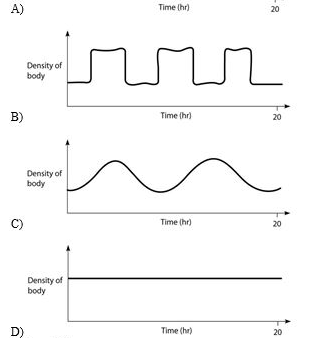
(91) Which graph below best represents the way that density changes over time in a physoclistus fish and in a physostomus fish,respectively? 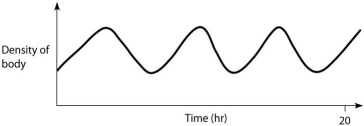
(Multiple Choice)
4.9/5 (82)
(82) The following questions refer to the phylogenetic tree shown below.
-Which number represents the birds?
-Which number represents the birds? (Multiple Choice)
4.9/5 (84)
(84) The following questions refer to the description below.
Terry catches a ray-finned fish from the ocean and notices that attached to its flank is an equally long,snakelike organism.The attached organism has no external segmentation,no scales,a round mouth surrounded by a sucker,and two small eyes.Terry thinks it might be a marine leech,a hagfish,or a lamprey.
-Terry takes the body of the snakelike organism and slices it open along its dorsal side.If it is a hagfish,what should Terry see?
(Multiple Choice)
4.9/5 (81)
(81) Which of the following are the only extant animals that descended directly from dinosaurs?
(Multiple Choice)
4.8/5 (80)
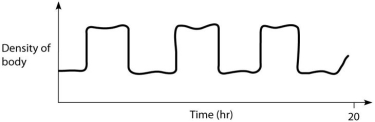
(80) At 5,10,and 15 hours in the graph below,which of the following statements should be true?
(Multiple Choice)
4.9/5 (87)
(87) What is the single unique characteristic that distinguishes extant birds from other extant vertebrates?
(Multiple Choice)
4.9/5 (75)
(75) On the back of your skull you can feel a small bump,below which is an opening where the spinal cord enters the skull.The location of this opening toward the bottom of the skull is significant in evolutionary biology for what reason?
(Multiple Choice)
4.9/5 (87)
(87) If Archaeopteryx had air sacs,then which of its features would have had the opposite effect on enabling Archaeopteryx to fly long distances from that provided by air sacs?
1)teeth
2)contour feathers
3)wing claws
4)long tail with many vertebrae
(Multiple Choice)
4.8/5 (73)
(73) In the United States and Canada,bats use one of two strategies to survive winter: They either migrate south,or they hibernate.Recently,those that hibernate seem to have come under attack by a fungus,Geomyces destructans (Gd),an attack that is occurring from Missouri to southern Canada.Many infected bats have a delicate,white filamentous mat on their muzzles,which is referred to as white-nose syndrome (WNS).The fungus invades the bat tissues,causes discomfort,and awakens the bat from its hibernation.The bat fidgets and wastes calories,using up its stored fat.The bat then behaves abnormally,leaving its cave during daytime in winter to search for food.Their food,primarily insects,is scarce during the winter,and the bats ultimately starve to death.Since 2007,it is estimated that up to 1 million bats have perished from WNS.
-Gd is a cold-loving fungus.Thus,which characteristics of normal bat behaviour can be most expected to favour the spread of this fungus to uninfected bats?
(Multiple Choice)
4.9/5 (69)
(69) The following questions refer to the phylogenetic tree shown below.
-If circle 3 includes all of the extant reptiles that are ectotherms,then what do circles 4 and 6 represent?
-If circle 3 includes all of the extant reptiles that are ectotherms,then what do circles 4 and 6 represent? (Multiple Choice)
4.8/5 (68)
(68) 
Filters
- Essay(0)
- Multiple Choice(0)
- Short Answer(0)
- True False(0)
- Matching(0)