



 Chat with AI
Exam 34: The Origin and Evolution of Vertebrates

Exam 1: Introduction: Evolution and Themes of Biology77 Questions
Exam 2: The Chemical Context of Life98 Questions
Exam 3: Water and Life92 Questions
Exam 4: Carbon and the Molecular Diversity of Life86 Questions
Exam 5: The Structure and Function of Large Biological Molecules131 Questions
Exam 6: A Tour of the Cell111 Questions
Exam 7: Membrane Structure and Function88 Questions
Exam 8: An Introduction to Metabolism92 Questions
Exam 9: Cellular Respiration and Fermentation128 Questions
Exam 10: Photosynthesis103 Questions
Exam 11: Cell Communication85 Questions
Exam 12: The Cell Cycle98 Questions
Exam 13: Meiosis and Sexual Life Cycles90 Questions
Exam 14: Mendel and the Gene Idea92 Questions
Exam 15: The Chromosomal Basis of Inheritance75 Questions
Exam 16: The Molecular Basis of Inheritance84 Questions
Exam 17: From Gene to Protein106 Questions
Exam 18: Regulation of Gene Expression116 Questions
Exam 19: Viruses71 Questions
Exam 20: DNA Tools and Biotechnology78 Questions
Exam 21: Genomes and Their Evolution64 Questions
Exam 22: Descent with Modification: A Darwinian View of Life68 Questions
Exam 23: The Evolution of Populations92 Questions
Exam 24: The Origin of Species76 Questions
Exam 25: The History of Life on Earth89 Questions
Exam 26: Phylogeny and the Tree of Life91 Questions
Exam 27: Bacteria and Archaea96 Questions
Exam 28: Protists82 Questions
Exam 29: Plant Diversity I: How Plants Colonized Land93 Questions
Exam 30: Plant Diversity II: The Evolution of Seed Plants119 Questions
Exam 31: Fungi105 Questions
Exam 32: An Overview of Animal Diversity93 Questions
Exam 33: An Introduction to Invertebrates111 Questions
Exam 34: The Origin and Evolution of Vertebrates126 Questions
Exam 35: Plant Structure,Growth,and Development82 Questions
Exam 36: Resource Acquisition and Transport in Vascular Plants100 Questions
Exam 37: Soil and Plant Nutrition99 Questions
Exam 38: Angiosperm Reproduction and Biotechnology107 Questions
Exam 39: Plant Responses to Internal and External Signals137 Questions
Exam 40: Basic Principles of Animal Form and Function98 Questions
Exam 41: Animal Nutrition87 Questions
Exam 42: Circulation and Gas Exchange112 Questions
Exam 43: The Immune System123 Questions
Exam 44: Osmoregulation and Excretion91 Questions
Exam 45: Hormones and the Endocrine System92 Questions
Exam 46: Animal Reproduction104 Questions
Exam 47: Animal Development106 Questions
Exam 48: Neurons,Synapses,and Signalling93 Questions
Exam 49: Nervous Systems85 Questions
Exam 50: Sensory and Motor Mechanisms106 Questions
Exam 51: Animal Behaviour91 Questions
Exam 52: An Introduction to Ecology and the Biosphere90 Questions
Exam 53: Population Ecology89 Questions
Exam 54: Community Ecology97 Questions
Exam 55: Ecosystems and Restoration Ecology98 Questions
Exam 56: Conservation Biology and Global Change90 Questions
Select questions type


Some animals that lived 530 million years ago resembled lancelets but had a brain and a skull.These animals may represent
(Multiple Choice)
4.8/5  (78)
(78) A trend first observed in the evolution of the earliest tetrapods was
(Multiple Choice)
4.7/5 (63)
(63) What is a key factor in the evolution of jaws that led to the diversification of vertebrates?
(Multiple Choice)
4.9/5 (83)
(83) A new species of aquatic chordate is discovered that closely resembles an ancient form.It has the following characteristics: external armour of bony plates,no paired lateral fins,and a suspension-feeding mode of nutrition.In addition to these,it will probably have which of the following characteristics?
(Multiple Choice)
4.8/5 (89)
(89) Which of the following is the most specific group that includes both the Old World monkeys and the New World monkeys?
(Multiple Choice)
5.0/5 (73)
(73) 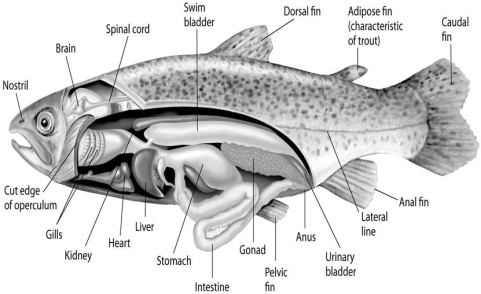 Fishes that have swim bladders can regulate their density and,thus,their buoyancy.There are two types of swim bladder: physostomus and physoclistus.The ancestral version is the physostomus version,in which the swim bladder is connected to the esophagus via a short tube (see the figure above).The fish fills this version by swimming to the surface,taking gulps of air,and directing them into the swim bladder.Air is removed from this version by "belching." The physoclistus version is more derived,and has lost its connection to the esophagus.Instead,gas enters and leaves the swim bladder via special circulatory mechanisms within the wall of the swim bladder.
-The presence of a swim bladder allows the typical ray-finned fish to stop swimming and still
Fishes that have swim bladders can regulate their density and,thus,their buoyancy.There are two types of swim bladder: physostomus and physoclistus.The ancestral version is the physostomus version,in which the swim bladder is connected to the esophagus via a short tube (see the figure above).The fish fills this version by swimming to the surface,taking gulps of air,and directing them into the swim bladder.Air is removed from this version by "belching." The physoclistus version is more derived,and has lost its connection to the esophagus.Instead,gas enters and leaves the swim bladder via special circulatory mechanisms within the wall of the swim bladder.
-The presence of a swim bladder allows the typical ray-finned fish to stop swimming and still (Multiple Choice)
4.9/5 (74)
(74) Which of the following statements about human evolution is a common misconception?
(Multiple Choice)
4.8/5 (74)
(74) Which of the following statements about human evolution is correct?
(Multiple Choice)
5.0/5 (83)
(83) Which group's members have had both lungs and gills during their adult lives?
(Multiple Choice)
4.8/5 (63)
(63) Which of these species was the first to have some members migrate out of Africa?
(Multiple Choice)
4.8/5 (72)
(72) Female birds lay their eggs,thereby facilitating flight by reducing weight.Which "strategy" seems most likely for female bats to use to achieve the same goal?
(Multiple Choice)
5.0/5 (87)
(87) In the United States and Canada,bats use one of two strategies to survive winter: They either migrate south,or they hibernate.Recently,those that hibernate seem to have come under attack by a fungus,Geomyces destructans (Gd),an attack that is occurring from Missouri to southern Canada.Many infected bats have a delicate,white filamentous mat on their muzzles,which is referred to as white-nose syndrome (WNS).The fungus invades the bat tissues,causes discomfort,and awakens the bat from its hibernation.The bat fidgets and wastes calories,using up its stored fat.The bat then behaves abnormally,leaving its cave during daytime in winter to search for food.Their food,primarily insects,is scarce during the winter,and the bats ultimately starve to death.Since 2007,it is estimated that up to 1 million bats have perished from WNS.
-Gd is a cold-loving fungus.Thus,which characteristics of abnormal bat behaviour can be most expected to favour the growth of this fungus?
(Multiple Choice)
4.7/5 (81)
(81) The earliest known mineralized structures in vertebrates are associated with which function?
(Multiple Choice)
4.8/5 (77)
(77) Which of these statements about human evolution is correct?
(Multiple Choice)
4.9/5 (78)
(78) Which characteristic of monotremes is ancestral to amniotes?
(Multiple Choice)
4.9/5 (78)
(78) What do all vertebrates have that earlier chordates did not have?
(Multiple Choice)
4.9/5 (71)
(71) Which of these species is currently thought to have coexisted (at the same time and places)with H.neanderthalensis?
(Multiple Choice)
4.9/5 (82)
(82) 
Filters
- Essay(0)
- Multiple Choice(0)
- Short Answer(0)
- True False(0)
- Matching(0)