Multiple Choice
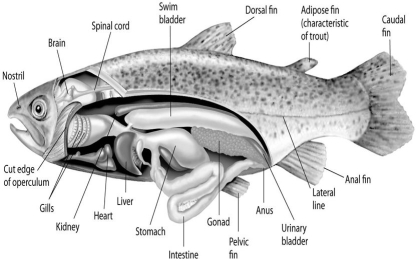
Fishes that have swim bladders can regulate their density and, thus, their buoyancy. There are two types of swim bladder: physostomus and physoclistus. The ancestral version is the physostomus version, in which the swim bladder is connected to the esophagus via a short tube (see the figure above) . The fish fills this version by swimming to the surface, taking gulps of air, and directing them into the swim bladder. Air is removed from this version by "belching." The physoclistus version is more derived, and has lost its connection to the esophagus. Instead, gas enters and leaves the swim bladder via special circulatory mechanisms within the wall of the swim bladder.
-The presence of a swim bladder allows the typical ray-finned fish to stop swimming and still
A) effectively circulate its blood.
B) be highly manoeuvrable.
C) use its lateral line system.
D) use its swim bladder as a respiratory organ.
E) not sink.
Correct Answer:

Verified
Correct Answer:
Verified
Q42: Unlike eutherians, both monotremes and marsupials<br>A) lack
Q46: As hominins diverged from other primates, which
Q50: Which clade does not include humans?<br>A) synapsids<br>B)
Q52: If a ray-finned fish is to both
Q53: The following questions refer to the description
Q60: During chordate evolution, what is the sequence
Q61: If Archaeopteryx had air sacs, then which
Q62: What do all craniates have that earlier
Q80: Which feature(s)allow(s)hibernating bats to conserve heat without
Q107: Arrange these taxonomic terms from most inclusive