



 Chat with AI
Exam 31: Fungi

Exam 1: Introduction: Evolution and Themes of Biology77 Questions
Exam 2: The Chemical Context of Life98 Questions
Exam 3: Water and Life92 Questions
Exam 4: Carbon and the Molecular Diversity of Life86 Questions
Exam 5: The Structure and Function of Large Biological Molecules131 Questions
Exam 6: A Tour of the Cell111 Questions
Exam 7: Membrane Structure and Function88 Questions
Exam 8: An Introduction to Metabolism92 Questions
Exam 9: Cellular Respiration and Fermentation128 Questions
Exam 10: Photosynthesis103 Questions
Exam 11: Cell Communication85 Questions
Exam 12: The Cell Cycle98 Questions
Exam 13: Meiosis and Sexual Life Cycles90 Questions
Exam 14: Mendel and the Gene Idea92 Questions
Exam 15: The Chromosomal Basis of Inheritance75 Questions
Exam 16: The Molecular Basis of Inheritance84 Questions
Exam 17: From Gene to Protein106 Questions
Exam 18: Regulation of Gene Expression116 Questions
Exam 19: Viruses71 Questions
Exam 20: DNA Tools and Biotechnology78 Questions
Exam 21: Genomes and Their Evolution64 Questions
Exam 22: Descent with Modification: A Darwinian View of Life68 Questions
Exam 23: The Evolution of Populations92 Questions
Exam 24: The Origin of Species76 Questions
Exam 25: The History of Life on Earth89 Questions
Exam 26: Phylogeny and the Tree of Life91 Questions
Exam 27: Bacteria and Archaea96 Questions
Exam 28: Protists82 Questions
Exam 29: Plant Diversity I: How Plants Colonized Land93 Questions
Exam 30: Plant Diversity II: The Evolution of Seed Plants119 Questions
Exam 31: Fungi105 Questions
Exam 32: An Overview of Animal Diversity93 Questions
Exam 33: An Introduction to Invertebrates111 Questions
Exam 34: The Origin and Evolution of Vertebrates126 Questions
Exam 35: Plant Structure,Growth,and Development82 Questions
Exam 36: Resource Acquisition and Transport in Vascular Plants100 Questions
Exam 37: Soil and Plant Nutrition99 Questions
Exam 38: Angiosperm Reproduction and Biotechnology107 Questions
Exam 39: Plant Responses to Internal and External Signals137 Questions
Exam 40: Basic Principles of Animal Form and Function98 Questions
Exam 41: Animal Nutrition87 Questions
Exam 42: Circulation and Gas Exchange112 Questions
Exam 43: The Immune System123 Questions
Exam 44: Osmoregulation and Excretion91 Questions
Exam 45: Hormones and the Endocrine System92 Questions
Exam 46: Animal Reproduction104 Questions
Exam 47: Animal Development106 Questions
Exam 48: Neurons,Synapses,and Signalling93 Questions
Exam 49: Nervous Systems85 Questions
Exam 50: Sensory and Motor Mechanisms106 Questions
Exam 51: Animal Behaviour91 Questions
Exam 52: An Introduction to Ecology and the Biosphere90 Questions
Exam 53: Population Ecology89 Questions
Exam 54: Community Ecology97 Questions
Exam 55: Ecosystems and Restoration Ecology98 Questions
Exam 56: Conservation Biology and Global Change90 Questions
Select questions type


You are given an organism to identify.It has a fruiting body that contains many structures with eight haploid spores lined up in a row.What kind of a fungus is this?
(Multiple Choice)
4.8/5  (78)
(78) Some fungi can exist either as unicellular yeasts or as filamentous hyphae.Which of these forms would be most favourable in an environment where nutrients are limited?
(Multiple Choice)
4.8/5 (70)
(70) Among the organisms listed here,which are thought to be the closest relatives of fungi?
(Multiple Choice)
4.9/5 (70)
(70) The following figure depicts the outline of a large fairy ring that has appeared overnight in an open meadow,as viewed from above.The fairy ring represents the furthest advance of this mycelium through the soil.Locations A-D are all 0.5 metres below the soil surface.Responses may be used once,more than once,or not at all.
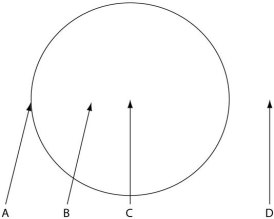 -Which location is nearest to basidiocarps?
 (Multiple Choice)
4.7/5 (86)
(86) Use the following information to answer the questions below.
Recent genetic studies of the structure of microsporidian genomes,as well as the sequences of their tubulin genes and the gene for RNA polymerase II,indicate that microsporidians are closely related to the fungi.Microsporidians lack flagella,centrioles,peroxisomes,and mitochondria (although they do have degenerate mitochondria,called mitosomes).They have the smallest genome of any eukaryote,and it is a genome that changes quickly.The genome is contained within two haploid nuclei.All microsporidians are obligate intracellular parasites.They use a unique organelle called a polar filament to gain access to the cells of their hosts.One species causes chronic diarrhea in AIDS patients.Another parasitizes Anopheles gambiae,the mosquito that transmits a fatal form of malaria to humans.
-Which of the following microsporidian features are shared with many other fungi?
1)chitinous cell wall
2)two haploid nuclei per cell
3)polar filament
4)chemoheterotrophy
(Multiple Choice)
4.8/5 (79)
(79) The microsporidian,Brachiola gambiae,parasitizes the mosquito,Anopheles gambiae.Adult female mosquitoes must take blood meals in order for their eggs to develop,and it is while they take blood that they transmit malarial parasites to humans.Male mosquitoes drink flower nectar.If humans are to safely and effectively use Brachiola gambiae as a biological control to reduce human deaths from malaria,then how many of the following statements should be true?
1)Brachiola should kill the mosquitoes before the malarial parasite they carry reaches maturity.
2)The microsporidian should not be harmful to other insects.
3)Microsporidians should infect mosquito larvae,rather than mosquito adults.
4)The subsequent decline in anopheline mosquitoes should not significantly disrupt human food resources or other food webs.
5)Brachiola must be harmful to male mosquitoes,but not to female mosquitoes.
(Multiple Choice)
4.9/5 (82)
(82) Sexual reproduction has not been observed in Bd.A Bd sporangium initially contains a single,haploid cell.Which of the following processes must be involved in generating the multiple zoospores eventually produced by each sporangium?
1)S phase
2)cytokinesis
3)mitosis
4)meiosis
(Multiple Choice)
4.8/5 (85)
(85) If haustoria from the fungal partner were to appear within the photosynthetic partner of a lichen,and if the growth rate of the photosynthetic partner consequently slowed substantially,then this would support the claim that
(Multiple Choice)
4.8/5 (68)
(68) The following figure depicts the outline of a large fairy ring that has appeared overnight in an open meadow,as viewed from above.The fairy ring represents the furthest advance of this mycelium through the soil.Locations A-D are all 0.5 metres below the soil surface.Responses may be used once,more than once,or not at all.
-At which location should one find the lowest concentration of fungal enzymes,assuming that the enzymes do not diffuse far from their source,and that no other fungi are present in this habitat?
-At which location should one find the lowest concentration of fungal enzymes,assuming that the enzymes do not diffuse far from their source,and that no other fungi are present in this habitat? (Multiple Choice)
4.9/5 (56)
(56) Arrange the following from largest to smallest,assuming that they all come from the same fungus.
1)basidiocarp
2)basidium
3)basidiospore
4)mycelium
5)gill
(Multiple Choice)
4.8/5 (93)
(93) Use the following information to answer the questions below.
Unicellular yeasts can be represented as spheres,whereas filamentous hyphae more closely resemble cylinders.As these two geometric figures increase in size,their surface area-to-volume ratios change.The following tables demonstrate how this ratio changes,first for spheres,and second for cylinders.For the cylinder,girth (i.e.,radius,r)will remain constant,whereas length,L,will increase.Note the formulas below the respective tables.
A sphere's change in surface area and volume with increasing radius,r
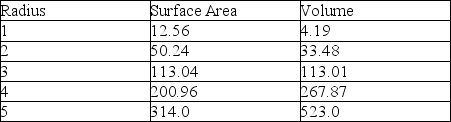 Area of a Sphere = 4r² Volume of a Sphere = 4/3r³
A cylinder's change in surface area and volume with increasing length,L
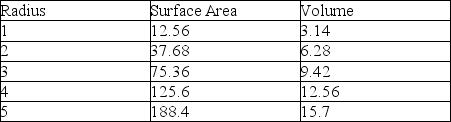 Area of a Cylinder = 2(r²)+ 2rL Volume of a Cylinder = r²ᴸ
-Which statement is a correct interpretation of the data in the previous tables?
Area of a Sphere = 4r² Volume of a Sphere = 4/3r³
A cylinder's change in surface area and volume with increasing length,L
Area of a Cylinder = 2(r²)+ 2rL Volume of a Cylinder = r²ᴸ
-Which statement is a correct interpretation of the data in the previous tables? (Multiple Choice)
4.9/5 (77)
(77) Use the following information to answer the questions below.
Rose-picker's disease is caused by the yeast,Sporothrix schenkii.The yeast grows on the exteriors of rose-bush thorns.If a human gets pricked by such a thorn,the yeasts can be introduced under the skin.The yeasts then assume a hyphal morphology and grow along the interiors of lymphatic vessels until they reach a lymph node.This often results in the accumulation of pus in the lymph node,which subsequently ulcerates through the skin surface and then drains.
-The answer to which of these questions would be of most assistance to one who is attempting to assign the genus Sporothrix to the correct fungal phylum?
(Multiple Choice)
4.8/5 (77)
(77) The functional significance of porous septa in certain fungal hyphae is most similar to that represented by which pair of structures in animal cells and plant cells,respectively?
(Multiple Choice)
4.9/5 (86)
(86) Many infected animals are induced by the parasitic microsporidians to develop huge cells,known as xenomas,which are full of spores.Given their large size,what should be true of the xenomas?
(Multiple Choice)
4.9/5 (76)
(76) Which description does not apply equally well to both sexual and asexual spores?
(Multiple Choice)
4.8/5 (81)
(81) Arrange the following from largest to smallest.
1)ascospore
2)ascocarp
3)ascomycete
4)ascus
(Multiple Choice)
4.8/5 (91)
(91) Which of the following are protists,the organisms thought to share the closest ancestor with the chytrids?
(Multiple Choice)
4.8/5 (65)
(65) The following questions refer to the description below.
A lichen is a mutualistic association between a fungus and a green algae or cyanobacteria.There are clear morphological differences in lichen body form; some have flat bodies and are very close together,others have leaf-like bodies,and still others grow upright.The association between the two organisms is so complete that lichens are classified as a single organism.
-Biologists have noted that lichen structure differs substantially from the fungus component grown separately.What is the most plausible explanation for this?
(Multiple Choice)
4.9/5 (85)
(85) Fungi differ from other heterotrophic organisms in which way?
(Multiple Choice)
4.7/5 (87)
(87) 
Filters
- Essay(0)
- Multiple Choice(0)
- Short Answer(0)
- True False(0)
- Matching(0)