



 Chat with AI
Exam 31: Fungi

Exam 1: Introduction: Evolution and Themes of Biology77 Questions
Exam 2: The Chemical Context of Life98 Questions
Exam 3: Water and Life92 Questions
Exam 4: Carbon and the Molecular Diversity of Life86 Questions
Exam 5: The Structure and Function of Large Biological Molecules131 Questions
Exam 6: A Tour of the Cell111 Questions
Exam 7: Membrane Structure and Function88 Questions
Exam 8: An Introduction to Metabolism92 Questions
Exam 9: Cellular Respiration and Fermentation128 Questions
Exam 10: Photosynthesis103 Questions
Exam 11: Cell Communication85 Questions
Exam 12: The Cell Cycle98 Questions
Exam 13: Meiosis and Sexual Life Cycles90 Questions
Exam 14: Mendel and the Gene Idea92 Questions
Exam 15: The Chromosomal Basis of Inheritance75 Questions
Exam 16: The Molecular Basis of Inheritance84 Questions
Exam 17: From Gene to Protein106 Questions
Exam 18: Regulation of Gene Expression116 Questions
Exam 19: Viruses71 Questions
Exam 20: DNA Tools and Biotechnology78 Questions
Exam 21: Genomes and Their Evolution64 Questions
Exam 22: Descent with Modification: A Darwinian View of Life68 Questions
Exam 23: The Evolution of Populations92 Questions
Exam 24: The Origin of Species76 Questions
Exam 25: The History of Life on Earth89 Questions
Exam 26: Phylogeny and the Tree of Life91 Questions
Exam 27: Bacteria and Archaea96 Questions
Exam 28: Protists82 Questions
Exam 29: Plant Diversity I: How Plants Colonized Land93 Questions
Exam 30: Plant Diversity II: The Evolution of Seed Plants119 Questions
Exam 31: Fungi105 Questions
Exam 32: An Overview of Animal Diversity93 Questions
Exam 33: An Introduction to Invertebrates111 Questions
Exam 34: The Origin and Evolution of Vertebrates126 Questions
Exam 35: Plant Structure,Growth,and Development82 Questions
Exam 36: Resource Acquisition and Transport in Vascular Plants100 Questions
Exam 37: Soil and Plant Nutrition99 Questions
Exam 38: Angiosperm Reproduction and Biotechnology107 Questions
Exam 39: Plant Responses to Internal and External Signals137 Questions
Exam 40: Basic Principles of Animal Form and Function98 Questions
Exam 41: Animal Nutrition87 Questions
Exam 42: Circulation and Gas Exchange112 Questions
Exam 43: The Immune System123 Questions
Exam 44: Osmoregulation and Excretion91 Questions
Exam 45: Hormones and the Endocrine System92 Questions
Exam 46: Animal Reproduction104 Questions
Exam 47: Animal Development106 Questions
Exam 48: Neurons,Synapses,and Signalling93 Questions
Exam 49: Nervous Systems85 Questions
Exam 50: Sensory and Motor Mechanisms106 Questions
Exam 51: Animal Behaviour91 Questions
Exam 52: An Introduction to Ecology and the Biosphere90 Questions
Exam 53: Population Ecology89 Questions
Exam 54: Community Ecology97 Questions
Exam 55: Ecosystems and Restoration Ecology98 Questions
Exam 56: Conservation Biology and Global Change90 Questions
Select questions type


The following questions refer to the description below.
A lichen is a mutualistic association between a fungus and a green algae or cyanobacteria.There are clear morphological differences in lichen body form; some have flat bodies and are very close together,others have leaf-like bodies,and still others grow upright.The association between the two organisms is so complete that lichens are classified as a single organism.
-Lichens are found in a wide variety of habitats,including rocks,soil,tree bark,buildings,etc.Aging of lichens has shown that some are thousands of years old; how is this possible when you see that some of these lichens are very small?
(Multiple Choice)
4.9/5  (75)
(75) Use the following information to answer the questions below.
Recent genetic studies of the structure of microsporidian genomes,as well as the sequences of their tubulin genes and the gene for RNA polymerase II,indicate that microsporidians are closely related to the fungi.Microsporidians lack flagella,centrioles,peroxisomes,and mitochondria (although they do have degenerate mitochondria,called mitosomes).They have the smallest genome of any eukaryote,and it is a genome that changes quickly.The genome is contained within two haploid nuclei.All microsporidians are obligate intracellular parasites.They use a unique organelle called a polar filament to gain access to the cells of their hosts.One species causes chronic diarrhea in AIDS patients.Another parasitizes Anopheles gambiae,the mosquito that transmits a fatal form of malaria to humans.
-Given the eukaryotic structures they lack,it should be expected that microsporidians also lack
(Multiple Choice)
4.8/5 (77)
(77) When adult amphibian skin harbours populations of the bacterium,Janthinobacterium lividum (Jl),chytrid infection seems to be inhibited.Which of the following represents the best experimental design for conclusively determining whether this inhibition is real?
(Multiple Choice)
4.8/5 (79)
(79) Basidiomycetes are the only fungal group capable of synthesizing lignin peroxidase.What advantage does this group of fungi have over other fungi because of this capability?
(Multiple Choice)
4.9/5 (73)
(73) In both lichens and mycorrhizae,what does the fungal partner provide to its photosynthetic partner?
(Multiple Choice)
4.8/5 (78)
(78) Which of the following characteristics is shared by both chytrids and other kinds of fungi?
(Multiple Choice)
4.9/5 (87)
(87) 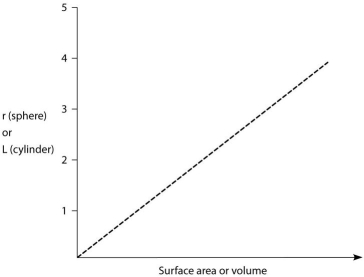 -Both axes of the graph are linear.Thus,the shape of the line plotted on this graph most accurately depicts the
 (Multiple Choice)
4.7/5 (80)
(80) If Bd cannot grow properly at temperatures above 28°C (82°F),then,assuming the amphibians can survive,in which time or place should the chytrid infection proceed most rapidly?
1)cooler months
2)warmer months
3)lower altitudes
4)higher altitudes
(Multiple Choice)
4.7/5 (86)
(86) If all fungi in an environment that perform decomposition were to suddenly die,then which group of organisms should benefit most,due to the fact that their fungal competitors have been removed?
(Multiple Choice)
4.7/5 (79)
(79) If all of their nuclei are equally active transcriptionally,then the cells of both dikaryotic and heterokaryotic fungi,in terms of the gene products they can make,are essentially
(Multiple Choice)
4.9/5 (66)
(66) Both fungus-derived antibiotics and hallucinogens used by humans probably evolved in fungi as a means to
(Multiple Choice)
4.9/5 (84)
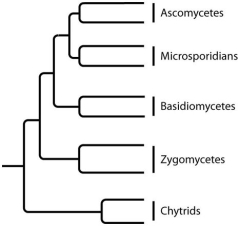
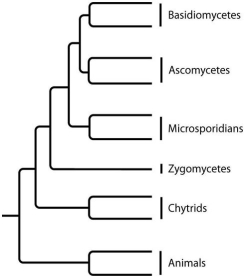
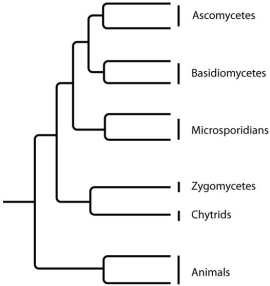
(84) The next few questions refer to the following phylogenetic trees.
 I.
 II.
 III.
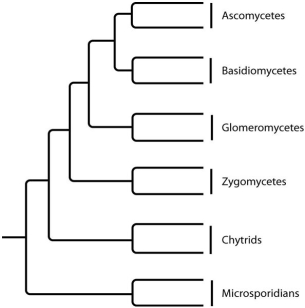 IV.
-Which tree depicts the closest relationship between zygomycetes and chytrids?
I.
II.
III.
IV.
-Which tree depicts the closest relationship between zygomycetes and chytrids? (Multiple Choice)
4.9/5 (71)
(71) Use the following information to answer the questions below.
Rose-picker's disease is caused by the yeast,Sporothrix schenkii.The yeast grows on the exteriors of rose-bush thorns.If a human gets pricked by such a thorn,the yeasts can be introduced under the skin.The yeasts then assume a hyphal morphology and grow along the interiors of lymphatic vessels until they reach a lymph node.This often results in the accumulation of pus in the lymph node,which subsequently ulcerates through the skin surface and then drains.
-Say S.schenkii had initially been classified as a deuteromycete.Asci were later discovered in the pus that oozed from an ulcerated lymph node,and the spores therein germinated,giving rise to S.schenkii yeasts.Which two of these are conclusions that make sense on the basis of this information?
1)S.schenkii produces asexual spores within lymph nodes.
2)S.schenkii should be reclassified.
3)S.schenkii continues to have no known sexual stage.
4)The hyphae growing in lymphatic vessels probably belonged to a different fungal species.
5)S.schenkii yeasts belonging to two different mating strains were introduced by the same thorn prick.
(Multiple Choice)
4.9/5 (91)
(91) Mycorrhizae are to the roots of vascular plants as endophytes are to vascular plants'
(Multiple Choice)
4.9/5 (80)
(80) What accounts most directly for the extremely fast growth of a fungal mycelium?
(Multiple Choice)
4.8/5 (78)
(78) 
Filters
- Essay(0)
- Multiple Choice(0)
- Short Answer(0)
- True False(0)
- Matching(0)