



 Chat with AI
Exam 29: Plant Diversity I: How Plants Colonized Land

Exam 1: Introduction: Evolution and Themes of Biology77 Questions
Exam 2: The Chemical Context of Life98 Questions
Exam 3: Water and Life92 Questions
Exam 4: Carbon and the Molecular Diversity of Life86 Questions
Exam 5: The Structure and Function of Large Biological Molecules131 Questions
Exam 6: A Tour of the Cell111 Questions
Exam 7: Membrane Structure and Function88 Questions
Exam 8: An Introduction to Metabolism92 Questions
Exam 9: Cellular Respiration and Fermentation128 Questions
Exam 10: Photosynthesis103 Questions
Exam 11: Cell Communication85 Questions
Exam 12: The Cell Cycle98 Questions
Exam 13: Meiosis and Sexual Life Cycles90 Questions
Exam 14: Mendel and the Gene Idea92 Questions
Exam 15: The Chromosomal Basis of Inheritance75 Questions
Exam 16: The Molecular Basis of Inheritance84 Questions
Exam 17: From Gene to Protein106 Questions
Exam 18: Regulation of Gene Expression116 Questions
Exam 19: Viruses71 Questions
Exam 20: DNA Tools and Biotechnology78 Questions
Exam 21: Genomes and Their Evolution64 Questions
Exam 22: Descent with Modification: A Darwinian View of Life68 Questions
Exam 23: The Evolution of Populations92 Questions
Exam 24: The Origin of Species76 Questions
Exam 25: The History of Life on Earth89 Questions
Exam 26: Phylogeny and the Tree of Life91 Questions
Exam 27: Bacteria and Archaea96 Questions
Exam 28: Protists82 Questions
Exam 29: Plant Diversity I: How Plants Colonized Land93 Questions
Exam 30: Plant Diversity II: The Evolution of Seed Plants119 Questions
Exam 31: Fungi105 Questions
Exam 32: An Overview of Animal Diversity93 Questions
Exam 33: An Introduction to Invertebrates111 Questions
Exam 34: The Origin and Evolution of Vertebrates126 Questions
Exam 35: Plant Structure,Growth,and Development82 Questions
Exam 36: Resource Acquisition and Transport in Vascular Plants100 Questions
Exam 37: Soil and Plant Nutrition99 Questions
Exam 38: Angiosperm Reproduction and Biotechnology107 Questions
Exam 39: Plant Responses to Internal and External Signals137 Questions
Exam 40: Basic Principles of Animal Form and Function98 Questions
Exam 41: Animal Nutrition87 Questions
Exam 42: Circulation and Gas Exchange112 Questions
Exam 43: The Immune System123 Questions
Exam 44: Osmoregulation and Excretion91 Questions
Exam 45: Hormones and the Endocrine System92 Questions
Exam 46: Animal Reproduction104 Questions
Exam 47: Animal Development106 Questions
Exam 48: Neurons,Synapses,and Signalling93 Questions
Exam 49: Nervous Systems85 Questions
Exam 50: Sensory and Motor Mechanisms106 Questions
Exam 51: Animal Behaviour91 Questions
Exam 52: An Introduction to Ecology and the Biosphere90 Questions
Exam 53: Population Ecology89 Questions
Exam 54: Community Ecology97 Questions
Exam 55: Ecosystems and Restoration Ecology98 Questions
Exam 56: Conservation Biology and Global Change90 Questions
Select questions type


Which of the following statements correctly describes the alternation of generation cycle of a fern?
(Multiple Choice)
4.8/5  (79)
(79) The next few questions are based on the following description.
A biology student hiking in a forest happens upon an erect,15-cm-tall plant that bears microphylls and a strobilus at its tallest point.When disturbed,the cone emits a dense cloud of brownish dust.A pocket magnifying glass reveals the dust to be composed of tiny spheres with a high oil content.
-Besides oil,what other chemical should be detected in substantial amounts upon chemical analysis of these small spheres?
(Multiple Choice)
4.9/5 (77)
(77) Which of the following is a true statement about plant reproduction?
(Multiple Choice)
5.0/5 (78)
(78) If researchers found that charophyte algae lack certain traits that land plants have,can we conclude that charophytes are not the closest relatives of land plants?
(Multiple Choice)
4.9/5 (79)
(79) Which of the following is a land plant that has flagellated sperm and a sporophyte-dominated life cycle?
(Multiple Choice)
4.7/5 (71)
(71) The next few questions are based on the following description.
A biology student hiking in a forest happens upon an erect,15-cm-tall plant that bears microphylls and a strobilus at its tallest point.When disturbed,the cone emits a dense cloud of brownish dust.A pocket magnifying glass reveals the dust to be composed of tiny spheres with a high oil content.
-This student has probably found a(n)
(Multiple Choice)
4.7/5 (75)
(75) In which of the following taxa does the mature sporophyte depend completely on the gametophyte for nutrition?
(Multiple Choice)
4.9/5 (81)
(81) Use the following figure to answer the questions below.
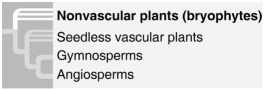 -The resolution of the relationships indicated by dashed lines in the figure above will most probably come from
 (Multiple Choice)
5.0/5 (84)
(84) Which of the following is not evidence that charophytes are the closest algal relatives of plants?
(Multiple Choice)
5.0/5 (69)
(69) Assuming that they all belong to the same plant,arrange the following structures from largest to smallest (or from most inclusive to least inclusive).
1)spores
2)sporophylls
3)sporophytes
4)sporangia
(Multiple Choice)
4.7/5 (69)
(69) If you were faced with the choice of eliminating all mutualistic symbioses involving plants and other organisms (besides humans),with the goal being to preserve the most plant biomass,which of the following would you save from elimination?
(Multiple Choice)
4.9/5 (67)
(67) Arrange the following terms from most inclusive to least inclusive.
1)embryophytes
2)green plants
3)seedless vascular plants
4)ferns
5)tracheophytes
(Multiple Choice)
4.8/5 (89)
(89) If a fern gametophyte is a hermaphrodite (that is,has both male and female gametangia on the same plant),then it
(Multiple Choice)
4.8/5 (69)
(69) Which of the following characteristics of plants is absent in their closest relatives,the charophyte algae?
(Multiple Choice)
4.8/5 (74)
(74) In which combination of locations would one who is searching for the gametophytes of flower of stone have the best chance of finding them?
1)moist soil
2)underground,nourished there by symbiotic fungi
3)south- or west-facing slopes
4)permanently shady places
5)far from any flower of stone sporophytes
(Multiple Choice)
4.9/5 (78)
(78) Upon closer inspection of the leaves of flower of stone,one can observe tiny,cone-like structures.Each cone-like structure emits spores of two different sizes.Consequently,which of the following is the closest living relative of flower of stone?
(Multiple Choice)
4.8/5 (81)
(81) If humans had been present to build log structures during the Carboniferous period (they weren't),which plant types would have been suitable sources of logs?
(Multiple Choice)
4.7/5 (102)
(102) Refer to the following information to answer the next few questions.
Researchers decided to test the hypothesis that if the 2-m tall Polytrichum gametophyte-sporophyte plants had acted as a physical buffer,then they would have reduced water's ability to erode the soil and carry away its nitrogen.They began with four equal-sized areas where Polytrichum mosses grew to a height of 2 m above the soil surface.One of the four areas was not modified.In the second area,the mosses were trimmed to a height of 1 m above the soil surface.In the third area,the mosses were trimmed to a height of 0.5 m above the soil surface.In the fourth area,the mosses were trimmed all the way to the ground,leaving only the rhizoids.Water,simulating rainfall,was then added in a controlled fashion to all plots over the course of one year.The figure below presents four graphs that depict potential results of this experiment.
 -The 2-m height attainable by Polytrichum moss is at the upper end of the size range reached by mosses.What accounts for the relative height of Polytrichum?
 (Multiple Choice)
4.8/5 (79)
(79) A botanist discovers a new species of plant in a tropical rain forest.After observing its anatomy and life cycle,he notes the following characteristics: flagellated sperm,xylem with tracheids,separate gametophyte and sporophyte generations with the sporophyte dominant,and no seeds.This plant is probably most closely related to
(Multiple Choice)
4.9/5 (79)
(79) 
Filters
- Essay(0)
- Multiple Choice(0)
- Short Answer(0)
- True False(0)
- Matching(0)