



 Chat with AI
Exam 29: Plant Diversity I: How Plants Colonized Land

Exam 1: Introduction: Evolution and Themes of Biology77 Questions
Exam 2: The Chemical Context of Life98 Questions
Exam 3: Water and Life92 Questions
Exam 4: Carbon and the Molecular Diversity of Life86 Questions
Exam 5: The Structure and Function of Large Biological Molecules131 Questions
Exam 6: A Tour of the Cell111 Questions
Exam 7: Membrane Structure and Function88 Questions
Exam 8: An Introduction to Metabolism92 Questions
Exam 9: Cellular Respiration and Fermentation128 Questions
Exam 10: Photosynthesis103 Questions
Exam 11: Cell Communication85 Questions
Exam 12: The Cell Cycle98 Questions
Exam 13: Meiosis and Sexual Life Cycles90 Questions
Exam 14: Mendel and the Gene Idea92 Questions
Exam 15: The Chromosomal Basis of Inheritance75 Questions
Exam 16: The Molecular Basis of Inheritance84 Questions
Exam 17: From Gene to Protein106 Questions
Exam 18: Regulation of Gene Expression116 Questions
Exam 19: Viruses71 Questions
Exam 20: DNA Tools and Biotechnology78 Questions
Exam 21: Genomes and Their Evolution64 Questions
Exam 22: Descent with Modification: A Darwinian View of Life68 Questions
Exam 23: The Evolution of Populations92 Questions
Exam 24: The Origin of Species76 Questions
Exam 25: The History of Life on Earth89 Questions
Exam 26: Phylogeny and the Tree of Life91 Questions
Exam 27: Bacteria and Archaea96 Questions
Exam 28: Protists82 Questions
Exam 29: Plant Diversity I: How Plants Colonized Land93 Questions
Exam 30: Plant Diversity II: The Evolution of Seed Plants119 Questions
Exam 31: Fungi105 Questions
Exam 32: An Overview of Animal Diversity93 Questions
Exam 33: An Introduction to Invertebrates111 Questions
Exam 34: The Origin and Evolution of Vertebrates126 Questions
Exam 35: Plant Structure,Growth,and Development82 Questions
Exam 36: Resource Acquisition and Transport in Vascular Plants100 Questions
Exam 37: Soil and Plant Nutrition99 Questions
Exam 38: Angiosperm Reproduction and Biotechnology107 Questions
Exam 39: Plant Responses to Internal and External Signals137 Questions
Exam 40: Basic Principles of Animal Form and Function98 Questions
Exam 41: Animal Nutrition87 Questions
Exam 42: Circulation and Gas Exchange112 Questions
Exam 43: The Immune System123 Questions
Exam 44: Osmoregulation and Excretion91 Questions
Exam 45: Hormones and the Endocrine System92 Questions
Exam 46: Animal Reproduction104 Questions
Exam 47: Animal Development106 Questions
Exam 48: Neurons,Synapses,and Signalling93 Questions
Exam 49: Nervous Systems85 Questions
Exam 50: Sensory and Motor Mechanisms106 Questions
Exam 51: Animal Behaviour91 Questions
Exam 52: An Introduction to Ecology and the Biosphere90 Questions
Exam 53: Population Ecology89 Questions
Exam 54: Community Ecology97 Questions
Exam 55: Ecosystems and Restoration Ecology98 Questions
Exam 56: Conservation Biology and Global Change90 Questions
Select questions type


Researchers tested nitrogen loss from soil where the moss Polytrichum was growing,and compared it to soil from which Polytrichum had been removed.The data are presented below.
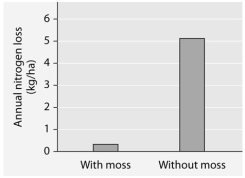 -Loss of soil nitrogen via "gaseous emission" was found to be negligible.Rather,most loss of soil nitrogen was due to water erosion of the soil.Which of these hypotheses is least likely to account for the observed results?
 (Multiple Choice)
4.7/5  (76)
(76) In animal cells and in the meristem cells of land plants,the nuclear envelope disintegrates during mitosis.This disintegration does not occur in the cells of most protists and fungi.According to our current knowledge of plant evolution,which group of organisms should feature mitosis most similar to that of land plants?
(Multiple Choice)
4.9/5 (87)
(87) Upon closer inspection of the leaves of flower of stone,one can observe tiny,cone-like structures.Each cone-like structure emits spores of two different sizes.Based on this information,which of the following can be properly inferred about flower of stone?
1)It is heterosporous.
2)It is a fern.
3)The cone-like structures are sori.
4)It is a lycophyte.
5)It has separate male and female gametophytes.
(Multiple Choice)
4.9/5 (77)
(77) Upon closer inspection of the leaves of flower of stone,one can observe tiny,cone-like structures.Each cone-like structure emits spores of two different sizes.Consequently,flower of stone should be expected to possess which other characteristics?
1)a gametophyte generation that is dominant
2)lignified vascular tissues
3)microphylls
4)filamentous rhizoids,but not true roots
5)spores that are diploid when mature
(Multiple Choice)
4.9/5 (77)
(77) Which of the following was not a challenge for survival of the first land plants?
(Multiple Choice)
4.9/5 (69)
(69) The structural integrity of bacteria is to peptidoglycan as the structural integrity of plant spores is to
(Multiple Choice)
4.9/5 (74)
(74) Considering that the mature sporophytes of true mosses get their nutrition from the gametophytes on which they grow,and considering these generations as individual plants,what is true of the relationship between true moss sporophytes and gametophytes?
(Multiple Choice)
4.8/5 (80)
(80) The leaflike appendages of moss gametophytes may be one to two cell layers thick.Consequently,which of the following is least likely to be found associated with such appendages?
(Multiple Choice)
4.8/5 (73)
(73) You find a green organism in a pond near your house and believe it is a plant,not an alga.The mystery organism is most likely a plant and not an alga if it ________.
(Multiple Choice)
4.8/5 (72)
(72) Use the following figure to answer the questions below.
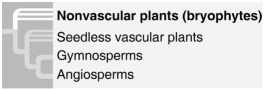 -Which of the following should be most helpful in distinguishing the clades depicted on the tree in the above figure from each other?
 (Multiple Choice)
4.9/5 (76)
(76) 
Filters
- Essay(0)
- Multiple Choice(0)
- Short Answer(0)
- True False(0)
- Matching(0)