



 Chat with AI
Exam 14: Mendel and the Gene Idea

Exam 1: Introduction: Evolution and Themes of Biology77 Questions
Exam 2: The Chemical Context of Life98 Questions
Exam 3: Water and Life92 Questions
Exam 4: Carbon and the Molecular Diversity of Life86 Questions
Exam 5: The Structure and Function of Large Biological Molecules131 Questions
Exam 6: A Tour of the Cell111 Questions
Exam 7: Membrane Structure and Function88 Questions
Exam 8: An Introduction to Metabolism92 Questions
Exam 9: Cellular Respiration and Fermentation128 Questions
Exam 10: Photosynthesis103 Questions
Exam 11: Cell Communication85 Questions
Exam 12: The Cell Cycle98 Questions
Exam 13: Meiosis and Sexual Life Cycles90 Questions
Exam 14: Mendel and the Gene Idea92 Questions
Exam 15: The Chromosomal Basis of Inheritance75 Questions
Exam 16: The Molecular Basis of Inheritance84 Questions
Exam 17: From Gene to Protein106 Questions
Exam 18: Regulation of Gene Expression116 Questions
Exam 19: Viruses71 Questions
Exam 20: DNA Tools and Biotechnology78 Questions
Exam 21: Genomes and Their Evolution64 Questions
Exam 22: Descent with Modification: A Darwinian View of Life68 Questions
Exam 23: The Evolution of Populations92 Questions
Exam 24: The Origin of Species76 Questions
Exam 25: The History of Life on Earth89 Questions
Exam 26: Phylogeny and the Tree of Life91 Questions
Exam 27: Bacteria and Archaea96 Questions
Exam 28: Protists82 Questions
Exam 29: Plant Diversity I: How Plants Colonized Land93 Questions
Exam 30: Plant Diversity II: The Evolution of Seed Plants119 Questions
Exam 31: Fungi105 Questions
Exam 32: An Overview of Animal Diversity93 Questions
Exam 33: An Introduction to Invertebrates111 Questions
Exam 34: The Origin and Evolution of Vertebrates126 Questions
Exam 35: Plant Structure,Growth,and Development82 Questions
Exam 36: Resource Acquisition and Transport in Vascular Plants100 Questions
Exam 37: Soil and Plant Nutrition99 Questions
Exam 38: Angiosperm Reproduction and Biotechnology107 Questions
Exam 39: Plant Responses to Internal and External Signals137 Questions
Exam 40: Basic Principles of Animal Form and Function98 Questions
Exam 41: Animal Nutrition87 Questions
Exam 42: Circulation and Gas Exchange112 Questions
Exam 43: The Immune System123 Questions
Exam 44: Osmoregulation and Excretion91 Questions
Exam 45: Hormones and the Endocrine System92 Questions
Exam 46: Animal Reproduction104 Questions
Exam 47: Animal Development106 Questions
Exam 48: Neurons,Synapses,and Signalling93 Questions
Exam 49: Nervous Systems85 Questions
Exam 50: Sensory and Motor Mechanisms106 Questions
Exam 51: Animal Behaviour91 Questions
Exam 52: An Introduction to Ecology and the Biosphere90 Questions
Exam 53: Population Ecology89 Questions
Exam 54: Community Ecology97 Questions
Exam 55: Ecosystems and Restoration Ecology98 Questions
Exam 56: Conservation Biology and Global Change90 Questions
Select questions type


Use the following information to answer the questions below.
Labrador retrievers are black,brown,or yellow.In a cross of a black female with a brown male,results can be either all black puppies,1/2 black to 1/2 brown puppies,or 3/4 black to 1/4 yellow puppies.
-In one type cross of black × black,the results were as follows:
9/16 black
4/16 yellow
3/16 brown
The genotype aabb must result in which of the following?
(Multiple Choice)
4.8/5  (73)
(73) Use the following information to answer the questions below.
Two true-breeding stocks of pea plants are crossed.One parent has red,axial flowers and the other has white,terminal flowers; all F₁ individuals have red,axial flowers.The genes for flower colour and location assort independently.
-If 1000 F₂ offspring resulted from the cross,approximately how many of them would you expect to have red,terminal flowers?
(Multiple Choice)
4.9/5 (79)
(79) Use the following information to answer the questions below.
Tallness (T)in snapdragons is dominant to dwarfness (t),while red (R)flower colour is dominant to white (r).The heterozygous condition results in pink (Rr)flower colour.
-If snapdragons are heterozygous for height as well as for flower colour,a mating between them will result in what ratio?
(Multiple Choice)
4.8/5 (81)
(81) Use the information given here to answer the following questions.
Feather colour in budgies is determined by two different genes,Y and B,one for pigment on the outside and one for the inside of the feather.YYBB,YyBB,or YYBb is green; yyBB or yyBb is blue; YYbb or Yybb is yellow; and yybb is white.
-A blue budgie is crossed with a white budgie.Which of the following results is not possible?
(Multiple Choice)
4.8/5 (60)
(60) A black guinea pig crossed with an albino guinea pig produced twelve black offspring.When the albino was crossed with a second black animal,six blacks and six albinos were obtained.What is the best explanation for this genetic situation?
(Multiple Choice)
4.8/5 (64)
(64) Use the following pedigree shown below for a family in which dark-shaded symbols represent individuals with one of the two major types of colon cancer.Numbers under the symbols are the individual's age at the time of diagnosis.
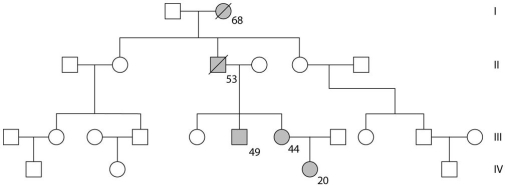 -What is the genotype of the deceased individual in generation II?
 (Multiple Choice)
4.9/5 (72)
(72) Mendel's observation of the segregation of alleles in gamete formation has its basis in which of the following phases of cell division?
(Multiple Choice)
4.9/5 (80)
(80) A man has extra digits (six fingers on each hand and six toes on each foot).His wife and their daughter have a normal number of digits.Having extra digits is a dominant trait.The couple's second child has extra digits.What is the probability that their next (third)child will have extra digits?
(Multiple Choice)
4.8/5 (87)
(87) Which of the following is the best statement of the use of the addition rule of probability?
(Multiple Choice)
5.0/5 (94)
(94) Most genes have many more than two alleles.However,which of the following is also true?
(Multiple Choice)
4.9/5 (74)
(74) In cattle,roan coat colour (mixed red and white hairs)occurs in the heterozygous (Rr)offspring of red (RR)and white (rr)homozygotes.Which of the following crosses would produce offspring in the ratio of 1 red:2 roan:1 white?
(Multiple Choice)
4.7/5 (90)
(90) What was the most significant conclusion that Gregor Mendel drew from his experiments with pea plants?
(Multiple Choice)
4.8/5 (83)
(83) Which of the following describes the ability of a single gene to have multiple phenotypic effects?
(Multiple Choice)
4.9/5 (94)
(94) Mendel's second law of independent assortment has its basis in which of the following events of meiosis I?
(Multiple Choice)
4.9/5 (74)
(74) Use the following information to answer the questions below.
Radish flowers may be red,purple,or white.A cross between a red-flowered plant and a white-flowered plant yields all-purple offspring.The part of the radish we eat may be oval or long,with long being the dominant characteristic.
-The flower colour trait in radishes is an example of which of the following?
(Multiple Choice)
4.8/5 (73)
(73) How many unique gametes could be produced through independent assortment by an individual with the genotype AaBbCCDdEE?
(Multiple Choice)
4.8/5 (80)
(80) The following questions refer to the pedigree chart in the figure below for a family,some of whose members exhibit the dominant trait,W.Affected individuals are indicated by a dark square or circle.
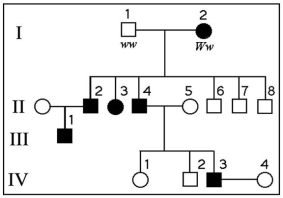 -What is the probability that individual III-1 is Ww?
 (Multiple Choice)
4.8/5 (79)
(79) The frequency of heterozygosity for the sickle-cell anemia allele is unusually high,presumably because this reduces the frequency of malaria.Such a relationship is related to which of the following?
(Multiple Choice)
4.8/5 (78)
(78) Assuming independent assortment for all gene pairs,what is the probability that the following parents,AABbCc × AaBbCc,will produce an AaBbCc offspring?
(Multiple Choice)
4.9/5 (77)
(77) Refer to the following information to answer the questions below.
Humanoids on the newly explored planet Brin (in a hypothetical galaxy in ~50 years from the present)have a gene structure similar to our own,but many very different plants and animals.
-One species of a small birdlike animal has an extremely variable tail length,which is a highly polymorphic trait.Geneticists have come to realize that there are eight separate genes for tail length per haploid genome,with each gene having two alleles.One allele for each gene (a,b,and so on)increases the length by 1 cm,whereas the other allele (a₂,b₂,and so on)increases it by 0.5 cm.One bird was analyzed and found to have the following genotype:
A₁a₁b₂b₂c₁c₂d₁d₂e₂e₂f₁f₂g₁g₁h₁h₂
What is the length of its tail?
(Multiple Choice)
4.9/5 (79)
(79) 
Filters
- Essay(0)
- Multiple Choice(0)
- Short Answer(0)
- True False(0)
- Matching(0)