



 Chat with AI
Exam 14: Mendel and the Gene Idea

Exam 1: Introduction: Evolution and Themes of Biology77 Questions
Exam 2: The Chemical Context of Life98 Questions
Exam 3: Water and Life92 Questions
Exam 4: Carbon and the Molecular Diversity of Life86 Questions
Exam 5: The Structure and Function of Large Biological Molecules131 Questions
Exam 6: A Tour of the Cell111 Questions
Exam 7: Membrane Structure and Function88 Questions
Exam 8: An Introduction to Metabolism92 Questions
Exam 9: Cellular Respiration and Fermentation128 Questions
Exam 10: Photosynthesis103 Questions
Exam 11: Cell Communication85 Questions
Exam 12: The Cell Cycle98 Questions
Exam 13: Meiosis and Sexual Life Cycles90 Questions
Exam 14: Mendel and the Gene Idea92 Questions
Exam 15: The Chromosomal Basis of Inheritance75 Questions
Exam 16: The Molecular Basis of Inheritance84 Questions
Exam 17: From Gene to Protein106 Questions
Exam 18: Regulation of Gene Expression116 Questions
Exam 19: Viruses71 Questions
Exam 20: DNA Tools and Biotechnology78 Questions
Exam 21: Genomes and Their Evolution64 Questions
Exam 22: Descent with Modification: A Darwinian View of Life68 Questions
Exam 23: The Evolution of Populations92 Questions
Exam 24: The Origin of Species76 Questions
Exam 25: The History of Life on Earth89 Questions
Exam 26: Phylogeny and the Tree of Life91 Questions
Exam 27: Bacteria and Archaea96 Questions
Exam 28: Protists82 Questions
Exam 29: Plant Diversity I: How Plants Colonized Land93 Questions
Exam 30: Plant Diversity II: The Evolution of Seed Plants119 Questions
Exam 31: Fungi105 Questions
Exam 32: An Overview of Animal Diversity93 Questions
Exam 33: An Introduction to Invertebrates111 Questions
Exam 34: The Origin and Evolution of Vertebrates126 Questions
Exam 35: Plant Structure,Growth,and Development82 Questions
Exam 36: Resource Acquisition and Transport in Vascular Plants100 Questions
Exam 37: Soil and Plant Nutrition99 Questions
Exam 38: Angiosperm Reproduction and Biotechnology107 Questions
Exam 39: Plant Responses to Internal and External Signals137 Questions
Exam 40: Basic Principles of Animal Form and Function98 Questions
Exam 41: Animal Nutrition87 Questions
Exam 42: Circulation and Gas Exchange112 Questions
Exam 43: The Immune System123 Questions
Exam 44: Osmoregulation and Excretion91 Questions
Exam 45: Hormones and the Endocrine System92 Questions
Exam 46: Animal Reproduction104 Questions
Exam 47: Animal Development106 Questions
Exam 48: Neurons,Synapses,and Signalling93 Questions
Exam 49: Nervous Systems85 Questions
Exam 50: Sensory and Motor Mechanisms106 Questions
Exam 51: Animal Behaviour91 Questions
Exam 52: An Introduction to Ecology and the Biosphere90 Questions
Exam 53: Population Ecology89 Questions
Exam 54: Community Ecology97 Questions
Exam 55: Ecosystems and Restoration Ecology98 Questions
Exam 56: Conservation Biology and Global Change90 Questions
Select questions type


The individual with genotype AaBbCCDdEE can make many kinds of gametes.Which of the following is the major reason?
(Multiple Choice)
4.8/5  (71)
(71) Mendel was able to draw his ideas of segregation and independent assortment because of the influence of which of the following?
(Multiple Choice)
5.0/5 (78)
(78) Use the following information to answer the questions below.
A certain (hypothetical)organism is diploid,has either blue or orange wings as the consequence of one of its genes on chromosome 12,and has either long or short antennae as the result of a second gene on chromosome 19,as shown in this figure.
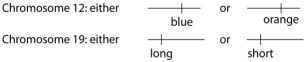 -A female with a paternal set of one orange and one long gene chromosome and a maternal set comprised of one blue and one short gene chromosome is expected to produce which of the following types of eggs after meiosis?
 (Multiple Choice)
4.8/5 (76)
(76) In rabbits,the homozygous CC is normal,Cc results in deformed legs,and cc results in very short legs.The genotype BB produces black fur,Bb brown fur,and bb white fur.If a cross is made between brown rabbits with deformed legs and white rabbits with deformed legs,what percentage of the offspring would be expected to have deformed legs and white fur?
(Multiple Choice)
4.8/5 (73)
(73) An individual that has two different alleles for the same trait is said to be
(Multiple Choice)
4.8/5 (101)
(101) In certain plants,tall is dominant to short.If a heterozygous plant is crossed with a homozygous tall plant,what is the probability that the offspring will be short?
(Multiple Choice)
4.8/5 (70)
(70) Use the following information to answer the questions below.
Labrador retrievers are black,brown,or yellow.In a cross of a black female with a brown male,results can be either all black puppies,1/2 black to 1/2 brown puppies,or 3/4 black to 1/4 yellow puppies.
-How many genes must be responsible for these coat colours in Labrador retrievers?
(Multiple Choice)
4.8/5 (85)
(85) A sexually reproducing animal has two unlinked genes,one for head shape (H)and one for tail length (T).Its genotype is HhTt.Which of the following genotypes is possible in a gamete from this organism?
(Multiple Choice)
4.8/5 (90)
(90) Use the following description and figure to answer the questions below.
In a particular plant,leaf colour is controlled by gene locus D.Plants with at least one allele D have dark green leaves,and plants with the homozygous recessive dd genotype have light green leaves.A true-breeding dark-leaved plant is crossed with a light-leaved one,and the F₁ offspring is allowed to self-pollinate.The predicted outcome of the F₂ is diagrammed in the Punnett square shown below,where 1,2,3,and 4 represent the genotypes corresponding to each box within the square.
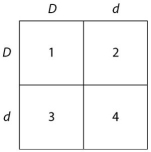 -Which of the plants will be true-breeding?
 (Multiple Choice)
4.8/5 (82)
(82) Given the parents AABBCc × AabbCc,assume simple dominance for each trait and independent assortment.What proportion of the progeny will be expected to phenotypically resemble the first parent?
(Multiple Choice)
4.9/5 (89)
(89) Use the following description and figure to answer the questions below.
In a particular plant,leaf colour is controlled by gene locus D.Plants with at least one allele D have dark green leaves,and plants with the homozygous recessive dd genotype have light green leaves.A true-breeding dark-leaved plant is crossed with a light-leaved one,and the F₁ offspring is allowed to self-pollinate.The predicted outcome of the F₂ is diagrammed in the Punnett square shown below,where 1,2,3,and 4 represent the genotypes corresponding to each box within the square.
-Which of the boxes correspond to plants with a heterozygous genotype?
-Which of the boxes correspond to plants with a heterozygous genotype? (Multiple Choice)
4.7/5 (81)
(81) ________ is when a gene on one locus has an influence on the phenotypic expression of an allele at another locus.
(Multiple Choice)
4.9/5 (70)
(70) 
Filters
- Essay(0)
- Multiple Choice(0)
- Short Answer(0)
- True False(0)
- Matching(0)