



 Chat with AI
Exam 54: Community Ecology

Exam 1: Introduction: Evolution and Themes of Biology77 Questions
Exam 2: The Chemical Context of Life98 Questions
Exam 3: Water and Life92 Questions
Exam 4: Carbon and the Molecular Diversity of Life86 Questions
Exam 5: The Structure and Function of Large Biological Molecules131 Questions
Exam 6: A Tour of the Cell111 Questions
Exam 7: Membrane Structure and Function88 Questions
Exam 8: An Introduction to Metabolism92 Questions
Exam 9: Cellular Respiration and Fermentation128 Questions
Exam 10: Photosynthesis103 Questions
Exam 11: Cell Communication85 Questions
Exam 12: The Cell Cycle98 Questions
Exam 13: Meiosis and Sexual Life Cycles90 Questions
Exam 14: Mendel and the Gene Idea92 Questions
Exam 15: The Chromosomal Basis of Inheritance75 Questions
Exam 16: The Molecular Basis of Inheritance84 Questions
Exam 17: From Gene to Protein106 Questions
Exam 18: Regulation of Gene Expression116 Questions
Exam 19: Viruses71 Questions
Exam 20: DNA Tools and Biotechnology78 Questions
Exam 21: Genomes and Their Evolution64 Questions
Exam 22: Descent with Modification: A Darwinian View of Life68 Questions
Exam 23: The Evolution of Populations92 Questions
Exam 24: The Origin of Species76 Questions
Exam 25: The History of Life on Earth89 Questions
Exam 26: Phylogeny and the Tree of Life91 Questions
Exam 27: Bacteria and Archaea96 Questions
Exam 28: Protists82 Questions
Exam 29: Plant Diversity I: How Plants Colonized Land93 Questions
Exam 30: Plant Diversity II: The Evolution of Seed Plants119 Questions
Exam 31: Fungi105 Questions
Exam 32: An Overview of Animal Diversity93 Questions
Exam 33: An Introduction to Invertebrates111 Questions
Exam 34: The Origin and Evolution of Vertebrates126 Questions
Exam 35: Plant Structure,Growth,and Development82 Questions
Exam 36: Resource Acquisition and Transport in Vascular Plants100 Questions
Exam 37: Soil and Plant Nutrition99 Questions
Exam 38: Angiosperm Reproduction and Biotechnology107 Questions
Exam 39: Plant Responses to Internal and External Signals137 Questions
Exam 40: Basic Principles of Animal Form and Function98 Questions
Exam 41: Animal Nutrition87 Questions
Exam 42: Circulation and Gas Exchange112 Questions
Exam 43: The Immune System123 Questions
Exam 44: Osmoregulation and Excretion91 Questions
Exam 45: Hormones and the Endocrine System92 Questions
Exam 46: Animal Reproduction104 Questions
Exam 47: Animal Development106 Questions
Exam 48: Neurons,Synapses,and Signalling93 Questions
Exam 49: Nervous Systems85 Questions
Exam 50: Sensory and Motor Mechanisms106 Questions
Exam 51: Animal Behaviour91 Questions
Exam 52: An Introduction to Ecology and the Biosphere90 Questions
Exam 53: Population Ecology89 Questions
Exam 54: Community Ecology97 Questions
Exam 55: Ecosystems and Restoration Ecology98 Questions
Exam 56: Conservation Biology and Global Change90 Questions
Select questions type


Which statement best describes the evolutionary significance of mutualism?
(Multiple Choice)
4.9/5  (78)
(78) How might an ecologist test whether a species is occupying its realized or its fundamental niche?
(Multiple Choice)
4.9/5 (86)
(86) Why is a pathogen generally more virulent in a new habitat?
(Multiple Choice)
4.8/5 (90)
(90) There are more species in tropical areas than in places more distant from the equator.This is probably a result of
(Multiple Choice)
5.0/5 (81)
(81) Which of the following terms is used by ecologists to describe the community interaction where one organism makes the environment more suitable for another organism?
(Multiple Choice)
4.8/5 (73)
(73) Many zootonic pathogens are highly virulent,can result in high death rates,and can cause world-wide pandemics.One example,the H5N1 avian flu,not only killed millions of domestic poultry,but also caused the deaths of people who came in contact with sick birds.What is the most probable hypothesis or reason as to why the H5N1 flu can be so deadly to people?
(Multiple Choice)
4.8/5 (85)
(85) The most plausible hypothesis to explain why species richness is higher in tropical than in temperate regions is that
(Multiple Choice)
4.9/5 (86)
(86) Which term do ecologists use to describe the ability of a community either to resist change or to recover to its original state after change?
(Multiple Choice)
4.8/5 (72)
(72) The energetic hypothesis and dynamic stability hypothesis are ideas that attempt to explain
(Multiple Choice)
4.9/5 (95)
(95) In a tide pool,15 species of invertebrates were reduced to eight after one species was removed.The species removed was likely a(n)
(Multiple Choice)
4.9/5 (93)
(93) The symbols +,-,and o are to be used to show the results of interactions between individuals and groups of individuals in the examples that follow.The symbol + denotes a positive interaction,- denotes a negative interaction,and o denotes where individuals are not affected by interacting.The first symbol refers to the first organism mentioned.
-What interactions exist between a "carrier crab" and "sea urchin hitch-hiker"?
(Multiple Choice)
4.7/5 (84)
(84) The Ebola virus is a very virulent zootonic pathogen that causes high mortality rates among people.In humans,this virus causes Ebola hemorrhagic fever (severe internal bleeding)and,in some years,mortality can reach 100%.The virus is likely transmitted from wild animals to people and spreads via human to human transmission.There is no vaccine or cure for people.If the virus is so deadly and kills its human hosts,speculate on a possible reason why the virus continues to survive and has not died off with the human hosts it kills in such large numbers.
(Multiple Choice)
4.9/5 (70)
(70) Use the following diagram of five islands formed at around the same time near a particular mainland,as well as MacArthur and Wilson's island biogeography principles,to answer the following questions.
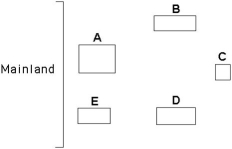 -Which island would likely have the greatest species diversity?
 (Multiple Choice)
4.9/5 (78)
(78) The symbols +,-,and o are to be used to show the results of interactions between individuals and groups of individuals in the examples that follow.The symbol + denotes a positive interaction,- denotes a negative interaction,and o denotes where individuals are not affected by interacting.The first symbol refers to the first organism mentioned.
-What interactions exist between mycorrhizae and evergreen tree roots?
(Multiple Choice)
4.9/5 (71)
(71) Which of the following studies would shed light on the mechanism of spread of H5N1 from Asia?
(Multiple Choice)
4.9/5 (88)
(88) Use the following diagram of a hypothetical food web to answer the following questions.The arrows represent the transfer of food energy between the various trophic levels.
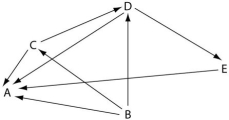 -Which letter represents an organism that could be a primary consumer?
 (Multiple Choice)
4.9/5 (84)
(84) In the hypothesis that C.stellatus (a species of barnacle)is competitively excluded from the lower intertidal zone by B.balanoides (another species of barnacle),what could be concluded about the two species?
(Multiple Choice)
4.7/5 (67)
(67) An event that changes resource availability and removes individuals from a community is a
(Multiple Choice)
4.9/5 (82)
(82) Which of the following studies would a community ecologist undertake to learn about competitive interactions?
I. selectivity of nest sites among cavity-nesting songbirds
II. the grass species preferred by grazing pronghorn antelope and bison
III.stomach analysis of brown trout and brook trout in streams where they coexist
(Multiple Choice)
4.8/5 (70)
(70) 
Filters
- Essay(0)
- Multiple Choice(0)
- Short Answer(0)
- True False(0)
- Matching(0)