



 Chat with AI
Exam 54: Community Ecology

Exam 1: Introduction: Evolution and Themes of Biology77 Questions
Exam 2: The Chemical Context of Life98 Questions
Exam 3: Water and Life92 Questions
Exam 4: Carbon and the Molecular Diversity of Life86 Questions
Exam 5: The Structure and Function of Large Biological Molecules131 Questions
Exam 6: A Tour of the Cell111 Questions
Exam 7: Membrane Structure and Function88 Questions
Exam 8: An Introduction to Metabolism92 Questions
Exam 9: Cellular Respiration and Fermentation128 Questions
Exam 10: Photosynthesis103 Questions
Exam 11: Cell Communication85 Questions
Exam 12: The Cell Cycle98 Questions
Exam 13: Meiosis and Sexual Life Cycles90 Questions
Exam 14: Mendel and the Gene Idea92 Questions
Exam 15: The Chromosomal Basis of Inheritance75 Questions
Exam 16: The Molecular Basis of Inheritance84 Questions
Exam 17: From Gene to Protein106 Questions
Exam 18: Regulation of Gene Expression116 Questions
Exam 19: Viruses71 Questions
Exam 20: DNA Tools and Biotechnology78 Questions
Exam 21: Genomes and Their Evolution64 Questions
Exam 22: Descent with Modification: A Darwinian View of Life68 Questions
Exam 23: The Evolution of Populations92 Questions
Exam 24: The Origin of Species76 Questions
Exam 25: The History of Life on Earth89 Questions
Exam 26: Phylogeny and the Tree of Life91 Questions
Exam 27: Bacteria and Archaea96 Questions
Exam 28: Protists82 Questions
Exam 29: Plant Diversity I: How Plants Colonized Land93 Questions
Exam 30: Plant Diversity II: The Evolution of Seed Plants119 Questions
Exam 31: Fungi105 Questions
Exam 32: An Overview of Animal Diversity93 Questions
Exam 33: An Introduction to Invertebrates111 Questions
Exam 34: The Origin and Evolution of Vertebrates126 Questions
Exam 35: Plant Structure,Growth,and Development82 Questions
Exam 36: Resource Acquisition and Transport in Vascular Plants100 Questions
Exam 37: Soil and Plant Nutrition99 Questions
Exam 38: Angiosperm Reproduction and Biotechnology107 Questions
Exam 39: Plant Responses to Internal and External Signals137 Questions
Exam 40: Basic Principles of Animal Form and Function98 Questions
Exam 41: Animal Nutrition87 Questions
Exam 42: Circulation and Gas Exchange112 Questions
Exam 43: The Immune System123 Questions
Exam 44: Osmoregulation and Excretion91 Questions
Exam 45: Hormones and the Endocrine System92 Questions
Exam 46: Animal Reproduction104 Questions
Exam 47: Animal Development106 Questions
Exam 48: Neurons,Synapses,and Signalling93 Questions
Exam 49: Nervous Systems85 Questions
Exam 50: Sensory and Motor Mechanisms106 Questions
Exam 51: Animal Behaviour91 Questions
Exam 52: An Introduction to Ecology and the Biosphere90 Questions
Exam 53: Population Ecology89 Questions
Exam 54: Community Ecology97 Questions
Exam 55: Ecosystems and Restoration Ecology98 Questions
Exam 56: Conservation Biology and Global Change90 Questions
Select questions type


According to bottom-up and top-down control models of community organization,which of the following expressions would imply that an increase in the size of a carnivore (C)population would negatively impact on its prey (P)population,but not vice versa?
(Multiple Choice)
4.8/5  (77)
(77) Of the following zoonotic diseases,which is most likely to be studied by a community ecologist?
(Multiple Choice)
4.9/5 (77)
(77) According to the equilibrium model of island biogeography,species richness would be greatest on an island that is
(Multiple Choice)
4.7/5 (82)
(82) Prairie dogs once covered the expanses of the Great Plains.Their grazing made the grass more nutritious for the huge herds of bison,and they were preyed upon by a variety of snakes,raptors,and mammals.In fact,the black-footed ferret (now endangered)specialized in prairie dog predation.Today,increases in housing and agricultural developments have eradicated many prairie dog towns.Which of the following statements about prairie dogs is true?
(Multiple Choice)
4.9/5 (86)
(86) In a two-week marketing analysis,McDonald's was interested in finding out the popularity of the Big Mac.Using the realized/fundamental niche concept of community ecology,what should the marketing researchers do?
(Multiple Choice)
4.8/5 (81)
(81) Which of the following is the most accepted hypothesis as to why invasive species take over communities into which they have been introduced?
(Multiple Choice)
4.9/5 (77)
(77) Imagine five forest communities,each with 100 individuals distributed among four different tree species (W,X,Y,and Z).Which forest community would be most diverse?
(Multiple Choice)
4.9/5 (81)
(81) The next series of questions presumes that you have at least once visited and have some knowledge of the fast-food restaurant McDonald's.Use your knowledge of McDonald's and your understanding of community ecology to answer the following questions about an ecological community,McDonaldland.
-Which two "species" are likely to compete for the same ecological niche?
(Multiple Choice)
4.9/5 (82)
(82) Resource partitioning would be most likely to occur between
(Multiple Choice)
4.9/5 (65)
(65) Use the following diagram of five islands formed at around the same time near a particular mainland,as well as MacArthur and Wilson's island biogeography principles,to answer the following questions.
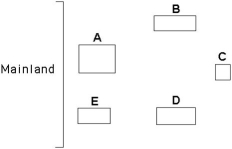 -Which island would likely exhibit the most impoverished species diversity?
 (Multiple Choice)
4.9/5 (72)
(72) Keystone predators can maintain species diversity in a community if they
(Multiple Choice)
4.8/5 (78)
(78) The oak tree pathogen,Phytophthora ramorum,has migrated 650 km in 10 years.West Nile virus spread from New York State to 46 other states in 5 years.The difference in the rate of spread is probably related to
(Multiple Choice)
4.8/5 (68)
(68) During the course of the formation of a parasite/host relationship,a critical first step in this evolution would be
(Multiple Choice)
4.9/5 (76)
(76) The plague bacterium Yersinia pestis,is well-known for the high death toll it caused in Europe during the Middle Ages.Upon introduction to North America,this disease
(Multiple Choice)
4.8/5 (82)
(82) What is the main advantage of controlled burnings of forested areas? Controlled burnings ________.
(Multiple Choice)
4.9/5 (75)
(75) Evidence shows that some grasses benefit from being grazed.Which of the following terms would best describe this plant-herbivore interaction?
(Multiple Choice)
4.8/5 (82)
(82) What interactions exist between acacia trees in South America and stinging ants?
(Multiple Choice)
5.0/5 (82)
(82) Based on the intermediate disturbance hypothesis,a community's species diversity is increased by
(Multiple Choice)
4.7/5 (71)
(71) 
Filters
- Essay(0)
- Multiple Choice(0)
- Short Answer(0)
- True False(0)
- Matching(0)