



 Chat with AI
Exam 54: Community Ecology

Exam 1: Introduction: Evolution and Themes of Biology77 Questions
Exam 2: The Chemical Context of Life98 Questions
Exam 3: Water and Life92 Questions
Exam 4: Carbon and the Molecular Diversity of Life86 Questions
Exam 5: The Structure and Function of Large Biological Molecules131 Questions
Exam 6: A Tour of the Cell111 Questions
Exam 7: Membrane Structure and Function88 Questions
Exam 8: An Introduction to Metabolism92 Questions
Exam 9: Cellular Respiration and Fermentation128 Questions
Exam 10: Photosynthesis103 Questions
Exam 11: Cell Communication85 Questions
Exam 12: The Cell Cycle98 Questions
Exam 13: Meiosis and Sexual Life Cycles90 Questions
Exam 14: Mendel and the Gene Idea92 Questions
Exam 15: The Chromosomal Basis of Inheritance75 Questions
Exam 16: The Molecular Basis of Inheritance84 Questions
Exam 17: From Gene to Protein106 Questions
Exam 18: Regulation of Gene Expression116 Questions
Exam 19: Viruses71 Questions
Exam 20: DNA Tools and Biotechnology78 Questions
Exam 21: Genomes and Their Evolution64 Questions
Exam 22: Descent with Modification: A Darwinian View of Life68 Questions
Exam 23: The Evolution of Populations92 Questions
Exam 24: The Origin of Species76 Questions
Exam 25: The History of Life on Earth89 Questions
Exam 26: Phylogeny and the Tree of Life91 Questions
Exam 27: Bacteria and Archaea96 Questions
Exam 28: Protists82 Questions
Exam 29: Plant Diversity I: How Plants Colonized Land93 Questions
Exam 30: Plant Diversity II: The Evolution of Seed Plants119 Questions
Exam 31: Fungi105 Questions
Exam 32: An Overview of Animal Diversity93 Questions
Exam 33: An Introduction to Invertebrates111 Questions
Exam 34: The Origin and Evolution of Vertebrates126 Questions
Exam 35: Plant Structure,Growth,and Development82 Questions
Exam 36: Resource Acquisition and Transport in Vascular Plants100 Questions
Exam 37: Soil and Plant Nutrition99 Questions
Exam 38: Angiosperm Reproduction and Biotechnology107 Questions
Exam 39: Plant Responses to Internal and External Signals137 Questions
Exam 40: Basic Principles of Animal Form and Function98 Questions
Exam 41: Animal Nutrition87 Questions
Exam 42: Circulation and Gas Exchange112 Questions
Exam 43: The Immune System123 Questions
Exam 44: Osmoregulation and Excretion91 Questions
Exam 45: Hormones and the Endocrine System92 Questions
Exam 46: Animal Reproduction104 Questions
Exam 47: Animal Development106 Questions
Exam 48: Neurons,Synapses,and Signalling93 Questions
Exam 49: Nervous Systems85 Questions
Exam 50: Sensory and Motor Mechanisms106 Questions
Exam 51: Animal Behaviour91 Questions
Exam 52: An Introduction to Ecology and the Biosphere90 Questions
Exam 53: Population Ecology89 Questions
Exam 54: Community Ecology97 Questions
Exam 55: Ecosystems and Restoration Ecology98 Questions
Exam 56: Conservation Biology and Global Change90 Questions
Select questions type


The feeding relationships among the species in a community determine the community's
(Multiple Choice)
4.9/5  (81)
(81) Use the following diagram of five islands formed at around the same time near a particular mainland,as well as MacArthur and Wilson's island biogeography principles,to answer the following questions.
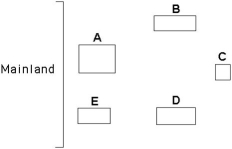 -Which island would likely have the lowest extinction rate?
 (Multiple Choice)
4.8/5 (75)
(75) Use the following diagram of a hypothetical food web to answer the following questions.The arrows represent the transfer of food energy between the various trophic levels.
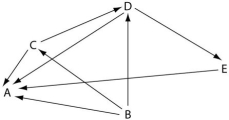 -Which letter represents an organism that could be a producer?
 (Multiple Choice)
4.9/5 (79)
(79) Which of the following statements does not describe a zoonotic pathogen?
(Multiple Choice)
4.9/5 (79)
(79) According to the equilibrium model of island biogeography,species richness would be greatest on an island that is
(Multiple Choice)
4.7/5 (79)
(79) Which of the following studies would a community ecologist undertake to learn about competitive interactions?
(Multiple Choice)
4.8/5 (88)
(88) The next series of questions presumes that you have at least once visited and have some knowledge of the fast-food restaurant McDonald's.Use your knowledge of McDonald's and your understanding of community ecology to answer the following questions about an ecological community,McDonaldland.
-In McDonaldland,which of the following would be an example of an introduced species?
(Multiple Choice)
4.9/5 (76)
(76) Which of the following statements is a valid conclusion of this experiment?
(Multiple Choice)
4.8/5 (79)
(79) Monarch butterflies are protected from birds and other predators because of cardiac glycosides they incorporate into their tissues from eating milkweed when they were in their caterpillar stage.The wings of a different species of butterfly,the Viceroy,look nearly identical to the Monarch so predators that have learned not to eat the bad-tasting Monarch avoid Viceroys as well.This example best describes
(Multiple Choice)
5.0/5 (79)
(79) The next series of questions presumes that you have at least once visited and have some knowledge of the fast-food restaurant McDonald's.Use your knowledge of McDonald's and your understanding of community ecology to answer the following questions about an ecological community,McDonaldland.
-Which of the following would be considered a keystone species in McDonaldland?
(Multiple Choice)
4.9/5 (90)
(90) According to the McDonaldland scenario,which of the following would best define an ecological community?
(Multiple Choice)
4.9/5 (81)
(81) White-breasted nuthatches and Downy woodpeckers both eat insects that hide in the furrows of bark in hardwood trees.The Downy woodpecker searches for insects by hunting from the bottom of the tree trunk to the top,whereas the white-breasted nuthatch searches from the top of the trunk down.These hunting behaviours best illustrate which of the following ecological concepts?
(Multiple Choice)
4.8/5 (78)
(78) Use the following diagram of a hypothetical food web to answer the following questions.The arrows represent the transfer of food energy between the various trophic levels.
-Which letter represents an organism that could be a carnivore?
-Which letter represents an organism that could be a carnivore? (Multiple Choice)
4.9/5 (82)
(82) As you are watching dairy cattle grazing in a field you notice a flock of starlings following them and eating insects that were disturbed by the cattle's hooves.Name the kind of species interaction you have observed and the benefit,if any.
(Multiple Choice)
4.7/5 (80)
(80) Which of the following could qualify as a top-down control on a grassland community?
(Multiple Choice)
5.0/5 (76)
(76) 
Filters
- Essay(0)
- Multiple Choice(0)
- Short Answer(0)
- True False(0)
- Matching(0)