



 Chat with AI
Exam 43: The Immune System

Exam 1: Introduction: Evolution and Themes of Biology77 Questions
Exam 2: The Chemical Context of Life98 Questions
Exam 3: Water and Life92 Questions
Exam 4: Carbon and the Molecular Diversity of Life86 Questions
Exam 5: The Structure and Function of Large Biological Molecules131 Questions
Exam 6: A Tour of the Cell111 Questions
Exam 7: Membrane Structure and Function88 Questions
Exam 8: An Introduction to Metabolism92 Questions
Exam 9: Cellular Respiration and Fermentation128 Questions
Exam 10: Photosynthesis103 Questions
Exam 11: Cell Communication85 Questions
Exam 12: The Cell Cycle98 Questions
Exam 13: Meiosis and Sexual Life Cycles90 Questions
Exam 14: Mendel and the Gene Idea92 Questions
Exam 15: The Chromosomal Basis of Inheritance75 Questions
Exam 16: The Molecular Basis of Inheritance84 Questions
Exam 17: From Gene to Protein106 Questions
Exam 18: Regulation of Gene Expression116 Questions
Exam 19: Viruses71 Questions
Exam 20: DNA Tools and Biotechnology78 Questions
Exam 21: Genomes and Their Evolution64 Questions
Exam 22: Descent with Modification: A Darwinian View of Life68 Questions
Exam 23: The Evolution of Populations92 Questions
Exam 24: The Origin of Species76 Questions
Exam 25: The History of Life on Earth89 Questions
Exam 26: Phylogeny and the Tree of Life91 Questions
Exam 27: Bacteria and Archaea96 Questions
Exam 28: Protists82 Questions
Exam 29: Plant Diversity I: How Plants Colonized Land93 Questions
Exam 30: Plant Diversity II: The Evolution of Seed Plants119 Questions
Exam 31: Fungi105 Questions
Exam 32: An Overview of Animal Diversity93 Questions
Exam 33: An Introduction to Invertebrates111 Questions
Exam 34: The Origin and Evolution of Vertebrates126 Questions
Exam 35: Plant Structure,Growth,and Development82 Questions
Exam 36: Resource Acquisition and Transport in Vascular Plants100 Questions
Exam 37: Soil and Plant Nutrition99 Questions
Exam 38: Angiosperm Reproduction and Biotechnology107 Questions
Exam 39: Plant Responses to Internal and External Signals137 Questions
Exam 40: Basic Principles of Animal Form and Function98 Questions
Exam 41: Animal Nutrition87 Questions
Exam 42: Circulation and Gas Exchange112 Questions
Exam 43: The Immune System123 Questions
Exam 44: Osmoregulation and Excretion91 Questions
Exam 45: Hormones and the Endocrine System92 Questions
Exam 46: Animal Reproduction104 Questions
Exam 47: Animal Development106 Questions
Exam 48: Neurons,Synapses,and Signalling93 Questions
Exam 49: Nervous Systems85 Questions
Exam 50: Sensory and Motor Mechanisms106 Questions
Exam 51: Animal Behaviour91 Questions
Exam 52: An Introduction to Ecology and the Biosphere90 Questions
Exam 53: Population Ecology89 Questions
Exam 54: Community Ecology97 Questions
Exam 55: Ecosystems and Restoration Ecology98 Questions
Exam 56: Conservation Biology and Global Change90 Questions
Select questions type


An invertebrate,such as an insect,has innate immunity activity in its intestine that likely includes
(Multiple Choice)
4.8/5  (90)
(90) Use the following information as background for the next few questions.
Immunodeficiencies can be genetic in origin,and two examples are Bruton's agammaglobulinemia,an X-linked disorder,and DiGeorge syndrome,caused by a deletion from chromosome 22.Bruton's disorder results in underdeveloped B cells,whereas DiGeorge syndrome results in a missing or seriously underdeveloped thymus.
-Bruton's disorder will likely include
(Multiple Choice)
4.9/5 (95)
(95) Which of the following pairs of proteins share the most overall similarity in structure?
(Multiple Choice)
4.9/5 (82)
(82) A patient who has a parasitic worm infection and another patient responding to an allergen such as ragweed pollen have which of the following in common?
(Multiple Choice)
4.8/5 (74)
(74) Use the following graph to answer the questions below.
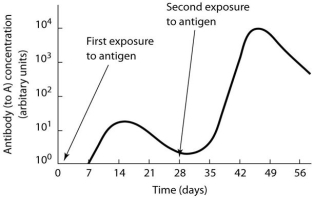 -According to the graph,naive memory cells will be produced
 (Multiple Choice)
4.9/5 (78)
(78) A systemic inflammatory response that is often life-threatening is
(Multiple Choice)
4.8/5 (77)
(77) A patient complaining of watery,itchy eyes and sneezing after being given a flower bouquet as a birthday gift should first be treated with
(Multiple Choice)
5.0/5 (80)
(80) Which of the following is the best definition of autoimmune disease?
(Multiple Choice)
5.0/5 (94)
(94) A bone marrow transplant may not be appropriate from a given donor (Jane)to a given recipient (Jane's cousin Bob),even though Jane has previously given blood for one of Bob's needed transfusions,because
(Multiple Choice)
4.9/5 (66)
(66) An immune response to a tissue graft will differ from an immune response to a bacterium because
(Multiple Choice)
4.9/5 (95)
(95) An individual who has been bitten by a poisonous snake that has a fast-acting toxin would likely benefit from
(Multiple Choice)
4.7/5 (59)
(59) The transfusion of type A blood to a person who has type O blood would result in
(Multiple Choice)
4.8/5 (67)
(67) Which of the following cells are involved in cell-mediated immunity and also respond to class I MHC molecule-antigen complexes?
(Multiple Choice)
4.9/5 (74)
(74) 
Filters
- Essay(0)
- Multiple Choice(0)
- Short Answer(0)
- True False(0)
- Matching(0)