



 Chat with AI
Exam 43: The Immune System

Exam 1: Introduction: Evolution and Themes of Biology77 Questions
Exam 2: The Chemical Context of Life98 Questions
Exam 3: Water and Life92 Questions
Exam 4: Carbon and the Molecular Diversity of Life86 Questions
Exam 5: The Structure and Function of Large Biological Molecules131 Questions
Exam 6: A Tour of the Cell111 Questions
Exam 7: Membrane Structure and Function88 Questions
Exam 8: An Introduction to Metabolism92 Questions
Exam 9: Cellular Respiration and Fermentation128 Questions
Exam 10: Photosynthesis103 Questions
Exam 11: Cell Communication85 Questions
Exam 12: The Cell Cycle98 Questions
Exam 13: Meiosis and Sexual Life Cycles90 Questions
Exam 14: Mendel and the Gene Idea92 Questions
Exam 15: The Chromosomal Basis of Inheritance75 Questions
Exam 16: The Molecular Basis of Inheritance84 Questions
Exam 17: From Gene to Protein106 Questions
Exam 18: Regulation of Gene Expression116 Questions
Exam 19: Viruses71 Questions
Exam 20: DNA Tools and Biotechnology78 Questions
Exam 21: Genomes and Their Evolution64 Questions
Exam 22: Descent with Modification: A Darwinian View of Life68 Questions
Exam 23: The Evolution of Populations92 Questions
Exam 24: The Origin of Species76 Questions
Exam 25: The History of Life on Earth89 Questions
Exam 26: Phylogeny and the Tree of Life91 Questions
Exam 27: Bacteria and Archaea96 Questions
Exam 28: Protists82 Questions
Exam 29: Plant Diversity I: How Plants Colonized Land93 Questions
Exam 30: Plant Diversity II: The Evolution of Seed Plants119 Questions
Exam 31: Fungi105 Questions
Exam 32: An Overview of Animal Diversity93 Questions
Exam 33: An Introduction to Invertebrates111 Questions
Exam 34: The Origin and Evolution of Vertebrates126 Questions
Exam 35: Plant Structure,Growth,and Development82 Questions
Exam 36: Resource Acquisition and Transport in Vascular Plants100 Questions
Exam 37: Soil and Plant Nutrition99 Questions
Exam 38: Angiosperm Reproduction and Biotechnology107 Questions
Exam 39: Plant Responses to Internal and External Signals137 Questions
Exam 40: Basic Principles of Animal Form and Function98 Questions
Exam 41: Animal Nutrition87 Questions
Exam 42: Circulation and Gas Exchange112 Questions
Exam 43: The Immune System123 Questions
Exam 44: Osmoregulation and Excretion91 Questions
Exam 45: Hormones and the Endocrine System92 Questions
Exam 46: Animal Reproduction104 Questions
Exam 47: Animal Development106 Questions
Exam 48: Neurons,Synapses,and Signalling93 Questions
Exam 49: Nervous Systems85 Questions
Exam 50: Sensory and Motor Mechanisms106 Questions
Exam 51: Animal Behaviour91 Questions
Exam 52: An Introduction to Ecology and the Biosphere90 Questions
Exam 53: Population Ecology89 Questions
Exam 54: Community Ecology97 Questions
Exam 55: Ecosystems and Restoration Ecology98 Questions
Exam 56: Conservation Biology and Global Change90 Questions
Select questions type


Mutant fruit flies that make only one antimicrobial peptide were tested for survival after infection with Neurospora crassa fungi or with Micrococcus luteus bacteria.
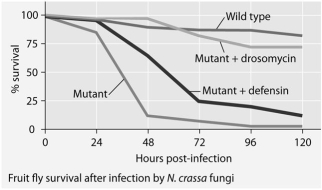
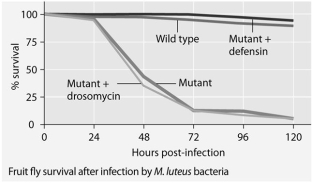 -According to the graph,naive B cells will produce effector cells
 (Multiple Choice)
4.8/5  (87)
(87) Which statement best describes the difference in responses of effector B cells (plasma cells)and cytotoxic T cells?
(Multiple Choice)
4.8/5 (75)
(75) Use the following information as background for the next few questions.
Immunodeficiencies can be genetic in origin,and two examples are Bruton's agammaglobulinemia,an X-linked disorder,and DiGeorge syndrome,caused by a deletion from chromosome 22.Bruton's disorder results in underdeveloped B cells,whereas DiGeorge syndrome results in a missing or seriously underdeveloped thymus.
-Select the description that likely indicates a child with Bruton's disease.
(Multiple Choice)
4.9/5 (67)
(67) Which of the following would not help a virus avoid triggering an adaptive immune response?
(Multiple Choice)
5.0/5 (74)
(74) Which of the following statements about epitopes are correct?
I.B-cell receptors bind to epitopes.
II.T-cell receptors bind to epitopes.
III.There can be several different epitopes on each antigen.
IV.There is a one-to-one correspondence between antigen and epitope.
(Multiple Choice)
4.8/5 (74)
(74) The cell-mediated immunity that destroys virally infected cells involves
(Multiple Choice)
4.9/5 (96)
(96) Several strains of the human papillomavirus (HPV)can cause cervical cancer in some women.In 2006,a vaccine against several of the cancer-causing HPV strains was released.If a mutation occurs in the virus resulting in antigenic variation,the vaccine may no longer be effective because
(Multiple Choice)
4.7/5 (88)
(88) Engulfing-phagocytic cells of innate immunity include all of the following except
(Multiple Choice)
4.9/5 (83)
(83) Within a differentiated B cell,the rearrangement of DNA sequences between variable regions and joining regions is accomplished by
(Multiple Choice)
4.9/5 (88)
(88) Following radiation,a person's bone marrow is been destroyed.Which of the following cells are no longer produced?
I.B cells
II.T cells
III.erythrocytes
IV.lysosome
(Multiple Choice)
4.9/5 (76)
(76) Use the following information as background for the next few questions.
Immunodeficiencies can be genetic in origin,and two examples are Bruton's agammaglobulinemia,an X-linked disorder,and DiGeorge syndrome,caused by a deletion from chromosome 22.Bruton's disorder results in underdeveloped B cells,whereas DiGeorge syndrome results in a missing or seriously underdeveloped thymus.
-Assume that a DiGeorge syndrome-like phenotype was produced in a specific "gene-knockout" mouse,one lacking expression of HA3,a Hox gene known to be involved in developmental regulation in the mouse.
The phenotype of the HA3 knockout can be ascertained by
(Multiple Choice)
4.9/5 (76)
(76) A newborn who is accidentally given a drug that destroys the thymus would most likely
(Multiple Choice)
4.8/5 (72)
(72) The cells and signalling molecules that initiate inflammatory responses are
(Multiple Choice)
4.9/5 (78)
(78) Use the following table to answer the questions below.Rh is a protein found on the surface of some people's red blood cells.
 -Study the table.The mother could exhibit an anti-Rh-factor reaction to the developing fetus in
 (Multiple Choice)
4.9/5 (84)
(84) A nonfunctional CD4 protein on a helper T cell would result in the helper T cell being unable to
(Multiple Choice)
4.8/5 (71)
(71) Secondary immune responses upon a second exposure to a pathogen are due to the activation of
(Multiple Choice)
4.9/5 (81)
(81) 
Filters
- Essay(0)
- Multiple Choice(0)
- Short Answer(0)
- True False(0)
- Matching(0)