



 Chat with AI
Exam 9: Cellular Respiration and Fermentation

Exam 1: Introduction: Evolution and Themes of Biology77 Questions
Exam 2: The Chemical Context of Life98 Questions
Exam 3: Water and Life92 Questions
Exam 4: Carbon and the Molecular Diversity of Life86 Questions
Exam 5: The Structure and Function of Large Biological Molecules131 Questions
Exam 6: A Tour of the Cell111 Questions
Exam 7: Membrane Structure and Function88 Questions
Exam 8: An Introduction to Metabolism92 Questions
Exam 9: Cellular Respiration and Fermentation128 Questions
Exam 10: Photosynthesis103 Questions
Exam 11: Cell Communication85 Questions
Exam 12: The Cell Cycle98 Questions
Exam 13: Meiosis and Sexual Life Cycles90 Questions
Exam 14: Mendel and the Gene Idea92 Questions
Exam 15: The Chromosomal Basis of Inheritance75 Questions
Exam 16: The Molecular Basis of Inheritance84 Questions
Exam 17: From Gene to Protein106 Questions
Exam 18: Regulation of Gene Expression116 Questions
Exam 19: Viruses71 Questions
Exam 20: DNA Tools and Biotechnology78 Questions
Exam 21: Genomes and Their Evolution64 Questions
Exam 22: Descent with Modification: A Darwinian View of Life68 Questions
Exam 23: The Evolution of Populations92 Questions
Exam 24: The Origin of Species76 Questions
Exam 25: The History of Life on Earth89 Questions
Exam 26: Phylogeny and the Tree of Life91 Questions
Exam 27: Bacteria and Archaea96 Questions
Exam 28: Protists82 Questions
Exam 29: Plant Diversity I: How Plants Colonized Land93 Questions
Exam 30: Plant Diversity II: The Evolution of Seed Plants119 Questions
Exam 31: Fungi105 Questions
Exam 32: An Overview of Animal Diversity93 Questions
Exam 33: An Introduction to Invertebrates111 Questions
Exam 34: The Origin and Evolution of Vertebrates126 Questions
Exam 35: Plant Structure,Growth,and Development82 Questions
Exam 36: Resource Acquisition and Transport in Vascular Plants100 Questions
Exam 37: Soil and Plant Nutrition99 Questions
Exam 38: Angiosperm Reproduction and Biotechnology107 Questions
Exam 39: Plant Responses to Internal and External Signals137 Questions
Exam 40: Basic Principles of Animal Form and Function98 Questions
Exam 41: Animal Nutrition87 Questions
Exam 42: Circulation and Gas Exchange112 Questions
Exam 43: The Immune System123 Questions
Exam 44: Osmoregulation and Excretion91 Questions
Exam 45: Hormones and the Endocrine System92 Questions
Exam 46: Animal Reproduction104 Questions
Exam 47: Animal Development106 Questions
Exam 48: Neurons,Synapses,and Signalling93 Questions
Exam 49: Nervous Systems85 Questions
Exam 50: Sensory and Motor Mechanisms106 Questions
Exam 51: Animal Behaviour91 Questions
Exam 52: An Introduction to Ecology and the Biosphere90 Questions
Exam 53: Population Ecology89 Questions
Exam 54: Community Ecology97 Questions
Exam 55: Ecosystems and Restoration Ecology98 Questions
Exam 56: Conservation Biology and Global Change90 Questions
Select questions type


Approximately how many molecules of ATP are produced from the complete oxidation of two molecules of glucose (C₆H₁₂O)in aerobic cellular respiration?
(Multiple Choice)
4.7/5  (73)
(73) In chemiosmotic phosphorylation,what is the most direct source of energy that is used to convert ADP +℗ ᵢ to ATP?
(Multiple Choice)
4.8/5 (72)
(72) Use the following figure to answer the questions below.
 -What happens at the end of the chain in the figure above?
 (Multiple Choice)
4.8/5 (75)
(75) The figure below illustrates some of the steps (reactions)of glycolysis in their proper sequence.Each step is lettered.Use these letters to answer the questions.
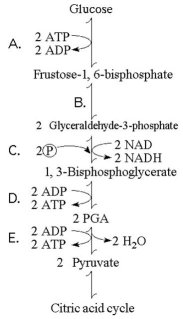 -Which portion of the pathway in the figure above contains a phosphorylation reaction in which ATP is the phosphate source?
 (Multiple Choice)
4.9/5 (72)
(72) An organism is discovered that thrives both in the presence and absence of oxygen in the air.Curiously,the consumption of sugar increases as oxygen is removed from the organism's environment,even though the organism does not gain much weight.This organism
(Multiple Choice)
4.7/5 (79)
(79) Use the following information to answer the questions below.
In the presence of oxygen,the three-carbon compound pyruvate can be catabolized in the citric acid cycle.First,however,the pyruvate (1)loses a carbon,which is given off as a molecule of CO₂,(2)is oxidized to form a two-carbon compound called acetate,and (3)is bonded to coenzyme A.
-These three steps result in the formation of
(Multiple Choice)
4.8/5 (71)
(71) During aerobic respiration,H₂O is formed.Where does the oxygen atom for the formation of the water come from?
(Multiple Choice)
4.9/5 (75)
(75) What is the term for metabolic pathways that release stored energy by breaking down complex molecules?
(Multiple Choice)
4.8/5 (71)
(71) When skeletal muscle cells undergo anaerobic respiration,they become fatigued and painful.This is now known to be caused by
(Multiple Choice)
4.9/5 (67)
(67) Why is glycolysis described as having an investment phase and a payoff phase?
(Multiple Choice)
4.8/5 (84)
(84) The figure below illustrates some of the steps (reactions)of glycolysis in their proper sequence.Each step is lettered.Use these letters to answer the questions.
-Which step in the figure above shows a split of one molecule into two smaller molecules?
-Which step in the figure above shows a split of one molecule into two smaller molecules? (Multiple Choice)
4.9/5 (92)
(92) Use the following information to answer the questions below.
Exposing inner mitochondrial membranes to ultrasonic vibrations will disrupt the membranes.However,the fragments will reseal "inside out." These little vesicles that result can still transfer electrons from NADH to oxygen and synthesize ATP.If the membranes are agitated further,however,the ability to synthesize ATP is lost.
-After the first disruption,when electron transfer and ATP synthesis still occur,what must be present?
(Multiple Choice)
4.7/5 (81)
(81) What happens to the acetyl groups produced during beta-oxidation of fat?
(Multiple Choice)
4.9/5 (83)
(83) The oxygen consumed during cellular respiration is involved directly in which process or event?
(Multiple Choice)
4.7/5 (101)
(101) When a molecule of NAD⁺ (nicotinamide adenine dinucleotide)
Gains a hydrogen atom (not a proton),the molecule becomes
(Multiple Choice)
4.8/5 (92)
(92) Carbon dioxide (CO)is released during which of the following stages of cellular respiration?
(Multiple Choice)
4.9/5 (74)
(74) Use the following information to answer the questions below.
You have collected samples from mud at the bottom of a nearby pond and have isolated different bacteria and protists from that community.You put the cultures in appropriate media in test tubes with loose-fitting lids and leave for the night,confident that your cultures will be growing well when you return.
-Test tube B has a strong smell of rotten eggs.This culture must contain
(Multiple Choice)
4.8/5 (76)
(76) Use the following figure to answer the questions below.
 The citric acid cycle.
-Which of the following is a likely reason that newborn infants have increased amounts of brown fat?
The citric acid cycle.
-Which of the following is a likely reason that newborn infants have increased amounts of brown fat? (Multiple Choice)
5.0/5 (68)
(68) ________ is the process whereby hydrogen is removed from sugars and fats and transferred to oxygen.
(Multiple Choice)
4.9/5 (86)
(86) 
Filters
- Essay(0)
- Multiple Choice(0)
- Short Answer(0)
- True False(0)
- Matching(0)