



 Chat with AI
Exam 43: Smoking--Beyond Lung Cancer

Exam 1: The Nature of Science and the Characteristics of Life75 Questions
Exam 2: Organizing the Diversity of Life75 Questions
Exam 3: Major Groups of Living Organisms74 Questions
Exam 4: Chemical Building Blocks77 Questions
Exam 5: Cell Structure and Internal Compartments76 Questions
Exam 6: Cell Membranes, Transport, and Communication73 Questions
Exam 7: Energy and Enzymes68 Questions
Exam 8: Photosynthesis and Cellular Respiration70 Questions
Exam 9: Cell Division77 Questions
Exam 10: Patterns of Inheritance65 Questions
Exam 11: Chromosomes and Human Genetics70 Questions
Exam 12: DNA62 Questions
Exam 13: From Gene to Protein73 Questions
Exam 14: Control of Gene Expression66 Questions
Exam 15: DNA Technology64 Questions
Exam 16: How Evolution Works65 Questions
Exam 17: Evolution of Populations64 Questions
Exam 18: Adaptation and Speciation66 Questions
Exam 19: The Evolutionary History of Life69 Questions
Exam 20: Maintaining the Internal Environment66 Questions
Exam 21: Animal Nutrition and Digestion68 Questions
Exam 22: Gas Exchange68 Questions
Exam 23: The Circulatory System68 Questions
Exam 24: Animal Hormones69 Questions
Exam 25: The Nervous System69 Questions
Exam 26: Sensing the Environment66 Questions
Exam 27: Skeletons, Muscles, and Movement65 Questions
Exam 28: Defenses against Disease67 Questions
Exam 29: Reproduction and Development68 Questions
Exam 30: Animal Behavior61 Questions
Exam 31: Plant Structure, Nutrition, and Transport63 Questions
Exam 32: Plant Growth and Reproduction67 Questions
Exam 33: The Biosphere67 Questions
Exam 34: Growth of Populations65 Questions
Exam 35: Interactions among Organisms70 Questions
Exam 36: Communities of Organisms65 Questions
Exam 37: Ecosystems68 Questions
Exam 38: Global Change65 Questions
Exam 39: Biodiversity and People72 Questions
Exam 40: Cancer: Cell Division Out of Control69 Questions
Exam 41: Harnessing the Human Genome62 Questions
Exam 42: Humans and Evolution60 Questions
Exam 43: Smoking--Beyond Lung Cancer63 Questions
Exam 44: Feeding a Hungry Planet55 Questions
Exam 45: Building a Sustainable Society47 Questions
Select questions type


Smoking paralyzes the cilia lining the respiratory system. This damages the lungs because
(Multiple Choice)
4.9/5  (76)
(76) Tobacco smoke inhaled by nonsmoking people near a smoker is called __________ smoke.
(Short Answer)
4.9/5 (76)
(76) Since nicotine is not normally found in your body, after smoking a cigarette it can easily _________ (a passive process) from the blood into your interstitial fluid and then to the cells of your nervous system.
(Short Answer)
4.8/5 (89)
(89) Secondhand smoke is dangerous to nonsmokers because it contains the same __________ that cause cancer in smokers.
(Short Answer)
4.9/5 (84)
(84) The more a person smokes, the more sensitive that person's brain becomes to nicotine.
(True/False)
4.9/5 (70)
(70) Which of the following describes why a light smoker may become a heavy smoker?
(Multiple Choice)
4.8/5 (82)
(82) Exposure to carbon monoxide (CO) from cigarette smoke is dangerous because it binds to the site where carbon dioxide (CO₂) binds to hemoglobin, preventing CO₂ from diffusing out of the blood.
(True/False)
4.7/5 (74)
(74) If a person addicted to cigarette smoking cannot quit successfully on the first try, there is almost no hope of ever quitting.
(True/False)
4.8/5 (84)
(84) People with emphysema have difficulty breathing because the walls of their alveoli break reducing the amount of _____________ available for gas exchange.
(Short Answer)
4.9/5 (90)
(90) Smoking a cigarette increases the amount of glucose in your blood stream.
(True/False)
4.9/5 (72)
(72) This figure shows a CT scan where the lung on the left is severely impacted by emphysema. 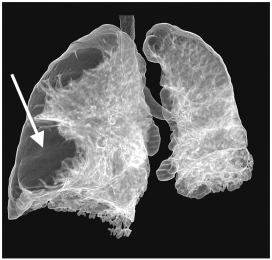 The region indicated by the arrow is clear because
 (Multiple Choice)
4.9/5 (72)
(72) Which of the following is most directly and intensely exposed to the dangerous agents in tobacco smoke?
(Multiple Choice)
4.9/5 (79)
(79) Like two other addictive drugs, cocaine and heroin, nicotine stimulates the release of ________ in the nucleus accumbens.
(Short Answer)
5.0/5 (75)
(75) Tobacco kills most of its victims by causing diseases of the heart and circulatory system.
(True/False)
4.8/5 (84)
(84) Smoking can reduce the ability to eliminate sodium and water from the body. In this case the ingredients in cigarette smoke would be affecting the
(Multiple Choice)
4.8/5 (84)
(84) The earlier a smoker quits, the better chance he or she has of living a normal life span.
(True/False)
4.7/5 (82)
(82) Where in your blood would you expect nicotine to be carried?
(Multiple Choice)
4.9/5 (87)
(87) 
Filters
- Essay(0)
- Multiple Choice(0)
- Short Answer(0)
- True False(0)
- Matching(0)