



 Chat with AI
Exam 34: Growth of Populations

Exam 1: The Nature of Science and the Characteristics of Life75 Questions
Exam 2: Organizing the Diversity of Life75 Questions
Exam 3: Major Groups of Living Organisms74 Questions
Exam 4: Chemical Building Blocks77 Questions
Exam 5: Cell Structure and Internal Compartments76 Questions
Exam 6: Cell Membranes, Transport, and Communication73 Questions
Exam 7: Energy and Enzymes68 Questions
Exam 8: Photosynthesis and Cellular Respiration70 Questions
Exam 9: Cell Division77 Questions
Exam 10: Patterns of Inheritance65 Questions
Exam 11: Chromosomes and Human Genetics70 Questions
Exam 12: DNA62 Questions
Exam 13: From Gene to Protein73 Questions
Exam 14: Control of Gene Expression66 Questions
Exam 15: DNA Technology64 Questions
Exam 16: How Evolution Works65 Questions
Exam 17: Evolution of Populations64 Questions
Exam 18: Adaptation and Speciation66 Questions
Exam 19: The Evolutionary History of Life69 Questions
Exam 20: Maintaining the Internal Environment66 Questions
Exam 21: Animal Nutrition and Digestion68 Questions
Exam 22: Gas Exchange68 Questions
Exam 23: The Circulatory System68 Questions
Exam 24: Animal Hormones69 Questions
Exam 25: The Nervous System69 Questions
Exam 26: Sensing the Environment66 Questions
Exam 27: Skeletons, Muscles, and Movement65 Questions
Exam 28: Defenses against Disease67 Questions
Exam 29: Reproduction and Development68 Questions
Exam 30: Animal Behavior61 Questions
Exam 31: Plant Structure, Nutrition, and Transport63 Questions
Exam 32: Plant Growth and Reproduction67 Questions
Exam 33: The Biosphere67 Questions
Exam 34: Growth of Populations65 Questions
Exam 35: Interactions among Organisms70 Questions
Exam 36: Communities of Organisms65 Questions
Exam 37: Ecosystems68 Questions
Exam 38: Global Change65 Questions
Exam 39: Biodiversity and People72 Questions
Exam 40: Cancer: Cell Division Out of Control69 Questions
Exam 41: Harnessing the Human Genome62 Questions
Exam 42: Humans and Evolution60 Questions
Exam 43: Smoking--Beyond Lung Cancer63 Questions
Exam 44: Feeding a Hungry Planet55 Questions
Exam 45: Building a Sustainable Society47 Questions
Select questions type


___________ growth occurs when a population increases by a constant proportion from one generation to the next.
(Short Answer)
5.0/5  (71)
(71) A __________ is a group of interacting individuals of the same species living within the same area.
(Short Answer)
4.9/5 (80)
(80) Which of the following statements best describes what will happen to the human population if it continues to increase exponentially?
(Multiple Choice)
4.9/5 (63)
(63) Which of the following has the smallest contribution to annual changes in the size of a population?
(Multiple Choice)
4.8/5 (90)
(90) At room temperature, a population of dangerous bacteria on a piece of raw chicken increases from 100,000 to 400,000 in forty minutes. Its doubling time is __ minutes
(Short Answer)
4.9/5 (94)
(94) Which of the following does not provide evidence that resources needed by humans are unsustainable?
(Multiple Choice)
4.8/5 (73)
(73) The graph below shows the growth of a Paramecium population. 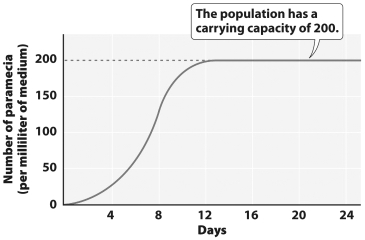 The greatest amount of daily growth occurred when the population was at approximately ___ percent of its carrying capacity
 (Multiple Choice)
4.8/5 (97)
(97) Nene, the Hawaiian goose, live on Maui. Their population density is .164 per square kilometer. Maui is 1,830 square kilometers in size. Approximately how many nene live on Maui?
(Multiple Choice)
4.9/5 (89)
(89) Pollution
is one of the many density-dependent factors that limit population growth.
(True/False)
4.8/5 (79)
(79) If there are 100 people living in a 2-square-kilometer area, the population density is _______.
(Short Answer)
5.0/5 (72)
(72) Density-dependent factors are more likely to limit population growth when
(Multiple Choice)
4.9/5 (92)
(92) Which of the following choices best explains why some introduced species experience an initial period of exponential growth?
(Multiple Choice)
4.8/5 (78)
(78) The carrying capacity of owls in an Alaskan forest is 8 per square kilometer. What will happen if 12 owls are confined to a 1-square-kilometer area?
(Multiple Choice)
4.9/5 (83)
(83) A vector is a term used to describe an organism that moves a disease organism from one host to another. What is the vector associated with the encephalitis caused by West Nile virus?
(Multiple Choice)
4.8/5 (81)
(81) Natural disasters can limit population growth in ways not related to population density.
(True/False)
4.9/5 (87)
(87) Which of the following populations would be most likely to experience an S-shaped growth pattern?
(Multiple Choice)
4.8/5 (80)
(80) The figure below shows that the human population was small and relatively stable for nearly 12,000 years, but has increased dramatically in the past 200 years. 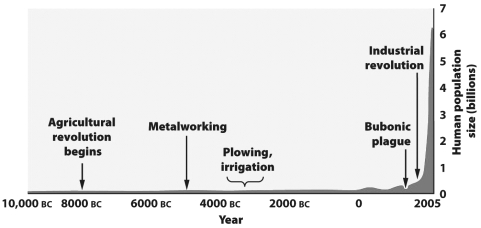 How might this increase in population growth be explained?
 (Multiple Choice)
4.8/5 (85)
(85) The effects of pollution are generally considered to be density-independent because
(Multiple Choice)
4.9/5 (71)
(71) Examine the graph below. 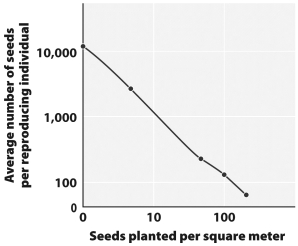 What statement best describes the relationship between planting density and seed production per individual plant?
 (Multiple Choice)
4.8/5 (79)
(79) 
Filters
- Essay(0)
- Multiple Choice(0)
- Short Answer(0)
- True False(0)
- Matching(0)