



 Chat with AI
Exam 33: The Biosphere

Exam 1: The Nature of Science and the Characteristics of Life75 Questions
Exam 2: Organizing the Diversity of Life75 Questions
Exam 3: Major Groups of Living Organisms74 Questions
Exam 4: Chemical Building Blocks77 Questions
Exam 5: Cell Structure and Internal Compartments76 Questions
Exam 6: Cell Membranes, Transport, and Communication73 Questions
Exam 7: Energy and Enzymes68 Questions
Exam 8: Photosynthesis and Cellular Respiration70 Questions
Exam 9: Cell Division77 Questions
Exam 10: Patterns of Inheritance65 Questions
Exam 11: Chromosomes and Human Genetics70 Questions
Exam 12: DNA62 Questions
Exam 13: From Gene to Protein73 Questions
Exam 14: Control of Gene Expression66 Questions
Exam 15: DNA Technology64 Questions
Exam 16: How Evolution Works65 Questions
Exam 17: Evolution of Populations64 Questions
Exam 18: Adaptation and Speciation66 Questions
Exam 19: The Evolutionary History of Life69 Questions
Exam 20: Maintaining the Internal Environment66 Questions
Exam 21: Animal Nutrition and Digestion68 Questions
Exam 22: Gas Exchange68 Questions
Exam 23: The Circulatory System68 Questions
Exam 24: Animal Hormones69 Questions
Exam 25: The Nervous System69 Questions
Exam 26: Sensing the Environment66 Questions
Exam 27: Skeletons, Muscles, and Movement65 Questions
Exam 28: Defenses against Disease67 Questions
Exam 29: Reproduction and Development68 Questions
Exam 30: Animal Behavior61 Questions
Exam 31: Plant Structure, Nutrition, and Transport63 Questions
Exam 32: Plant Growth and Reproduction67 Questions
Exam 33: The Biosphere67 Questions
Exam 34: Growth of Populations65 Questions
Exam 35: Interactions among Organisms70 Questions
Exam 36: Communities of Organisms65 Questions
Exam 37: Ecosystems68 Questions
Exam 38: Global Change65 Questions
Exam 39: Biodiversity and People72 Questions
Exam 40: Cancer: Cell Division Out of Control69 Questions
Exam 41: Harnessing the Human Genome62 Questions
Exam 42: Humans and Evolution60 Questions
Exam 43: Smoking--Beyond Lung Cancer63 Questions
Exam 44: Feeding a Hungry Planet55 Questions
Exam 45: Building a Sustainable Society47 Questions
Select questions type


When a predator is removed or displaced from its ecosystem, numerous additional species of both plants and animals can be affected.
(True/False)
4.9/5  (85)
(85) Rivers are not greatly influenced by bordering terrestrial biomes.
(True/False)
4.9/5 (77)
(77) The rotation of Earth causes winds to _______ as they move across the Earth's surface.
(Short Answer)
4.8/5 (83)
(83) The deep waters of tropical lakes are home to very few life forms. What best explains the low number of organisms in deep water?
(Multiple Choice)
5.0/5 (82)
(82) Species that are accidentally or intentionally released into new geographic regions are called __________ species.
(Short Answer)
4.8/5 (86)
(86) Cuban tree frogs are a much greater problem in the United States than in Cuba; what hypothesis best suggests why?
(Multiple Choice)
4.8/5 (91)
(91) In the northern ocean basins, ocean currents generally flow _______ between continents.
(Multiple Choice)
5.0/5 (76)
(76) The biosphere can be divided into major terrestrial and aquatic life zones called ______.
(Short Answer)
4.9/5 (84)
(84) Climate is defined as the prevailing weather conditions in an area over a time period of thirty years or longer.
(True/False)
4.8/5 (84)
(84) One of the primary forces that cause atmospheric circulation is convection, which occurs when
(Multiple Choice)
4.9/5 (87)
(87) Although the terms climate and weather are often used interchangeably, they are not the same thing; climate differs from weather in that
(Multiple Choice)
4.8/5 (70)
(70) Chaparral and grasslands are examples of ______ that receive moderate amount of rainfall.
(Short Answer)
4.9/5 (78)
(78) Despite the absence of photosynthesis, the continuous settling of detritus makes the _______ zone of the coastal ocean a stable habitat.
(Short Answer)
4.8/5 (71)
(71) The particular type of terrestrial biome that develops is strongly influenced by
(Multiple Choice)
4.8/5 (86)
(86) Understanding plate tectonics has helped ecologists make sense of ancient biomes; when land masses move in elevation or to different regions of the globe they experience climatic change. 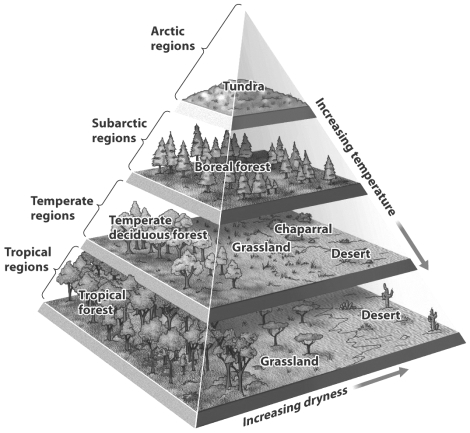 Use the figure above to predict the change for a temperate deciduous forest as it moves south and elevates by 5,000 feet.
 (Multiple Choice)
4.8/5 (77)
(77) 
Filters
- Essay(0)
- Multiple Choice(0)
- Short Answer(0)
- True False(0)
- Matching(0)