



 Chat with AI
Exam 26: Sensing the Environment

Exam 1: The Nature of Science and the Characteristics of Life75 Questions
Exam 2: Organizing the Diversity of Life75 Questions
Exam 3: Major Groups of Living Organisms74 Questions
Exam 4: Chemical Building Blocks77 Questions
Exam 5: Cell Structure and Internal Compartments76 Questions
Exam 6: Cell Membranes, Transport, and Communication73 Questions
Exam 7: Energy and Enzymes68 Questions
Exam 8: Photosynthesis and Cellular Respiration70 Questions
Exam 9: Cell Division77 Questions
Exam 10: Patterns of Inheritance65 Questions
Exam 11: Chromosomes and Human Genetics70 Questions
Exam 12: DNA62 Questions
Exam 13: From Gene to Protein73 Questions
Exam 14: Control of Gene Expression66 Questions
Exam 15: DNA Technology64 Questions
Exam 16: How Evolution Works65 Questions
Exam 17: Evolution of Populations64 Questions
Exam 18: Adaptation and Speciation66 Questions
Exam 19: The Evolutionary History of Life69 Questions
Exam 20: Maintaining the Internal Environment66 Questions
Exam 21: Animal Nutrition and Digestion68 Questions
Exam 22: Gas Exchange68 Questions
Exam 23: The Circulatory System68 Questions
Exam 24: Animal Hormones69 Questions
Exam 25: The Nervous System69 Questions
Exam 26: Sensing the Environment66 Questions
Exam 27: Skeletons, Muscles, and Movement65 Questions
Exam 28: Defenses against Disease67 Questions
Exam 29: Reproduction and Development68 Questions
Exam 30: Animal Behavior61 Questions
Exam 31: Plant Structure, Nutrition, and Transport63 Questions
Exam 32: Plant Growth and Reproduction67 Questions
Exam 33: The Biosphere67 Questions
Exam 34: Growth of Populations65 Questions
Exam 35: Interactions among Organisms70 Questions
Exam 36: Communities of Organisms65 Questions
Exam 37: Ecosystems68 Questions
Exam 38: Global Change65 Questions
Exam 39: Biodiversity and People72 Questions
Exam 40: Cancer: Cell Division Out of Control69 Questions
Exam 41: Harnessing the Human Genome62 Questions
Exam 42: Humans and Evolution60 Questions
Exam 43: Smoking--Beyond Lung Cancer63 Questions
Exam 44: Feeding a Hungry Planet55 Questions
Exam 45: Building a Sustainable Society47 Questions
Select questions type


The figure below depicts a human eye. 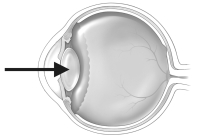 When focusing on an object that is far away, the structure indicated by the arrow in the figure above
 (Multiple Choice)
5.0/5  (91)
(91) The ________ of the lens of your eye changes when you focus on objects at different distances.
(Short Answer)
4.9/5 (71)
(71) The lens of your eye projects images ____________ on your retina, but brain processing returns images to the correct orientation.
(Short Answer)
4.9/5 (64)
(64) The eye is not like a camera in which of the following ways?
(Multiple Choice)
4.9/5 (74)
(74) Which of the following statements about insect eyes is true?
(Multiple Choice)
4.9/5 (73)
(73) The figure below illustrates the organ of Corti, a part of the Cochlea in the human inner ear. 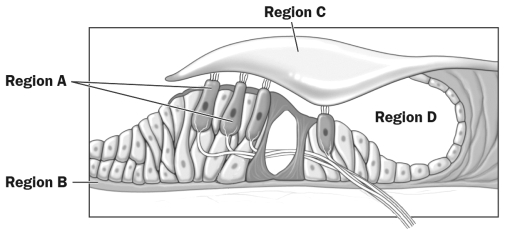 What labeled region of this figure of the organ of Corti is directly stimulated to vibrate in response to the air movements causes by sound?
 (Multiple Choice)
4.9/5 (71)
(71) Compound eyes of insects use mechanoreceptors rather than photoreceptors.
(True/False)
4.8/5 (80)
(80) The evolution of the complex eyes we find in vertebrates could have begun with
(Multiple Choice)
4.8/5 (76)
(76) We can distinguish volume because __________ sounds produce greater movement of the basilar membrane.
(Short Answer)
4.8/5 (83)
(83) A drug that decreases your ability to taste and smell might inhibit the function of
(Multiple Choice)
4.9/5 (83)
(83) In the case of both smell and taste, chemicals must dissolve in water before they can be detected by sensory receptors.
(True/False)
4.8/5 (87)
(87) The human skin has numerous sensory receptors that take in information about our environment, and these receptors are concentrated in areas where detailed information on touch is needed. Which of the following body areas is likely to have the smallest number of sensory receptors?
(Multiple Choice)
5.0/5 (82)
(82) 
Filters
- Essay(0)
- Multiple Choice(0)
- Short Answer(0)
- True False(0)
- Matching(0)