



 Chat with AI
Exam 3: Major Groups of Living Organisms

Exam 1: The Nature of Science and the Characteristics of Life75 Questions
Exam 2: Organizing the Diversity of Life75 Questions
Exam 3: Major Groups of Living Organisms74 Questions
Exam 4: Chemical Building Blocks77 Questions
Exam 5: Cell Structure and Internal Compartments76 Questions
Exam 6: Cell Membranes, Transport, and Communication73 Questions
Exam 7: Energy and Enzymes68 Questions
Exam 8: Photosynthesis and Cellular Respiration70 Questions
Exam 9: Cell Division77 Questions
Exam 10: Patterns of Inheritance65 Questions
Exam 11: Chromosomes and Human Genetics70 Questions
Exam 12: DNA62 Questions
Exam 13: From Gene to Protein73 Questions
Exam 14: Control of Gene Expression66 Questions
Exam 15: DNA Technology64 Questions
Exam 16: How Evolution Works65 Questions
Exam 17: Evolution of Populations64 Questions
Exam 18: Adaptation and Speciation66 Questions
Exam 19: The Evolutionary History of Life69 Questions
Exam 20: Maintaining the Internal Environment66 Questions
Exam 21: Animal Nutrition and Digestion68 Questions
Exam 22: Gas Exchange68 Questions
Exam 23: The Circulatory System68 Questions
Exam 24: Animal Hormones69 Questions
Exam 25: The Nervous System69 Questions
Exam 26: Sensing the Environment66 Questions
Exam 27: Skeletons, Muscles, and Movement65 Questions
Exam 28: Defenses against Disease67 Questions
Exam 29: Reproduction and Development68 Questions
Exam 30: Animal Behavior61 Questions
Exam 31: Plant Structure, Nutrition, and Transport63 Questions
Exam 32: Plant Growth and Reproduction67 Questions
Exam 33: The Biosphere67 Questions
Exam 34: Growth of Populations65 Questions
Exam 35: Interactions among Organisms70 Questions
Exam 36: Communities of Organisms65 Questions
Exam 37: Ecosystems68 Questions
Exam 38: Global Change65 Questions
Exam 39: Biodiversity and People72 Questions
Exam 40: Cancer: Cell Division Out of Control69 Questions
Exam 41: Harnessing the Human Genome62 Questions
Exam 42: Humans and Evolution60 Questions
Exam 43: Smoking--Beyond Lung Cancer63 Questions
Exam 44: Feeding a Hungry Planet55 Questions
Exam 45: Building a Sustainable Society47 Questions
Select questions type


Examine the evolutionary tree pictured below. 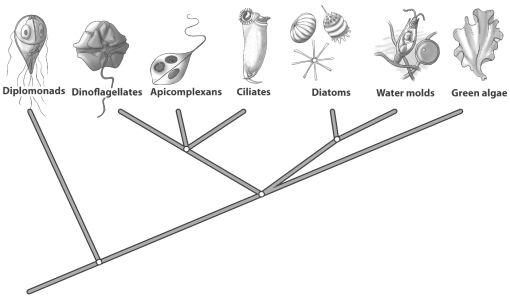 One prediction based on the arrangement of ciliates in the illustration is that the DNA of
 (Multiple Choice)
4.8/5  (89)
(89) The figure below shows the vertebrates and arthropods to be distantly related, yet each has features, like limbs and jaws, seen in no other groups. 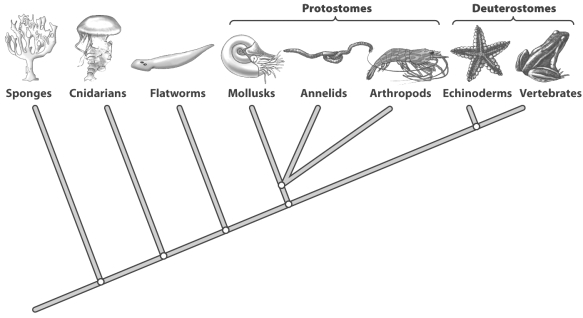 How can such an obvious similarity be discounted in favor of embryological development as a basis for classification?
 (Multiple Choice)
4.9/5 (78)
(78) Resolving the relationship between the various kingdoms has been challenging because species often resemble one another; for example, the _______ contain some organisms that are animal-like and others that are plant-like.
(Multiple Choice)
4.8/5 (77)
(77) The ________ were the first plant group to evolve a vascular system.
(Short Answer)
4.8/5 (75)
(75) Prokaryotes obtain their nutrition in a variety of ways; all of the following methods except ______ have been observed.
(Multiple Choice)
4.8/5 (74)
(74) The organisms found living inside boiling-hot geysers can be described as thermophiles.
(True/False)
4.9/5 (84)
(84) Honeybees have declined dramatically within the United States in recent years, but it's important to note that the honeybee is not a native species; it is native to Asia. If the honeybee disappears entirely,
(Multiple Choice)
4.9/5 (69)
(69) Cells carry out many chemical processes, some of which produce toxic by-products. If you were designing a cell from known components, which of the following would provide the best method of protecting the cell from its own toxic by-products while allowing it to complete the chemical reactions necessary for life?
(Multiple Choice)
4.8/5 (75)
(75) Taxonomy is the subdiscipline in biology that classifies living organisms; at the present time
(Multiple Choice)
5.0/5 (73)
(73) No single characteristic is sufficient to describe a kingdom, for example, plants and some bacteria share in common
(Multiple Choice)
4.9/5 (82)
(82) Seeds contain the embryos of plants and nutrients to assist with germination and initial growth.
(True/False)
4.8/5 (75)
(75) Which of the following terms describes organisms that can survive in extremely salty environments?
(Multiple Choice)
5.0/5 (82)
(82) Life on earth appears to have began in the water; the first organisms believed to colonize land were
(Multiple Choice)
4.8/5 (70)
(70) Protists display the earliest version of sexual reproduction, whereby
(Multiple Choice)
4.8/5 (74)
(74) Which of the following would you most likely find surviving in a boiling-hot spring?
(Multiple Choice)
4.9/5 (80)
(80) In nature, fungi function primarily as _______, getting their nutrition from dead and dying organisms.
(Short Answer)
4.9/5 (77)
(77) In addition to the Bacteria, which other kingdom is comprised exclusively of prokaryotic organisms?
(Multiple Choice)
4.9/5 (72)
(72) 
Filters
- Essay(0)
- Multiple Choice(0)
- Short Answer(0)
- True False(0)
- Matching(0)