



 Chat with AI
Exam 53: Population Ecology

Exam 1: Introduction: Themes in the Study of Life66 Questions
Exam 2: The Chemical Context of Life83 Questions
Exam 3: Water and the Fitness of the Environment66 Questions
Exam 4: Carbon and the Molecular Diversity of Life68 Questions
Exam 5: The Structure and Function of Large Biological Molecules109 Questions
Exam 6: A Tour of the Cell75 Questions
Exam 7: Membrane Structure and Function75 Questions
Exam 8: An Introduction to Metabolism79 Questions
Exam 9: Cellular Respiration: Harvesting Chemical Energy103 Questions
Exam 10: Photosynthesis74 Questions
Exam 11: Cell Communication62 Questions
Exam 12: The Cell Cycle80 Questions
Exam 13: Meiosis and Sexual Life Cycles68 Questions
Exam 14: Mendel and the Gene Idea90 Questions
Exam 15: The Chromosomal Basis of Inheritance75 Questions
Exam 16: The Molecular Basis of Inheritance72 Questions
Exam 17: From Gene to Protein84 Questions
Exam 18: Control of Gene Expression101 Questions
Exam 19: Viruses38 Questions
Exam 20: Biotechnology70 Questions
Exam 21: Genomes and Their Evolution37 Questions
Exam 22: Descent With Modification: a Darwinian View of Life57 Questions
Exam 23: The Evolution of Populations84 Questions
Exam 24: The Origin of Species60 Questions
Exam 25: The History of Life on Earth85 Questions
Exam 26: Phylogeny and the Tree of Life90 Questions
Exam 27: Bacteria and Archaea78 Questions
Exam 28: Protists79 Questions
Exam 29: Plant Diversity I: How Plants Colonized Land74 Questions
Exam 30: Plant Diversity Ii: the Evolution of Seed Plants101 Questions
Exam 31: Fungi87 Questions
Exam 32: An Introduction to Animal Diversity82 Questions
Exam 33: Invertebrates98 Questions
Exam 34: Vertebrates112 Questions
Exam 35: Plant Structure, Growth, and Development77 Questions
Exam 36: Transport in Vascular Plants84 Questions
Exam 37: Soil and Plant Nutrition85 Questions
Exam 38: Angiosperm Reproduction and Biotechnology86 Questions
Exam 39: Plant Responses to Internal and External Signals111 Questions
Exam 40: Basic Principles of Animal Form and Function74 Questions
Exam 41: Animal Nutrition68 Questions
Exam 42: Circulation and Gas Exchange78 Questions
Exam 43: The Immune System85 Questions
Exam 44: Osmoregulation and Excretion49 Questions
Exam 45: Hormones and the Endocrine System71 Questions
Exam 46: Animal Reproduction85 Questions
Exam 47: Animal Development75 Questions
Exam 48: Neurons, Synapses, and Signaling52 Questions
Exam 49: Nervous Systems48 Questions
Exam 50: Sensory and Motor Mechanisms59 Questions
Exam 51: Animal Behavior74 Questions
Exam 52: An Introduction to Ecology and the Biosphere71 Questions
Exam 53: Population Ecology80 Questions
Exam 54: Community Ecology74 Questions
Exam 55: Ecosystems79 Questions
Exam 56: Conservation Biology and Restoration Ecology65 Questions
Select questions type


Most ecologists believe that the average global carrying capacity for the human population is between
(Multiple Choice)
4.9/5  (74)
(74) The observation that members of a population are uniformly distributed suggests that
(Multiple Choice)
4.8/5 (91)
(91) Often the growth cycle of one population has an effect on the cycle of another. As moose populations increase, wolf populations also increase. Thus, if we are considering the logistic equation for the wolf population, dN/dt = rN ,
Which of the factors accounts for the effect on the moose population?
(Multiple Choice)
4.8/5 (86)
(86) A recent study of ecological footprints (described in the text)concluded that
(Multiple Choice)
4.9/5 (94)
(94) Which of the following examples would most accurately measure the density of the population being studied?
(Multiple Choice)
4.8/5 (82)
(82) Which of the following graphs illustrates the population growth curve of single bacterium growing in a flask of ideal medium at optimum temperature over a 24-hour period?
(Multiple Choice)
4.9/5 (83)
(83) In which of the following habitats would you expect to find the largest number of K-selected individuals?
(Multiple Choice)
4.9/5 (81)
(81) Please read the paragraph below and review Figure 53.2 to answer the following questions.
Researchers in the Netherlands studied the effects of parental caregiving in European kestrels over 5 years. The researchers transferred chicks among nests to produce reduced broods (three or four chicks), normal broods (five or six), and enlarged broods (seven or eight). They then measured the percentage of male and female parent birds that survived the following winter. (Both males and females provide care for chicks.)
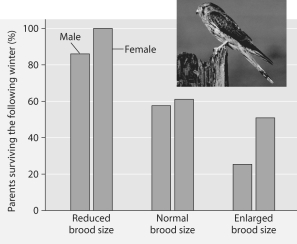 Brood Size Manipulations in the Kestrel: Effects on Offspring and Parent Survival
Figure 53.2
-Which of the following pairs of reproductive strategies is consistent with energetic trade-off and reproductive success?
Brood Size Manipulations in the Kestrel: Effects on Offspring and Parent Survival
Figure 53.2
-Which of the following pairs of reproductive strategies is consistent with energetic trade-off and reproductive success? (Multiple Choice)
4.8/5 (88)
(88) Which of the following graphs illustrates the growth curve of a small population of rodents that has grown to reach a static carrying capacity?
(Multiple Choice)
4.9/5 (74)
(74) Consider several human populations of equal size and net reproductive rate, but different in age structure. The population that is likely to grow the most during the next 30 years is the one with the greatest fraction of people in which age range?
(Multiple Choice)
4.9/5 (73)
(73) Your friend comes to you with a problem. It seems his shrimp boats aren't catching nearly as much shrimp as they used to. He can't understand why because originally he caught all the shrimp he could handle. Each year he added a new boat, and for a long time each boat caught tons of shrimp. As he added more boats, there came a time when each boat caught somewhat fewer shrimp, and now, each boat is catching a lot less shrimp. Which of the following topics might help your friend understand the source of his problem?
(Multiple Choice)
4.7/5 (61)
(61) In 2005, the United States had a population of approximately 295,000,000 people. If the birth rate was 13 births for every 1,000 people, approximately how many births occurred in the United States in 2005?
(Multiple Choice)
4.8/5 (94)
(94) Which of the following characterizes relatively K-selected populations?
(Multiple Choice)
4.9/5 (79)
(79) The following questions refer to Figure 53.3, which depicts the age structure of three populations.
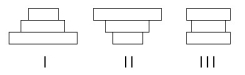 Figure 53.3
-Assuming these age-structure diagrams describe human populations, which population is likely to experience zero population growth (ZPG)?
Figure 53.3
-Assuming these age-structure diagrams describe human populations, which population is likely to experience zero population growth (ZPG)? (Multiple Choice)
4.9/5 (80)
(80) A population of white-footed mice becomes severely overpopulated in a habitat that has been disturbed by human activity. Sometimes intrinsic factors cause the population to increase in mortality and lower reproduction rates in reaction to the stress of overpopulation. Which of the following is an example of intrinsic population control?
(Multiple Choice)
4.9/5 (79)
(79) A population of ground squirrels has an annual per capita birth rate of 0.06 and an annual per capita death rate of 0.02. Estimate the number of individuals added to (or lost from)a population of 1,000 individuals in one year.
(Multiple Choice)
4.8/5 (81)
(81) Which of the following graphs illustrates the growth curve of a population of snowshoe hares over several seasons in northern Canada?
(Multiple Choice)
4.8/5 (81)
(81) Life tables are most useful in determining which of the following?
(Multiple Choice)
4.8/5 (85)
(85) The three basic variables that make up the life history of an organism are
(Multiple Choice)
4.9/5 (75)
(75) Use the survivorship curves in Figure 53.1 to answer the following questions.
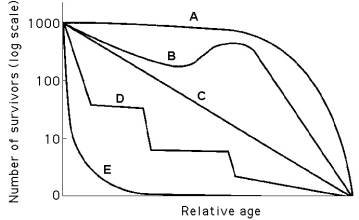 Figure 53.1
-Which curve best describes survivorship in songbirds?
Figure 53.1
-Which curve best describes survivorship in songbirds? (Short Answer)
4.8/5 (77)
(77) 
Filters
- Essay(0)
- Multiple Choice(0)
- Short Answer(0)
- True False(0)
- Matching(0)