



 Chat with AI
Exam 53: Population Ecology

Exam 1: Introduction: Themes in the Study of Life66 Questions
Exam 2: The Chemical Context of Life83 Questions
Exam 3: Water and the Fitness of the Environment66 Questions
Exam 4: Carbon and the Molecular Diversity of Life68 Questions
Exam 5: The Structure and Function of Large Biological Molecules109 Questions
Exam 6: A Tour of the Cell75 Questions
Exam 7: Membrane Structure and Function75 Questions
Exam 8: An Introduction to Metabolism79 Questions
Exam 9: Cellular Respiration: Harvesting Chemical Energy103 Questions
Exam 10: Photosynthesis74 Questions
Exam 11: Cell Communication62 Questions
Exam 12: The Cell Cycle80 Questions
Exam 13: Meiosis and Sexual Life Cycles68 Questions
Exam 14: Mendel and the Gene Idea90 Questions
Exam 15: The Chromosomal Basis of Inheritance75 Questions
Exam 16: The Molecular Basis of Inheritance72 Questions
Exam 17: From Gene to Protein84 Questions
Exam 18: Control of Gene Expression101 Questions
Exam 19: Viruses38 Questions
Exam 20: Biotechnology70 Questions
Exam 21: Genomes and Their Evolution37 Questions
Exam 22: Descent With Modification: a Darwinian View of Life57 Questions
Exam 23: The Evolution of Populations84 Questions
Exam 24: The Origin of Species60 Questions
Exam 25: The History of Life on Earth85 Questions
Exam 26: Phylogeny and the Tree of Life90 Questions
Exam 27: Bacteria and Archaea78 Questions
Exam 28: Protists79 Questions
Exam 29: Plant Diversity I: How Plants Colonized Land74 Questions
Exam 30: Plant Diversity Ii: the Evolution of Seed Plants101 Questions
Exam 31: Fungi87 Questions
Exam 32: An Introduction to Animal Diversity82 Questions
Exam 33: Invertebrates98 Questions
Exam 34: Vertebrates112 Questions
Exam 35: Plant Structure, Growth, and Development77 Questions
Exam 36: Transport in Vascular Plants84 Questions
Exam 37: Soil and Plant Nutrition85 Questions
Exam 38: Angiosperm Reproduction and Biotechnology86 Questions
Exam 39: Plant Responses to Internal and External Signals111 Questions
Exam 40: Basic Principles of Animal Form and Function74 Questions
Exam 41: Animal Nutrition68 Questions
Exam 42: Circulation and Gas Exchange78 Questions
Exam 43: The Immune System85 Questions
Exam 44: Osmoregulation and Excretion49 Questions
Exam 45: Hormones and the Endocrine System71 Questions
Exam 46: Animal Reproduction85 Questions
Exam 47: Animal Development75 Questions
Exam 48: Neurons, Synapses, and Signaling52 Questions
Exam 49: Nervous Systems48 Questions
Exam 50: Sensory and Motor Mechanisms59 Questions
Exam 51: Animal Behavior74 Questions
Exam 52: An Introduction to Ecology and the Biosphere71 Questions
Exam 53: Population Ecology80 Questions
Exam 54: Community Ecology74 Questions
Exam 55: Ecosystems79 Questions
Exam 56: Conservation Biology and Restoration Ecology65 Questions
Select questions type


Which of the following is a likely graphic outcome of a population of deer introduced to an island with an adequate herbivory and without natural predators, parasites, or disease?
(Multiple Choice)
4.8/5  (91)
(91) A table listing such items as age, observed number of organisms alive each year, and life expectancy is known as a (an)
(Multiple Choice)
4.7/5 (71)
(71) As N approaches K for a certain population, which of the following is predicted by the logistic equation?
(Multiple Choice)
4.9/5 (93)
(93) The life history traits favored by selection are most likely to vary with
(Multiple Choice)
4.9/5 (94)
(94) Pacific salmon or annual plants illustrate which of the following?
(Multiple Choice)
4.9/5 (93)
(93) Density-dependent factors are related to which of the following?
(Multiple Choice)
4.8/5 (95)
(95) Imagine that you are managing a large ranch. You know from historical accounts that wild sheep used to live there, but they have been extirpated. You decide to reintroduce them. After doing some research to determine what might be an appropriately sized founding population, you do so. You then watch the population increase for several generations, and graph the number of individuals (vertical axis)against the number of generations (horizontal axis). The graph will appear as
(Multiple Choice)
4.8/5 (75)
(75) You are observing a population of lizards when you notice that the number of adults has increased and is higher than previously observed. One explanation for such an observation would include
(Multiple Choice)
5.0/5 (94)
(94) Please read the paragraph below and review Figure 53.2 to answer the following questions.
Researchers in the Netherlands studied the effects of parental caregiving in European kestrels over 5 years. The researchers transferred chicks among nests to produce reduced broods (three or four chicks), normal broods (five or six), and enlarged broods (seven or eight). They then measured the percentage of male and female parent birds that survived the following winter. (Both males and females provide care for chicks.)
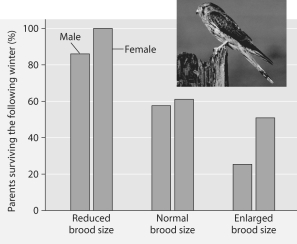 Brood Size Manipulations in the Kestrel: Effects on Offspring and Parent Survival
Figure 53.2
-Which of the following is a conclusion that can be drawn from this graph?
Brood Size Manipulations in the Kestrel: Effects on Offspring and Parent Survival
Figure 53.2
-Which of the following is a conclusion that can be drawn from this graph? (Multiple Choice)
4.7/5 (71)
(71) Which of the following is an incorrect statement about the regulation of populations?
(Multiple Choice)
4.8/5 (89)
(89) Exponential growth of a population is represented by dN/dt =
(Multiple Choice)
4.9/5 (84)
(84) Use the survivorship curves in Figure 53.1 to answer the following questions.
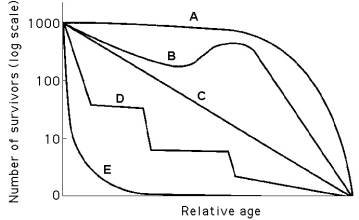 Figure 53.1
-Which curve best describes survivorship that is independent of age?
Figure 53.1
-Which curve best describes survivorship that is independent of age? (Short Answer)
4.8/5 (100)
(100) Field observation suggests that populations of a particular species of herbivorous mammal undergo cyclic fluctuations in density at three- to five-year intervals. Which of the following represent (a)plausible explanation(s)of these cycles?
(Multiple Choice)
4.8/5 (72)
(72) Which of the following groups would be most likely to exhibit uniform dispersion?
(Multiple Choice)
4.9/5 (69)
(69) Which of the following graphs refer to this equation?
=0.5 N
(Multiple Choice)
4.9/5 (79)
(79) A small population of white-footed mice has the same intrinsic rate of increase (r)as a large population. If everything else is equal,
(Multiple Choice)
4.8/5 (93)
(93) In the logistic equation dN/dt = rN, , r is a measure of the population's intrinsic rate of increase. It is determined by which of the following?
(Multiple Choice)
4.7/5 (69)
(69) 
Filters
- Essay(0)
- Multiple Choice(0)
- Short Answer(0)
- True False(0)
- Matching(0)