



 Chat with AI
Exam 14: Mendel and the Gene Idea

Exam 1: Introduction: Themes in the Study of Life66 Questions
Exam 2: The Chemical Context of Life83 Questions
Exam 3: Water and the Fitness of the Environment66 Questions
Exam 4: Carbon and the Molecular Diversity of Life68 Questions
Exam 5: The Structure and Function of Large Biological Molecules109 Questions
Exam 6: A Tour of the Cell75 Questions
Exam 7: Membrane Structure and Function75 Questions
Exam 8: An Introduction to Metabolism79 Questions
Exam 9: Cellular Respiration: Harvesting Chemical Energy103 Questions
Exam 10: Photosynthesis74 Questions
Exam 11: Cell Communication62 Questions
Exam 12: The Cell Cycle80 Questions
Exam 13: Meiosis and Sexual Life Cycles68 Questions
Exam 14: Mendel and the Gene Idea90 Questions
Exam 15: The Chromosomal Basis of Inheritance75 Questions
Exam 16: The Molecular Basis of Inheritance72 Questions
Exam 17: From Gene to Protein84 Questions
Exam 18: Control of Gene Expression101 Questions
Exam 19: Viruses38 Questions
Exam 20: Biotechnology70 Questions
Exam 21: Genomes and Their Evolution37 Questions
Exam 22: Descent With Modification: a Darwinian View of Life57 Questions
Exam 23: The Evolution of Populations84 Questions
Exam 24: The Origin of Species60 Questions
Exam 25: The History of Life on Earth85 Questions
Exam 26: Phylogeny and the Tree of Life90 Questions
Exam 27: Bacteria and Archaea78 Questions
Exam 28: Protists79 Questions
Exam 29: Plant Diversity I: How Plants Colonized Land74 Questions
Exam 30: Plant Diversity Ii: the Evolution of Seed Plants101 Questions
Exam 31: Fungi87 Questions
Exam 32: An Introduction to Animal Diversity82 Questions
Exam 33: Invertebrates98 Questions
Exam 34: Vertebrates112 Questions
Exam 35: Plant Structure, Growth, and Development77 Questions
Exam 36: Transport in Vascular Plants84 Questions
Exam 37: Soil and Plant Nutrition85 Questions
Exam 38: Angiosperm Reproduction and Biotechnology86 Questions
Exam 39: Plant Responses to Internal and External Signals111 Questions
Exam 40: Basic Principles of Animal Form and Function74 Questions
Exam 41: Animal Nutrition68 Questions
Exam 42: Circulation and Gas Exchange78 Questions
Exam 43: The Immune System85 Questions
Exam 44: Osmoregulation and Excretion49 Questions
Exam 45: Hormones and the Endocrine System71 Questions
Exam 46: Animal Reproduction85 Questions
Exam 47: Animal Development75 Questions
Exam 48: Neurons, Synapses, and Signaling52 Questions
Exam 49: Nervous Systems48 Questions
Exam 50: Sensory and Motor Mechanisms59 Questions
Exam 51: Animal Behavior74 Questions
Exam 52: An Introduction to Ecology and the Biosphere71 Questions
Exam 53: Population Ecology80 Questions
Exam 54: Community Ecology74 Questions
Exam 55: Ecosystems79 Questions
Exam 56: Conservation Biology and Restoration Ecology65 Questions
Select questions type


Use Figure 14.1 and the following description to answer the questions below.
In a particular plant, leaf color is controlled by gene locus D. Plants with at least one allele D have dark green leaves, and plants with the homozygous recessive dd genotype have light green leaves. A True-breeding dark-leaved plant is crossed with a light-leaved one, and the F1 offspring is allowed to self-pollinate. The predicted outcome of the F2 is diagrammed in the Punnett square shown in Figure 14.1, where 1, 2, 3, and 4 represent the genotypes corresponding to each box within the square.
 -Which of the boxes correspond to plants with a heterozygous genotype?
Free
(Multiple Choice)
4.9/5  (67)
(67) Correct Answer: Verified
D
A 1:2:1 phenotypic ratio in the F₂ generation of a monohybrid cross is a sign of
Free
(Multiple Choice)
4.8/5 (85)
(85) Correct Answer:Verified
VerifiedC
Which of the following about the law of segregation is False?
Free
(Multiple Choice)
4.8/5 (83)
(83) Correct Answer:Verified
VerifiedE
Use the following information to answer the questions below.
A woman who has blood type A positive has a daughter who is type O positive and a son who is type B negative. Rh positive is a trait that shows simple dominance over Rh negative and is designated by the alleles R and r, respectively. A third gene for the MN blood group has codominant alleles M and N.
-Which of the following is the probable genotype for the mother?
(Multiple Choice)
4.9/5 (90)
(90) Two plants are crossed, resulting in offspring with a 3:1 ratio for a particular trait. This suggests
(Multiple Choice)
4.8/5 (66)
(66) Imagine that a newly discovered, recessively inherited disease is expressed only in individuals with type O blood, although the disease and blood group are independently inherited. A normal man with type A blood and a normal woman with type B blood have already had one child with the disease. The woman is now pregnant for a second time. What is the probability that the second child will also have the disease?
Assume that both parents are heterozygous for the gene that causes the disease.
(Short Answer)
4.9/5 (73)
(73) Hydrangea plants of the same genotype are planted in a large flower garden. Some of the plants produce blue flowers and others pink flowers. This can be best explained by which of the following?
(Multiple Choice)
4.8/5 (81)
(81) The pedigree below traces the inheritance of alkaptonuria, a biochemical disorder. Affected individuals, indicated here by the colored circles and squares, are unable to metabolize a substance called alkapton, which colors the urine and stains body tissues. Does alkaptonuria appear to be caused by a dominant allele or by a recessive allele?
Fill in the genotypes of the individuals whose genotypes can be deduced. What genotypes are possible for each of the other individuals?
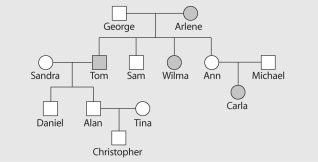
(Essay)
4.8/5 (76)
(76) The genotype of F₁ individuals in a tetrahybrid cross is AaBbCcDd. Assuming independent assortment of these four genes, what are the probabilities that F₂ offspring will have the following genotypes?
A)aabbccdd
B)AaBbCcDd
C)AABBCCDD
D)AaBBccDd
E)AaBBCCdd
(Essay)
4.9/5 (76)
(76) A pedigree analysis for a given disorder's occurrence in a family shows that, although both parents of an affected child are normal, each of the parents has had affected relatives with the same condition. The disorder is then which of the following?
(Multiple Choice)
4.9/5 (74)
(74) Mendel's second law of independent assortment has its basis in which of the following events of meiosis I?
(Multiple Choice)
4.8/5 (82)
(82) A sexually reproducing animal has two unlinked genes, one for head shape (H)and one for tail length (T). Its genotype is HhTt. Which of the following genotypes is possible in a gamete from this organism?
(Multiple Choice)
5.0/5 (80)
(80) Use the following information to answer the questions below.
A woman who has blood type A positive has a daughter who is type O positive and a son who is type B negative. Rh positive is a trait that shows simple dominance over Rh negative and is designated by the alleles R and r, respectively. A third gene for the MN blood group has codominant alleles M and N.
-If both children are of blood group MM, which of the following is possible?
(Multiple Choice)
4.8/5 (68)
(68) When a disease is said to have a multifactorial basis, it means that
(Multiple Choice)
4.7/5 (78)
(78) A cross between a True-breeding sharp-spined cactus and a spineless cactus would produce
(Multiple Choice)
4.8/5 (71)
(71) How many unique gametes could be produced through independent assortment by an individual with the genotype AaBbCCDdEE?
(Multiple Choice)
4.8/5 (56)
(56) In snapdragons, heterozygotes for one of the genes have pink flowers, whereas homozygotes have red or white flowers. When plants with red flowers are crossed with plants with white flowers, what proportion of the offspring will have pink flowers?
(Multiple Choice)
4.7/5 (79)
(79) A man has six fingers on each hand and six toes on each foot. His wife and their daughter have the normal number of digits. Extra digits is a dominant trait. What fraction of this couple's children would be expected to have extra digits?
(Short Answer)
4.9/5 (75)
(75) One of two major forms of a human condition called neurofibromatosis (NF 1)is inherited as a dominant, although it may be either mildly to very severely expressed. If a young child is the first in her family to be diagnosed, which of the following is the best explanation?
(Multiple Choice)
4.8/5 (89)
(89) 
Filters
- Essay(0)
- Multiple Choice(0)
- Short Answer(0)
- True False(0)
- Matching(0)