



 Chat with AI
Exam 14: Mendel and the Gene Idea

Exam 1: Introduction: Themes in the Study of Life66 Questions
Exam 2: The Chemical Context of Life83 Questions
Exam 3: Water and the Fitness of the Environment66 Questions
Exam 4: Carbon and the Molecular Diversity of Life68 Questions
Exam 5: The Structure and Function of Large Biological Molecules109 Questions
Exam 6: A Tour of the Cell75 Questions
Exam 7: Membrane Structure and Function75 Questions
Exam 8: An Introduction to Metabolism79 Questions
Exam 9: Cellular Respiration: Harvesting Chemical Energy103 Questions
Exam 10: Photosynthesis74 Questions
Exam 11: Cell Communication62 Questions
Exam 12: The Cell Cycle80 Questions
Exam 13: Meiosis and Sexual Life Cycles68 Questions
Exam 14: Mendel and the Gene Idea90 Questions
Exam 15: The Chromosomal Basis of Inheritance75 Questions
Exam 16: The Molecular Basis of Inheritance72 Questions
Exam 17: From Gene to Protein84 Questions
Exam 18: Control of Gene Expression101 Questions
Exam 19: Viruses38 Questions
Exam 20: Biotechnology70 Questions
Exam 21: Genomes and Their Evolution37 Questions
Exam 22: Descent With Modification: a Darwinian View of Life57 Questions
Exam 23: The Evolution of Populations84 Questions
Exam 24: The Origin of Species60 Questions
Exam 25: The History of Life on Earth85 Questions
Exam 26: Phylogeny and the Tree of Life90 Questions
Exam 27: Bacteria and Archaea78 Questions
Exam 28: Protists79 Questions
Exam 29: Plant Diversity I: How Plants Colonized Land74 Questions
Exam 30: Plant Diversity Ii: the Evolution of Seed Plants101 Questions
Exam 31: Fungi87 Questions
Exam 32: An Introduction to Animal Diversity82 Questions
Exam 33: Invertebrates98 Questions
Exam 34: Vertebrates112 Questions
Exam 35: Plant Structure, Growth, and Development77 Questions
Exam 36: Transport in Vascular Plants84 Questions
Exam 37: Soil and Plant Nutrition85 Questions
Exam 38: Angiosperm Reproduction and Biotechnology86 Questions
Exam 39: Plant Responses to Internal and External Signals111 Questions
Exam 40: Basic Principles of Animal Form and Function74 Questions
Exam 41: Animal Nutrition68 Questions
Exam 42: Circulation and Gas Exchange78 Questions
Exam 43: The Immune System85 Questions
Exam 44: Osmoregulation and Excretion49 Questions
Exam 45: Hormones and the Endocrine System71 Questions
Exam 46: Animal Reproduction85 Questions
Exam 47: Animal Development75 Questions
Exam 48: Neurons, Synapses, and Signaling52 Questions
Exam 49: Nervous Systems48 Questions
Exam 50: Sensory and Motor Mechanisms59 Questions
Exam 51: Animal Behavior74 Questions
Exam 52: An Introduction to Ecology and the Biosphere71 Questions
Exam 53: Population Ecology80 Questions
Exam 54: Community Ecology74 Questions
Exam 55: Ecosystems79 Questions
Exam 56: Conservation Biology and Restoration Ecology65 Questions
Select questions type


In tigers, a recessive allele causes an absence of fur pigmentation (a white tiger)and a cross-eyed condition. If two phenotypically normal tigers that are heterozygous at this locus are mated, what percentage of their offspring will be cross-eyed?
What percentage will be white?
(Essay)
4.8/5  (73)
(73) In certain plants, tall is dominant to short. If a heterozygous plant is crossed with a homozygous tall plant, what is the probability that the offspring will be short?
(Multiple Choice)
4.8/5 (88)
(88) Cystic fibrosis affects the lungs, the pancreas, the digestive system, and other organs, resulting in symptoms ranging from breathing difficulties to recurrent infections. Which of the following terms best describes this?
(Multiple Choice)
4.9/5 (77)
(77) The F1 offspring of Mendel's classic pea cross always looked like one of the two parental varieties because
(Multiple Choice)
4.9/5 (88)
(88) Use Figure 14.1 and the following description to answer the questions below.
In a particular plant, leaf color is controlled by gene locus D. Plants with at least one allele D have dark green leaves, and plants with the homozygous recessive dd genotype have light green leaves. A True-breeding dark-leaved plant is crossed with a light-leaved one, and the F1 offspring is allowed to self-pollinate. The predicted outcome of the F2 is diagrammed in the Punnett square shown in Figure 14.1, where 1, 2, 3, and 4 represent the genotypes corresponding to each box within the square.
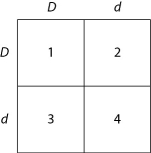 -Which of the plants will be True-breeding?
 (Multiple Choice)
4.8/5 (70)
(70) Black fur in mice (B)is dominant to brown fur (b). Short tails (T)are dominant to long tails (t). What fraction of the progeny of the cross BbTt × BBtt will have black fur and long tails?
(Multiple Choice)
4.8/5 (87)
(87) A blue budgie is crossed with a white budgie. Which of the following results is not possible?
(Multiple Choice)
4.8/5 (92)
(92) Karen and Steve each have a sibling with sickle-cell disease. Neither Karen nor Steve nor any of their parents have the disease, and none of them have been tested to reveal sickle-cell trait. Based on this incomplete information, calculate the probability that if this couple has a child, the child will have sickle-cell disease.
(Short Answer)
4.9/5 (71)
(71) Use the following information to answer the questions below.
Radish flowers may be red, purple, or white. A cross between a red-flowered plant and a white-flowered plant yields all-purple offspring. The part of the radish we eat may be oval or long, with long being the dominant characteristic.
-In the F₂ generation of the above cross, which of the following phenotypic ratios would be expected?
(Multiple Choice)
4.9/5 (72)
(72) In corn plants, a dominant allele I inhibits kernel color, while the recessive allele i permits color when homozygous. At a different locus, the dominant allele P causes purple kernel color, while the homozygous recessive genotype pp causes red kernels. If plants heterozygous at both loci are crossed, what will be the phenotypic ratio of the offspring?
(Essay)
4.8/5 (77)
(77) Use the following information to answer the questions below.
A woman who has blood type A positive has a daughter who is type O positive and a son who is type B negative. Rh positive is a trait that shows simple dominance over Rh negative and is designated by the alleles R and r, respectively. A third gene for the MN blood group has codominant alleles M and N.
-Which of the following is a possible phenotype for the father?
(Multiple Choice)
4.9/5 (87)
(87) Huntington's disease is a dominant condition with late age of onset in humans. If one parent has the disease, what is the probability that his or her child will have the disease?
(Multiple Choice)
4.9/5 (76)
(76) In cattle, roan coat color (mixed red and white hairs)occurs in the heterozygous (Rr)offspring of red (RR)and white (rr)homozygotes. Which of the following crosses would produce offspring in the ratio of 1 red : 2 roan : 1 white?
(Multiple Choice)
4.7/5 (78)
(78) The fact that all seven of the pea plant traits studied by Mendel obeyed the principle of independent assortment most probably indicates which of the following?
(Multiple Choice)
4.9/5 (75)
(75) In sesame plants, the one-pod condition (P)is dominant to the three-pod condition (p), and normal leaf (L)is dominant to wrinkled leaf (l). Pod type and leaf type are inherited independently. Determine the genotypes for the two parents for all possible matings producing the following offspring:
A)318 one-pod, normal leaf and 98 one-pod, wrinkled leaf
B)323 three-pod, normal leaf and 106 three-pod, wrinkled leaf
C)401 one-pod, normal leaf
D)150 one-pod, normal leaf, 147 one-pod, wrinkled leaf, 51 three-pod, normal leaf, and 48 three-pod, wrinkled leaf
E)223 one-pod, normal leaf, 72 one-pod, wrinkled leaf, 76 three-pod, normal leaf, and 27 three-pod, wrinkled leaf
(Essay)
4.9/5 (62)
(62) An ideal procedure for fetal testing in humans would have which of the following features?
(Multiple Choice)
5.0/5 (80)
(80) Skin color in a certain species of fish is inherited via a single gene with four different alleles. How many different types of gametes would be possible in this system?
(Multiple Choice)
4.9/5 (69)
(69) An obstetrician knows that one of her patients is a pregnant woman whose fetus is at risk for a serious disorder that is detectable biochemically in fetal cells. The obstetrician would most reasonably offer which of the following procedures to her patient?
(Multiple Choice)
4.9/5 (79)
(79) Two True-breeding stocks of pea plants are crossed. One parent has red, axial flowers and the other has white, terminal flowers; all F₁ individuals have red, axial flowers. The genes for flower color and location assort independently. If 1,000 F₂ offspring resulted from the cross, approximately how many of them would you expect to have red, terminal flowers?
(Multiple Choice)
5.0/5 (89)
(89) 
Filters
- Essay(0)
- Multiple Choice(0)
- Short Answer(0)
- True False(0)
- Matching(0)