



 Chat with AI
Exam 14: Mendel and the Gene Idea

Exam 1: Introduction: Themes in the Study of Life66 Questions
Exam 2: The Chemical Context of Life83 Questions
Exam 3: Water and the Fitness of the Environment66 Questions
Exam 4: Carbon and the Molecular Diversity of Life68 Questions
Exam 5: The Structure and Function of Large Biological Molecules109 Questions
Exam 6: A Tour of the Cell75 Questions
Exam 7: Membrane Structure and Function75 Questions
Exam 8: An Introduction to Metabolism79 Questions
Exam 9: Cellular Respiration: Harvesting Chemical Energy103 Questions
Exam 10: Photosynthesis74 Questions
Exam 11: Cell Communication62 Questions
Exam 12: The Cell Cycle80 Questions
Exam 13: Meiosis and Sexual Life Cycles68 Questions
Exam 14: Mendel and the Gene Idea90 Questions
Exam 15: The Chromosomal Basis of Inheritance75 Questions
Exam 16: The Molecular Basis of Inheritance72 Questions
Exam 17: From Gene to Protein84 Questions
Exam 18: Control of Gene Expression101 Questions
Exam 19: Viruses38 Questions
Exam 20: Biotechnology70 Questions
Exam 21: Genomes and Their Evolution37 Questions
Exam 22: Descent With Modification: a Darwinian View of Life57 Questions
Exam 23: The Evolution of Populations84 Questions
Exam 24: The Origin of Species60 Questions
Exam 25: The History of Life on Earth85 Questions
Exam 26: Phylogeny and the Tree of Life90 Questions
Exam 27: Bacteria and Archaea78 Questions
Exam 28: Protists79 Questions
Exam 29: Plant Diversity I: How Plants Colonized Land74 Questions
Exam 30: Plant Diversity Ii: the Evolution of Seed Plants101 Questions
Exam 31: Fungi87 Questions
Exam 32: An Introduction to Animal Diversity82 Questions
Exam 33: Invertebrates98 Questions
Exam 34: Vertebrates112 Questions
Exam 35: Plant Structure, Growth, and Development77 Questions
Exam 36: Transport in Vascular Plants84 Questions
Exam 37: Soil and Plant Nutrition85 Questions
Exam 38: Angiosperm Reproduction and Biotechnology86 Questions
Exam 39: Plant Responses to Internal and External Signals111 Questions
Exam 40: Basic Principles of Animal Form and Function74 Questions
Exam 41: Animal Nutrition68 Questions
Exam 42: Circulation and Gas Exchange78 Questions
Exam 43: The Immune System85 Questions
Exam 44: Osmoregulation and Excretion49 Questions
Exam 45: Hormones and the Endocrine System71 Questions
Exam 46: Animal Reproduction85 Questions
Exam 47: Animal Development75 Questions
Exam 48: Neurons, Synapses, and Signaling52 Questions
Exam 49: Nervous Systems48 Questions
Exam 50: Sensory and Motor Mechanisms59 Questions
Exam 51: Animal Behavior74 Questions
Exam 52: An Introduction to Ecology and the Biosphere71 Questions
Exam 53: Population Ecology80 Questions
Exam 54: Community Ecology74 Questions
Exam 55: Ecosystems79 Questions
Exam 56: Conservation Biology and Restoration Ecology65 Questions
Select questions type


The following questions refer to the pedigree chart in Figure 14.2 for a family, some of whose members exhibit the dominant trait, wooly hair. Affected individuals are indicated by an open square or circle.
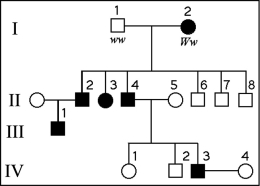 Figure 14.2
-What is the genotype of individual II-5?
Figure 14.2
-What is the genotype of individual II-5? (Multiple Choice)
4.8/5  (78)
(78) Pea plants were particularly well suited for use in Mendel's breeding experiments for all of the following reasons except that
(Multiple Choice)
4.8/5 (79)
(79) Mendel's observation of the segregation of alleles in gamete formation has its basis in which of the following phases of cell division?
(Multiple Choice)
4.9/5 (80)
(80) Which of the following is an example of polygenic inheritance?
(Multiple Choice)
4.8/5 (82)
(82) Use the following information to answer the questions below.
Labrador retrievers are black, brown, or yellow. In a cross of a black female with a brown male, results can be either all black puppies, 1/2 black to 1/2 brown puppies, or 3/4 black to 1/4 yellow puppies.
-In one type cross of black × black, the results were as follows: 9/16 black
4/16 yellow
3/16 brown
The genotype aabb must result in which of the following?
(Multiple Choice)
4.8/5 (94)
(94) When crossing an organism that is homozygous recessive for a single trait with a heterozygote, what is the chance of producing an offspring with the homozygous recessive phenotype?
(Multiple Choice)
5.0/5 (82)
(82) In a cross AaBbCc × AaBbCc, what is the probability of producing the genotype AABBCC?
(Multiple Choice)
4.8/5 (67)
(67) Phenylketonuria (PKU)is an inherited disease caused by a recessive allele. If a woman and her husband, who are both carriers, have three children, what is the probability of each of the following?
A)All three children are of normal phenotype.
B)One or more of the three children have the disease.
C)All three children have the disease.
D)At least one child is phenotypically normal.
(Note: Remember that the probabilities of all possible outcomes always add up to 1.)
(Essay)
4.7/5 (77)
(77) In mice, black color (B)is dominant to white (b). At a different locus, a dominant allele (A)produces a band of yellow just below the tip of each hair in mice with black fur. This gives a frosted appearance known as agouti. Expression of the recessive allele (a)results in a solid coat color. If mice that are heterozygous at both loci are crossed, what is the expected phenotypic ratio of their offspring?
(Essay)
4.9/5 (98)
(98) Hutchinson-Gilford progeria is an exceedingly rare human genetic disorder in which there is very early senility, and death, usually of coronary artery disease, at an average age of approximately 13. Patients, who look very old even as children, do not live to reproduce. Which of the following represents the most likely assumption?
(Multiple Choice)
4.8/5 (91)
(91) What is the difference between a monohybrid cross and a dihybrid cross?
(Multiple Choice)
4.8/5 (66)
(66) Drosophila (fruit flies)usually have long wings (+)but mutations in two different genes can result in bent wings (bt)or vestigial wings (vg). If a homozygous bent wing fly is mated with a homozygous vestigial wing fly, which of the following offspring would you expect?
(Multiple Choice)
4.8/5 (63)
(63) Two characters that appear in a 9:3:3:1 ratio in the F₂ generation should have which of the following properties?
(Multiple Choice)
4.7/5 (69)
(69) In some plants, a True-breeding, red-flowered strain gives all pink flowers when crossed with a white-flowered strain: CᴿCᴿ (red)× CᵂCᵂ (white)→ CᴿCᵂ (pink). If flower position (axial or terminal)is inherited as it is in peas (see Table 14.1 in your textbook), what will be the ratios of genotypes and phenotypes of the F₁ generation resulting from the following cross: axial-red (True-breeding)× terminal-white?
What will be the ratios in the F₂ generation?
(Essay)
4.8/5 (89)
(89) Most genes have many more than two alleles. However, which of the following is also True?
(Multiple Choice)
4.9/5 (66)
(66) In 1981, a stray black cat with unusual rounded, curled-back ears was adopted by a family in California. Hundreds of descendants of the cat have since been born, and cat fanciers hope to develop the curl cat into a show breed. Suppose you owned the first curl cat and wanted to develop a True-breeding variety. How would you determine whether the curl allele is dominant or recessive?
How would you obtain True-breeding curl cats?
How could you be sure they are True-breeding?
(Essay)
4.9/5 (86)
(86) Use the following information to answer the questions below.
Radish flowers may be red, purple, or white. A cross between a red-flowered plant and a white-flowered plant yields all-purple offspring. The part of the radish we eat may be oval or long, with long being the dominant characteristic.
-If True-breeding red long radishes are crossed with True breeding white oval radishes, the F₁ will be expected to be which of the following?
(Multiple Choice)
4.9/5 (88)
(88) A scientist discovers a DNA-based test for the allele of a particular gene. This and only this allele, if homozygous, produces an effect that results in death at or about the time of birth. Of the following, which is the best use of this discovery?
(Multiple Choice)
4.9/5 (94)
(94) Imagine that you are a genetic counselor, and a couple planning to start a family comes to you for information. Charles was married once before, and he and his first wife had a child with cystic fibrosis. The brother of his current wife, Elaine, died of cystic fibrosis. What is the probability that Charles and Elaine will have a baby with cystic fibrosis?
(Neither Charles nor Elaine has cystic fibrosis.)
(Short Answer)
5.0/5 (82)
(82) 
Filters
- Essay(0)
- Multiple Choice(0)
- Short Answer(0)
- True False(0)
- Matching(0)