



 Chat with AI
Exam 50: Sensory and Motor Mechanisms

Exam 1: Introduction: Themes in the Study of Life66 Questions
Exam 2: The Chemical Context of Life83 Questions
Exam 3: Water and the Fitness of the Environment66 Questions
Exam 4: Carbon and the Molecular Diversity of Life68 Questions
Exam 5: The Structure and Function of Large Biological Molecules109 Questions
Exam 6: A Tour of the Cell75 Questions
Exam 7: Membrane Structure and Function75 Questions
Exam 8: An Introduction to Metabolism79 Questions
Exam 9: Cellular Respiration: Harvesting Chemical Energy103 Questions
Exam 10: Photosynthesis74 Questions
Exam 11: Cell Communication62 Questions
Exam 12: The Cell Cycle80 Questions
Exam 13: Meiosis and Sexual Life Cycles68 Questions
Exam 14: Mendel and the Gene Idea90 Questions
Exam 15: The Chromosomal Basis of Inheritance75 Questions
Exam 16: The Molecular Basis of Inheritance72 Questions
Exam 17: From Gene to Protein84 Questions
Exam 18: Control of Gene Expression101 Questions
Exam 19: Viruses38 Questions
Exam 20: Biotechnology70 Questions
Exam 21: Genomes and Their Evolution37 Questions
Exam 22: Descent With Modification: a Darwinian View of Life57 Questions
Exam 23: The Evolution of Populations84 Questions
Exam 24: The Origin of Species60 Questions
Exam 25: The History of Life on Earth85 Questions
Exam 26: Phylogeny and the Tree of Life90 Questions
Exam 27: Bacteria and Archaea78 Questions
Exam 28: Protists79 Questions
Exam 29: Plant Diversity I: How Plants Colonized Land74 Questions
Exam 30: Plant Diversity Ii: the Evolution of Seed Plants101 Questions
Exam 31: Fungi87 Questions
Exam 32: An Introduction to Animal Diversity82 Questions
Exam 33: Invertebrates98 Questions
Exam 34: Vertebrates112 Questions
Exam 35: Plant Structure, Growth, and Development77 Questions
Exam 36: Transport in Vascular Plants84 Questions
Exam 37: Soil and Plant Nutrition85 Questions
Exam 38: Angiosperm Reproduction and Biotechnology86 Questions
Exam 39: Plant Responses to Internal and External Signals111 Questions
Exam 40: Basic Principles of Animal Form and Function74 Questions
Exam 41: Animal Nutrition68 Questions
Exam 42: Circulation and Gas Exchange78 Questions
Exam 43: The Immune System85 Questions
Exam 44: Osmoregulation and Excretion49 Questions
Exam 45: Hormones and the Endocrine System71 Questions
Exam 46: Animal Reproduction85 Questions
Exam 47: Animal Development75 Questions
Exam 48: Neurons, Synapses, and Signaling52 Questions
Exam 49: Nervous Systems48 Questions
Exam 50: Sensory and Motor Mechanisms59 Questions
Exam 51: Animal Behavior74 Questions
Exam 52: An Introduction to Ecology and the Biosphere71 Questions
Exam 53: Population Ecology80 Questions
Exam 54: Community Ecology74 Questions
Exam 55: Ecosystems79 Questions
Exam 56: Conservation Biology and Restoration Ecology65 Questions
Select questions type


Muscle cells are stimulated by neurotransmitters released from the synaptic terminal of

Free
(Multiple Choice)
4.9/5  (72)
(72) Correct Answer: Verified
B
Skeletal fibers may be classified as either oxidative or glycolytic. Which of the following muscles would be called glycolytic?
Free
(Multiple Choice)
4.9/5 (87)
(87) Correct Answer:Verified
VerifiedE
Which of the following sensory receptors is incorrectly paired with its category?
Free
(Multiple Choice)
4.9/5 (67)
(67) Correct Answer:Verified
VerifiedE
Which of the following receptors is incorrectly paired with the type of energy it transduces?
(Multiple Choice)
4.8/5 (73)
(73) When light strikes the rhodopsin in a rod, retinal isomerizes, initiating a signal transduction pathway that
(Multiple Choice)
4.9/5 (82)
(82) If a baseball player is hit in the back of the head, which part of his brain would be the most likely injured?
(Multiple Choice)
4.8/5 (83)
(83) Why does your arm feel cold when you reach inside the refrigerator to get a container of milk?
(Multiple Choice)
4.8/5 (90)
(90) Which of the following is an attachment site between sensory hairs that open ion channels when the hairs bend?
(Multiple Choice)
4.9/5 (59)
(59) It is very difficult to sneak up to a grasshopper and catch it. Why?
(Multiple Choice)
4.7/5 (83)
(83) Which of the following is a correct statement about the cells of the human retina?
(Multiple Choice)
5.0/5 (84)
(84) The following questions refer to the diagram of the ear in Figure 50.2.
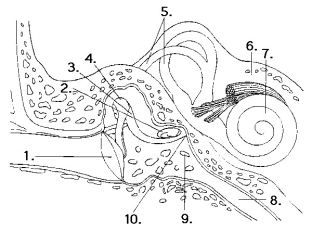 Figure 50.2
-Which structure(s)is (are)involved in equilibrium?
Figure 50.2
-Which structure(s)is (are)involved in equilibrium? (Multiple Choice)
4.9/5 (82)
(82) Duchenne muscular dystrophy is a sex-linked condition in humans that results from abnormal dystrophin protein. The condition results in progressive weakening and atrophy of muscles, usually beginning with the legs. This is most consistent with which of the following?
(Multiple Choice)
4.9/5 (66)
(66) What are animals with hydrostatic skeletons able to do that animals with exoskeletons or internal skeletons cannot do?
(Multiple Choice)
4.7/5 (66)
(66) Which of the following is controlled by the magnitude of a receptor potential?
(Multiple Choice)
4.9/5 (82)
(82) The pathway leading to the perception of sound by mammals begins with the
(Multiple Choice)
4.9/5 (71)
(71) Which function associated with muscle would be most directly affected by low levels of calcium?
(Multiple Choice)
4.9/5 (88)
(88) Which of the following are shared by skeletal, cardiac, and smooth muscle?
(Multiple Choice)
4.7/5 (75)
(75) Use Figure 50.3 to answer the following questions.
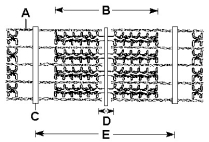 Figure 50.3
-Which section consists only of myosin filaments?
Figure 50.3
-Which section consists only of myosin filaments? (Short Answer)
4.8/5 (87)
(87) 
Filters
- Essay(0)
- Multiple Choice(0)
- Short Answer(0)
- True False(0)
- Matching(0)