



 Chat with AI
Exam 34: Vertebrates

Exam 1: Introduction: Themes in the Study of Life66 Questions
Exam 2: The Chemical Context of Life83 Questions
Exam 3: Water and the Fitness of the Environment66 Questions
Exam 4: Carbon and the Molecular Diversity of Life68 Questions
Exam 5: The Structure and Function of Large Biological Molecules109 Questions
Exam 6: A Tour of the Cell75 Questions
Exam 7: Membrane Structure and Function75 Questions
Exam 8: An Introduction to Metabolism79 Questions
Exam 9: Cellular Respiration: Harvesting Chemical Energy103 Questions
Exam 10: Photosynthesis74 Questions
Exam 11: Cell Communication62 Questions
Exam 12: The Cell Cycle80 Questions
Exam 13: Meiosis and Sexual Life Cycles68 Questions
Exam 14: Mendel and the Gene Idea90 Questions
Exam 15: The Chromosomal Basis of Inheritance75 Questions
Exam 16: The Molecular Basis of Inheritance72 Questions
Exam 17: From Gene to Protein84 Questions
Exam 18: Control of Gene Expression101 Questions
Exam 19: Viruses38 Questions
Exam 20: Biotechnology70 Questions
Exam 21: Genomes and Their Evolution37 Questions
Exam 22: Descent With Modification: a Darwinian View of Life57 Questions
Exam 23: The Evolution of Populations84 Questions
Exam 24: The Origin of Species60 Questions
Exam 25: The History of Life on Earth85 Questions
Exam 26: Phylogeny and the Tree of Life90 Questions
Exam 27: Bacteria and Archaea78 Questions
Exam 28: Protists79 Questions
Exam 29: Plant Diversity I: How Plants Colonized Land74 Questions
Exam 30: Plant Diversity Ii: the Evolution of Seed Plants101 Questions
Exam 31: Fungi87 Questions
Exam 32: An Introduction to Animal Diversity82 Questions
Exam 33: Invertebrates98 Questions
Exam 34: Vertebrates112 Questions
Exam 35: Plant Structure, Growth, and Development77 Questions
Exam 36: Transport in Vascular Plants84 Questions
Exam 37: Soil and Plant Nutrition85 Questions
Exam 38: Angiosperm Reproduction and Biotechnology86 Questions
Exam 39: Plant Responses to Internal and External Signals111 Questions
Exam 40: Basic Principles of Animal Form and Function74 Questions
Exam 41: Animal Nutrition68 Questions
Exam 42: Circulation and Gas Exchange78 Questions
Exam 43: The Immune System85 Questions
Exam 44: Osmoregulation and Excretion49 Questions
Exam 45: Hormones and the Endocrine System71 Questions
Exam 46: Animal Reproduction85 Questions
Exam 47: Animal Development75 Questions
Exam 48: Neurons, Synapses, and Signaling52 Questions
Exam 49: Nervous Systems48 Questions
Exam 50: Sensory and Motor Mechanisms59 Questions
Exam 51: Animal Behavior74 Questions
Exam 52: An Introduction to Ecology and the Biosphere71 Questions
Exam 53: Population Ecology80 Questions
Exam 54: Community Ecology74 Questions
Exam 55: Ecosystems79 Questions
Exam 56: Conservation Biology and Restoration Ecology65 Questions
Select questions type


The following questions refer to the phylogenetic tree shown in Figure 34.1.
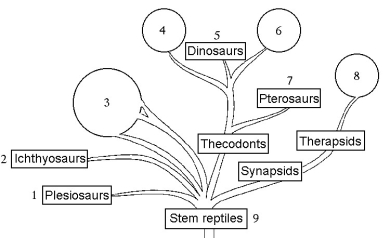 -During chordate evolution, what is the sequence (from earliest to most recent)in which the following structures arose?
1) amniotic egg
2) paired fins
3) jaws
4) swim bladder
5) four-chambered heart
-During chordate evolution, what is the sequence (from earliest to most recent)in which the following structures arose?
1) amniotic egg
2) paired fins
3) jaws
4) swim bladder
5) four-chambered heart
Free
(Multiple Choice)
4.8/5  (87)
(87) Correct Answer: Verified
A
The following questions refer to the phylogenetic tree shown in Figure 34.1.
-Which organisms are represented by 6?
-Which organisms are represented by 6?Free
(Multiple Choice)
4.7/5 (87)
(87) Correct Answer:Verified
VerifiedA
The following questions refer to the phylogenetic tree shown in Figure 34.1.
-Which of these would a paleontologist be most likely to do in order to determine whether a fossil represents a reptile or a mammal?
-Which of these would a paleontologist be most likely to do in order to determine whether a fossil represents a reptile or a mammal?Free
(Multiple Choice)
4.9/5 (69)
(69) Correct Answer:Verified
VerifiedE
The following questions refer to the phylogenetic tree shown in Figure 34.1.
-Which pair of numbers includes extant endotherms?
-Which pair of numbers includes extant endotherms? (Multiple Choice)
4.9/5 (81)
(81) For the following items, match the extant vertebrate groups with the descriptions.
-Their scales closely resemble teeth in both structure and origin.
(Multiple Choice)
4.8/5 (75)
(75) The following questions refer to the phylogenetic tree shown in Figure 34.1.
-How are primates different from all other mammals?
-How are primates different from all other mammals? (Multiple Choice)
4.8/5 (81)
(81) The following questions refer to the description below.
While on an intersession course in tropical ecology, Kris pulls a large, snakelike organism from a burrow (the class was granted a collecting permit). The 1-m-long organism has smooth skin, which appears to be segmented. It has two tiny eyes that are hard to see because they seem to be covered by skin. Kris brings it back to the lab at the field station, where it is a source of puzzlement to the class. Kris says that it is a giant oligochaete worm; Shaun suggests it is a legless amphibian; Kelly proposes it belongs to a snake species that is purely fossorial (lives in a burrow).
-Which one of these, if found, should clear up any remaining doubt as to the identity of the organism?
(Multiple Choice)
4.9/5 (77)
(77) The following questions refer to the phylogenetic tree shown in Figure 34.1.
-Among extant vertebrates, a sheet of muscle called the diaphragm is found in
-Among extant vertebrates, a sheet of muscle called the diaphragm is found in (Multiple Choice)
4.7/5 (77)
(77) The following questions refer to the description below.
Terry catches a ray-finned fish from the ocean and notices that, attached to its flank, there is an equally long, snakelike organism. The attached organism has no external segmentation, no scales, a round mouth surrounded by a sucker and two small eyes. Terry thinks it might be a marine leech, a hagfish, or a lamprey.
-Terry saved some of the tooth-like objects within the hagfish's round mouth to analyze their composition in his mentor's biochemistry research lab. Terry will find that they are composed of the same protein found in reptilian
(Multiple Choice)
4.9/5 (87)
(87) Which of the following could be considered the most recent common ancestor of living tetrapods?
(Multiple Choice)
4.8/5 (76)
(76) Which of the following statements is correct in regard to Homo erectus?
(Multiple Choice)
4.9/5 (85)
(85) The following questions refer to the phylogenetic tree shown in Figure 34.1.
-Whose DNA would have had the most sequence homologies with amphibian DNA?
-Whose DNA would have had the most sequence homologies with amphibian DNA? (Multiple Choice)
4.8/5 (82)
(82) The following questions refer to the phylogenetic tree shown in Figure 34.1.
-Which pair of numbers most likely represents extant, nonbird reptiles?
-Which pair of numbers most likely represents extant, nonbird reptiles? (Multiple Choice)
5.0/5 (83)
(83) The origin of the craniates occurred at roughly the same time as the
(Multiple Choice)
4.9/5 (85)
(85) The following questions refer to the description below.
While on an intersession course in tropical ecology, Kris pulls a large, snakelike organism from a burrow (the class was granted a collecting permit). The 1-m-long organism has smooth skin, which appears to be segmented. It has two tiny eyes that are hard to see because they seem to be covered by skin. Kris brings it back to the lab at the field station, where it is a source of puzzlement to the class. Kris says that it is a giant oligochaete worm; Shaun suggests it is a legless amphibian; Kelly proposes it belongs to a snake species that is purely fossorial (lives in a burrow).
-Most dinosaurs and pterosaurs become extinct at the close of the __________ era.
(Multiple Choice)
4.8/5 (92)
(92) A trend first observed in the evolution of the earliest tetrapods was
(Multiple Choice)
4.8/5 (90)
(90) There is evidence that ray-finned fishes originally evolved
(Multiple Choice)
4.8/5 (75)
(75) Which of these statements accurately describes a similarity between sharks and ray-finned fishes?
(Multiple Choice)
4.9/5 (88)
(88) 
Filters
- Essay(0)
- Multiple Choice(0)
- Short Answer(0)
- True False(0)
- Matching(0)