



 Chat with AI
Exam 34: Vertebrates

Exam 1: Introduction: Themes in the Study of Life66 Questions
Exam 2: The Chemical Context of Life83 Questions
Exam 3: Water and the Fitness of the Environment66 Questions
Exam 4: Carbon and the Molecular Diversity of Life68 Questions
Exam 5: The Structure and Function of Large Biological Molecules109 Questions
Exam 6: A Tour of the Cell75 Questions
Exam 7: Membrane Structure and Function75 Questions
Exam 8: An Introduction to Metabolism79 Questions
Exam 9: Cellular Respiration: Harvesting Chemical Energy103 Questions
Exam 10: Photosynthesis74 Questions
Exam 11: Cell Communication62 Questions
Exam 12: The Cell Cycle80 Questions
Exam 13: Meiosis and Sexual Life Cycles68 Questions
Exam 14: Mendel and the Gene Idea90 Questions
Exam 15: The Chromosomal Basis of Inheritance75 Questions
Exam 16: The Molecular Basis of Inheritance72 Questions
Exam 17: From Gene to Protein84 Questions
Exam 18: Control of Gene Expression101 Questions
Exam 19: Viruses38 Questions
Exam 20: Biotechnology70 Questions
Exam 21: Genomes and Their Evolution37 Questions
Exam 22: Descent With Modification: a Darwinian View of Life57 Questions
Exam 23: The Evolution of Populations84 Questions
Exam 24: The Origin of Species60 Questions
Exam 25: The History of Life on Earth85 Questions
Exam 26: Phylogeny and the Tree of Life90 Questions
Exam 27: Bacteria and Archaea78 Questions
Exam 28: Protists79 Questions
Exam 29: Plant Diversity I: How Plants Colonized Land74 Questions
Exam 30: Plant Diversity Ii: the Evolution of Seed Plants101 Questions
Exam 31: Fungi87 Questions
Exam 32: An Introduction to Animal Diversity82 Questions
Exam 33: Invertebrates98 Questions
Exam 34: Vertebrates112 Questions
Exam 35: Plant Structure, Growth, and Development77 Questions
Exam 36: Transport in Vascular Plants84 Questions
Exam 37: Soil and Plant Nutrition85 Questions
Exam 38: Angiosperm Reproduction and Biotechnology86 Questions
Exam 39: Plant Responses to Internal and External Signals111 Questions
Exam 40: Basic Principles of Animal Form and Function74 Questions
Exam 41: Animal Nutrition68 Questions
Exam 42: Circulation and Gas Exchange78 Questions
Exam 43: The Immune System85 Questions
Exam 44: Osmoregulation and Excretion49 Questions
Exam 45: Hormones and the Endocrine System71 Questions
Exam 46: Animal Reproduction85 Questions
Exam 47: Animal Development75 Questions
Exam 48: Neurons, Synapses, and Signaling52 Questions
Exam 49: Nervous Systems48 Questions
Exam 50: Sensory and Motor Mechanisms59 Questions
Exam 51: Animal Behavior74 Questions
Exam 52: An Introduction to Ecology and the Biosphere71 Questions
Exam 53: Population Ecology80 Questions
Exam 54: Community Ecology74 Questions
Exam 55: Ecosystems79 Questions
Exam 56: Conservation Biology and Restoration Ecology65 Questions
Select questions type


Which of the following statements about craniates is (are)correct?
1) Craniates are more highly cephalized than are non-craniates.
2) Craniates' genomic evolution includes duplication of clusters of genes that code for transcription factors.
3) The craniate clade is synonymous with the vertebrate clade.
4) Pharyngeal slits that can assist in gas exchange originated in craniates,
5) The two-chambered heart originated with the early craniates.
(Multiple Choice)
5.0/5  (80)
(80) The following questions refer to the description below.
While on an intersession course in tropical ecology, Kris pulls a large, snakelike organism from a burrow (the class was granted a collecting permit). The 1-m-long organism has smooth skin, which appears to be segmented. It has two tiny eyes that are hard to see because they seem to be covered by skin. Kris brings it back to the lab at the field station, where it is a source of puzzlement to the class. Kris says that it is a giant oligochaete worm; Shaun suggests it is a legless amphibian; Kelly proposes it belongs to a snake species that is purely fossorial (lives in a burrow).
-The condition of the eyes in this organism is similar to that seen in placental and marsupial moles. It is also most similar in functional significance to the
(Multiple Choice)
4.8/5 (82)
(82) The following questions refer to the phylogenetic tree shown in Figure 34.1.
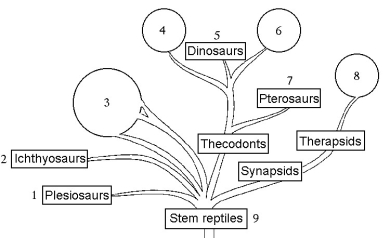 -In which vertebrates is fertilization exclusively internal?
 (Multiple Choice)
4.7/5 (74)
(74) Some animals that lived 530 million years ago resembled lancelets but had a brain and a skull. These animals may represent
(Multiple Choice)
4.9/5 (82)
(82) Which of these statements about human evolution is correct?
(Multiple Choice)
4.7/5 (64)
(64) Which is the most specific group in which prosimians can be included?
(Multiple Choice)
4.9/5 (79)
(79) As humans diverged from other primates, which of the following appeared first?
(Multiple Choice)
4.8/5 (81)
(81) Arrange these taxonomic terms from most inclusive (i.e., most general)to least inclusive (i.e., most specific). 1. lobe-fins
2) amphibians
3) gnathostomes
4) osteichthyans
5) tetrapods
(Multiple Choice)
4.7/5 (81)
(81) What is the single unique characteristic that distinguishes extant birds from other extant vertebrates?
(Multiple Choice)
4.9/5 (85)
(85) The oldest fossil remains of Homo sapiens found so far date from about
(Multiple Choice)
4.9/5 (92)
(92) The following questions refer to the description below.
While on an intersession course in tropical ecology, Kris pulls a large, snakelike organism from a burrow (the class was granted a collecting permit). The 1-m-long organism has smooth skin, which appears to be segmented. It has two tiny eyes that are hard to see because they seem to be covered by skin. Kris brings it back to the lab at the field station, where it is a source of puzzlement to the class. Kris says that it is a giant oligochaete worm; Shaun suggests it is a legless amphibian; Kelly proposes it belongs to a snake species that is purely fossorial (lives in a burrow).
-Which of the following structures are possessed only by birds?
(Multiple Choice)
4.9/5 (64)
(64) 
Filters
- Essay(0)
- Multiple Choice(0)
- Short Answer(0)
- True False(0)
- Matching(0)