



 Chat with AI
Exam 31: Fungi

Exam 1: Introduction: Themes in the Study of Life66 Questions
Exam 2: The Chemical Context of Life83 Questions
Exam 3: Water and the Fitness of the Environment66 Questions
Exam 4: Carbon and the Molecular Diversity of Life68 Questions
Exam 5: The Structure and Function of Large Biological Molecules109 Questions
Exam 6: A Tour of the Cell75 Questions
Exam 7: Membrane Structure and Function75 Questions
Exam 8: An Introduction to Metabolism79 Questions
Exam 9: Cellular Respiration: Harvesting Chemical Energy103 Questions
Exam 10: Photosynthesis74 Questions
Exam 11: Cell Communication62 Questions
Exam 12: The Cell Cycle80 Questions
Exam 13: Meiosis and Sexual Life Cycles68 Questions
Exam 14: Mendel and the Gene Idea90 Questions
Exam 15: The Chromosomal Basis of Inheritance75 Questions
Exam 16: The Molecular Basis of Inheritance72 Questions
Exam 17: From Gene to Protein84 Questions
Exam 18: Control of Gene Expression101 Questions
Exam 19: Viruses38 Questions
Exam 20: Biotechnology70 Questions
Exam 21: Genomes and Their Evolution37 Questions
Exam 22: Descent With Modification: a Darwinian View of Life57 Questions
Exam 23: The Evolution of Populations84 Questions
Exam 24: The Origin of Species60 Questions
Exam 25: The History of Life on Earth85 Questions
Exam 26: Phylogeny and the Tree of Life90 Questions
Exam 27: Bacteria and Archaea78 Questions
Exam 28: Protists79 Questions
Exam 29: Plant Diversity I: How Plants Colonized Land74 Questions
Exam 30: Plant Diversity Ii: the Evolution of Seed Plants101 Questions
Exam 31: Fungi87 Questions
Exam 32: An Introduction to Animal Diversity82 Questions
Exam 33: Invertebrates98 Questions
Exam 34: Vertebrates112 Questions
Exam 35: Plant Structure, Growth, and Development77 Questions
Exam 36: Transport in Vascular Plants84 Questions
Exam 37: Soil and Plant Nutrition85 Questions
Exam 38: Angiosperm Reproduction and Biotechnology86 Questions
Exam 39: Plant Responses to Internal and External Signals111 Questions
Exam 40: Basic Principles of Animal Form and Function74 Questions
Exam 41: Animal Nutrition68 Questions
Exam 42: Circulation and Gas Exchange78 Questions
Exam 43: The Immune System85 Questions
Exam 44: Osmoregulation and Excretion49 Questions
Exam 45: Hormones and the Endocrine System71 Questions
Exam 46: Animal Reproduction85 Questions
Exam 47: Animal Development75 Questions
Exam 48: Neurons, Synapses, and Signaling52 Questions
Exam 49: Nervous Systems48 Questions
Exam 50: Sensory and Motor Mechanisms59 Questions
Exam 51: Animal Behavior74 Questions
Exam 52: An Introduction to Ecology and the Biosphere71 Questions
Exam 53: Population Ecology80 Questions
Exam 54: Community Ecology74 Questions
Exam 55: Ecosystems79 Questions
Exam 56: Conservation Biology and Restoration Ecology65 Questions
Select questions type


Zygosporangia are to zygomycetes as basidia are to

Free
(Multiple Choice)
4.9/5  (76)
(76) Correct Answer: Verified
E
Which of these is a fungal structure that is usually associated with asexual reproduction?
Free
(Multiple Choice)
4.8/5 (72)
(72) Correct Answer:Verified
VerifiedC
Which of the following terms is correctly associated with fungi in general?
Free
(Multiple Choice)
4.9/5 (80)
(80) Correct Answer:Verified
VerifiedC
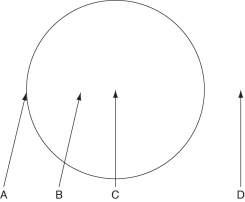
Figure 31.1 below depicts the outline of a large fairy ring that has appeared overnight in an open meadow, as viewed from above. The fairy ring represents the furthest advance of this mycelium through the soil. Locations A-D are all 0.5 meters below the soil surface. Responses may be used once, more than once, or not at all.
 -The symbiotic associations involving roots and soil fungi are considered
 (Multiple Choice)
4.8/5 (65)
(65) In septate fungi, what structures allow cytoplasmic streaming to distribute needed nutrients, synthesized compounds, and organelles throughout the hyphae?
(Multiple Choice)
4.9/5 (87)
(87) Figure 31.1 below depicts the outline of a large fairy ring that has appeared overnight in an open meadow, as viewed from above. The fairy ring represents the furthest advance of this mycelium through the soil. Locations A-D are all 0.5 meters below the soil surface. Responses may be used once, more than once, or not at all.
-Lichens are symbiotic associations of fungi and
-Lichens are symbiotic associations of fungi and (Multiple Choice)
4.7/5 (79)
(79) The gray-black, filamentous, haploid mycelium growing on bread is most likely what kind of organism?
(Multiple Choice)
4.9/5 (76)
(76) Figure 31.1 below depicts the outline of a large fairy ring that has appeared overnight in an open meadow, as viewed from above. The fairy ring represents the furthest advance of this mycelium through the soil. Locations A-D are all 0.5 meters below the soil surface. Responses may be used once, more than once, or not at all.
-Sexual reproduction has never been observed among the fungi that produce the blue-green marbling of blue cheeses. What is True of these fungi and others that do not have a sexual stage?
-Sexual reproduction has never been observed among the fungi that produce the blue-green marbling of blue cheeses. What is True of these fungi and others that do not have a sexual stage? (Multiple Choice)
4.7/5 (86)
(86) The following questions are based on the description below.
Rose-picker's disease is caused by the yeast, Sporothrix schenkii. The yeast grows on the exteriors of rose-bush thorns. If a human gets pricked by such a thorn, the yeasts can be introduced under the skin. The yeasts then assume a hyphal morphology and grow along the interiors of lymphatic vessels until they reach a lymph node. This often results in the accumulation of pus in the lymph node, which subsequently ulcerates through the skin surface, and drains.
-All fungi share which of the following characteristics?
(Multiple Choice)
4.8/5 (75)
(75) Members of this phylum produce two kinds of haploid spores, one kind being asexually produced conidia:
(Multiple Choice)
5.0/5 (92)
(92) Mushrooms with gills have meiotically produced spores located in or on
(Multiple Choice)
4.9/5 (84)
(84) Figure 31.1 below depicts the outline of a large fairy ring that has appeared overnight in an open meadow, as viewed from above. The fairy ring represents the furthest advance of this mycelium through the soil. Locations A-D are all 0.5 meters below the soil surface. Responses may be used once, more than once, or not at all.
-Lichens sometimes reproduce asexually using
-Lichens sometimes reproduce asexually using (Multiple Choice)
4.7/5 (90)
(90) Figure 31.1 below depicts the outline of a large fairy ring that has appeared overnight in an open meadow, as viewed from above. The fairy ring represents the furthest advance of this mycelium through the soil. Locations A-D are all 0.5 meters below the soil surface. Responses may be used once, more than once, or not at all.
-What is the most probable location of the oldest portion of this mycelium?
-What is the most probable location of the oldest portion of this mycelium? (Short Answer)
4.8/5 (81)
(81) What is the primary role of a mushroom's underground mycelium?
(Multiple Choice)
4.8/5 (78)
(78) Please refer to the following information to answer the following questions.
Diploid nuclei of the ascomycete Neurospora crassa contain 14 chromosomes. A single diploid cell in an ascus will undergo one round of meiosis, followed in each of the daughter cells by one round of mitosis, producing a total of eight ascospores.
-Each of the eight ascospores present at the end of mitosis has the same chromosome number and DNA content (ng)as each of the four cells at the end of meiosis. What must have occurred in each spore between the round of meiosis and the round of mitosis?
(Multiple Choice)
4.8/5 (79)
(79) When a mycelium infiltrates an unexploited source of dead organic matter, what are most likely to appear within the food source soon thereafter?
(Multiple Choice)
4.9/5 (71)
(71) The following questions are based on the description below.
Rose-picker's disease is caused by the yeast, Sporothrix schenkii. The yeast grows on the exteriors of rose-bush thorns. If a human gets pricked by such a thorn, the yeasts can be introduced under the skin. The yeasts then assume a hyphal morphology and grow along the interiors of lymphatic vessels until they reach a lymph node. This often results in the accumulation of pus in the lymph node, which subsequently ulcerates through the skin surface, and drains.
-Which of the following cells or structures are associated with asexual reproduction in fungi?
(Multiple Choice)
4.7/5 (79)
(79) Arrange the following from largest to smallest: 1. ascospore
2) ascocarp
3) ascomycete
4) ascus
(Multiple Choice)
5.0/5 (79)
(79) Asexual reproduction in yeasts occurs by budding. Due to unequal cytokinesis, the "bud" cell receives less cytoplasm than the parent cell. Which of the following should be True of the smaller cell until it reaches the size of the larger cell?
(Multiple Choice)
4.9/5 (86)
(86) 
Filters
- Essay(0)
- Multiple Choice(0)
- Short Answer(0)
- True False(0)
- Matching(0)