



 Chat with AI
Exam 31: Fungi

Exam 1: Introduction: Themes in the Study of Life66 Questions
Exam 2: The Chemical Context of Life83 Questions
Exam 3: Water and the Fitness of the Environment66 Questions
Exam 4: Carbon and the Molecular Diversity of Life68 Questions
Exam 5: The Structure and Function of Large Biological Molecules109 Questions
Exam 6: A Tour of the Cell75 Questions
Exam 7: Membrane Structure and Function75 Questions
Exam 8: An Introduction to Metabolism79 Questions
Exam 9: Cellular Respiration: Harvesting Chemical Energy103 Questions
Exam 10: Photosynthesis74 Questions
Exam 11: Cell Communication62 Questions
Exam 12: The Cell Cycle80 Questions
Exam 13: Meiosis and Sexual Life Cycles68 Questions
Exam 14: Mendel and the Gene Idea90 Questions
Exam 15: The Chromosomal Basis of Inheritance75 Questions
Exam 16: The Molecular Basis of Inheritance72 Questions
Exam 17: From Gene to Protein84 Questions
Exam 18: Control of Gene Expression101 Questions
Exam 19: Viruses38 Questions
Exam 20: Biotechnology70 Questions
Exam 21: Genomes and Their Evolution37 Questions
Exam 22: Descent With Modification: a Darwinian View of Life57 Questions
Exam 23: The Evolution of Populations84 Questions
Exam 24: The Origin of Species60 Questions
Exam 25: The History of Life on Earth85 Questions
Exam 26: Phylogeny and the Tree of Life90 Questions
Exam 27: Bacteria and Archaea78 Questions
Exam 28: Protists79 Questions
Exam 29: Plant Diversity I: How Plants Colonized Land74 Questions
Exam 30: Plant Diversity Ii: the Evolution of Seed Plants101 Questions
Exam 31: Fungi87 Questions
Exam 32: An Introduction to Animal Diversity82 Questions
Exam 33: Invertebrates98 Questions
Exam 34: Vertebrates112 Questions
Exam 35: Plant Structure, Growth, and Development77 Questions
Exam 36: Transport in Vascular Plants84 Questions
Exam 37: Soil and Plant Nutrition85 Questions
Exam 38: Angiosperm Reproduction and Biotechnology86 Questions
Exam 39: Plant Responses to Internal and External Signals111 Questions
Exam 40: Basic Principles of Animal Form and Function74 Questions
Exam 41: Animal Nutrition68 Questions
Exam 42: Circulation and Gas Exchange78 Questions
Exam 43: The Immune System85 Questions
Exam 44: Osmoregulation and Excretion49 Questions
Exam 45: Hormones and the Endocrine System71 Questions
Exam 46: Animal Reproduction85 Questions
Exam 47: Animal Development75 Questions
Exam 48: Neurons, Synapses, and Signaling52 Questions
Exam 49: Nervous Systems48 Questions
Exam 50: Sensory and Motor Mechanisms59 Questions
Exam 51: Animal Behavior74 Questions
Exam 52: An Introduction to Ecology and the Biosphere71 Questions
Exam 53: Population Ecology80 Questions
Exam 54: Community Ecology74 Questions
Exam 55: Ecosystems79 Questions
Exam 56: Conservation Biology and Restoration Ecology65 Questions
Select questions type


A biologist is trying to classify a newly discovered fungus on the basis of the following characteristics: filamentous appearance, reproduction by asexual spores, no apparent sexual phase, and parasitism of woody plants. If asked for advice, to which group would you assign this new species?
(Multiple Choice)
4.8/5  (65)
(65) Figure 31.1 below depicts the outline of a large fairy ring that has appeared overnight in an open meadow, as viewed from above. The fairy ring represents the furthest advance of this mycelium through the soil. Locations A-D are all 0.5 meters below the soil surface. Responses may be used once, more than once, or not at all.
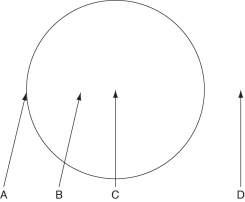 -If all mycorrhizae were somehow disrupted, then which of the following would be True?
 (Multiple Choice)
4.8/5 (74)
(74) Which of the following characteristics is shared by both chytrids and other kinds of fungi?
(Multiple Choice)
4.9/5 (64)
(64) Consider two hyphae having equal dimensions: one from a septate species and the other from a coenocytic species. Compared with the septate species, the coenocytic species should have
(Multiple Choice)
4.8/5 (93)
(93) Arrange the following from largest to smallest, assuming that they all come from the same fungus. 1. basidiocarp
2) basidium
3) basidiospore
4) mycelium
5) gill
(Multiple Choice)
4.9/5 (87)
(87) Figure 31.1 below depicts the outline of a large fairy ring that has appeared overnight in an open meadow, as viewed from above. The fairy ring represents the furthest advance of this mycelium through the soil. Locations A-D are all 0.5 meters below the soil surface. Responses may be used once, more than once, or not at all.
-Mycorrhizae are to the roots of vascular plants as endophytes are to vascular plants'
-Mycorrhizae are to the roots of vascular plants as endophytes are to vascular plants' (Multiple Choice)
4.9/5 (84)
(84) For mycelia described as heterokaryons or as being dikaryotic, which process has already occurred, and which process has not yet occurred?
(Multiple Choice)
4.9/5 (68)
(68) This phylum contains organisms that most closely resemble the common ancestor of fungi and animals:
(Multiple Choice)
4.8/5 (76)
(76) Figure 31.1 below depicts the outline of a large fairy ring that has appeared overnight in an open meadow, as viewed from above. The fairy ring represents the furthest advance of this mycelium through the soil. Locations A-D are all 0.5 meters below the soil surface. Responses may be used once, more than once, or not at all.
-How are the vascular plants that are involved in mycorrhizae and the photosynthetic cells that are involved in lichens alike?
-How are the vascular plants that are involved in mycorrhizae and the photosynthetic cells that are involved in lichens alike? (Multiple Choice)
4.8/5 (69)
(69) Which of these structures are most likely to be a component of both chytrid zoospores and motile animal cells?
(Multiple Choice)
4.8/5 (85)
(85) The following questions are based on the description below.
Rose-picker's disease is caused by the yeast, Sporothrix schenkii. The yeast grows on the exteriors of rose-bush thorns. If a human gets pricked by such a thorn, the yeasts can be introduced under the skin. The yeasts then assume a hyphal morphology and grow along the interiors of lymphatic vessels until they reach a lymph node. This often results in the accumulation of pus in the lymph node, which subsequently ulcerates through the skin surface, and drains.
-Among the organisms listed here, which are thought to be the closest relatives of fungi?
(Multiple Choice)
4.7/5 (76)
(76) This phylum contains the mushrooms, shelf fungi, and puffballs:
(Multiple Choice)
4.8/5 (74)
(74) Figure 31.1 below depicts the outline of a large fairy ring that has appeared overnight in an open meadow, as viewed from above. The fairy ring represents the furthest advance of this mycelium through the soil. Locations A-D are all 0.5 meters below the soil surface. Responses may be used once, more than once, or not at all.
-In which of these human mycoses should one expect to find a growth pattern most similar to that of the mycelium that produced the fairy ring?
-In which of these human mycoses should one expect to find a growth pattern most similar to that of the mycelium that produced the fairy ring? (Multiple Choice)
4.8/5 (78)
(78) The vegetative (nutritionally active)bodies of most fungi are
(Multiple Choice)
4.9/5 (92)
(92) In what structures do both Penicillium and Aspergillus produce asexual spores?
(Multiple Choice)
4.9/5 (80)
(80) Figure 31.1 below depicts the outline of a large fairy ring that has appeared overnight in an open meadow, as viewed from above. The fairy ring represents the furthest advance of this mycelium through the soil. Locations A-D are all 0.5 meters below the soil surface. Responses may be used once, more than once, or not at all.
-Which location is nearest to basidiocarps?
-Which location is nearest to basidiocarps? (Short Answer)
4.8/5 (82)
(82) Figure 31.1 below depicts the outline of a large fairy ring that has appeared overnight in an open meadow, as viewed from above. The fairy ring represents the furthest advance of this mycelium through the soil. Locations A-D are all 0.5 meters below the soil surface. Responses may be used once, more than once, or not at all.
-If the fungus that produced the fairy ring can also produce arbuscules, then which of the following is most likely to be buried at location "C"?
-If the fungus that produced the fairy ring can also produce arbuscules, then which of the following is most likely to be buried at location "C"? (Multiple Choice)
4.9/5 (79)
(79) Figure 31.1 below depicts the outline of a large fairy ring that has appeared overnight in an open meadow, as viewed from above. The fairy ring represents the furthest advance of this mycelium through the soil. Locations A-D are all 0.5 meters below the soil surface. Responses may be used once, more than once, or not at all.
-If haustoria from the fungal partner were to appear within the photosynthetic partner of a lichen, and if the growth rate of the photosynthetic partner consequently slowed substantially, then this would support the claim that
-If haustoria from the fungal partner were to appear within the photosynthetic partner of a lichen, and if the growth rate of the photosynthetic partner consequently slowed substantially, then this would support the claim that (Multiple Choice)
4.9/5 (70)
(70) The following questions are based on the description below.
Rose-picker's disease is caused by the yeast, Sporothrix schenkii. The yeast grows on the exteriors of rose-bush thorns. If a human gets pricked by such a thorn, the yeasts can be introduced under the skin. The yeasts then assume a hyphal morphology and grow along the interiors of lymphatic vessels until they reach a lymph node. This often results in the accumulation of pus in the lymph node, which subsequently ulcerates through the skin surface, and drains.
-Which feature seen in chytrids supports the hypothesis that they diverged earliest in fungal evolution?
(Multiple Choice)
4.9/5 (85)
(85) 
Filters
- Essay(0)
- Multiple Choice(0)
- Short Answer(0)
- True False(0)
- Matching(0)