



 Chat with AI
Exam 31: Fungi

Exam 1: Introduction: Themes in the Study of Life66 Questions
Exam 2: The Chemical Context of Life83 Questions
Exam 3: Water and the Fitness of the Environment66 Questions
Exam 4: Carbon and the Molecular Diversity of Life68 Questions
Exam 5: The Structure and Function of Large Biological Molecules109 Questions
Exam 6: A Tour of the Cell75 Questions
Exam 7: Membrane Structure and Function75 Questions
Exam 8: An Introduction to Metabolism79 Questions
Exam 9: Cellular Respiration: Harvesting Chemical Energy103 Questions
Exam 10: Photosynthesis74 Questions
Exam 11: Cell Communication62 Questions
Exam 12: The Cell Cycle80 Questions
Exam 13: Meiosis and Sexual Life Cycles68 Questions
Exam 14: Mendel and the Gene Idea90 Questions
Exam 15: The Chromosomal Basis of Inheritance75 Questions
Exam 16: The Molecular Basis of Inheritance72 Questions
Exam 17: From Gene to Protein84 Questions
Exam 18: Control of Gene Expression101 Questions
Exam 19: Viruses38 Questions
Exam 20: Biotechnology70 Questions
Exam 21: Genomes and Their Evolution37 Questions
Exam 22: Descent With Modification: a Darwinian View of Life57 Questions
Exam 23: The Evolution of Populations84 Questions
Exam 24: The Origin of Species60 Questions
Exam 25: The History of Life on Earth85 Questions
Exam 26: Phylogeny and the Tree of Life90 Questions
Exam 27: Bacteria and Archaea78 Questions
Exam 28: Protists79 Questions
Exam 29: Plant Diversity I: How Plants Colonized Land74 Questions
Exam 30: Plant Diversity Ii: the Evolution of Seed Plants101 Questions
Exam 31: Fungi87 Questions
Exam 32: An Introduction to Animal Diversity82 Questions
Exam 33: Invertebrates98 Questions
Exam 34: Vertebrates112 Questions
Exam 35: Plant Structure, Growth, and Development77 Questions
Exam 36: Transport in Vascular Plants84 Questions
Exam 37: Soil and Plant Nutrition85 Questions
Exam 38: Angiosperm Reproduction and Biotechnology86 Questions
Exam 39: Plant Responses to Internal and External Signals111 Questions
Exam 40: Basic Principles of Animal Form and Function74 Questions
Exam 41: Animal Nutrition68 Questions
Exam 42: Circulation and Gas Exchange78 Questions
Exam 43: The Immune System85 Questions
Exam 44: Osmoregulation and Excretion49 Questions
Exam 45: Hormones and the Endocrine System71 Questions
Exam 46: Animal Reproduction85 Questions
Exam 47: Animal Development75 Questions
Exam 48: Neurons, Synapses, and Signaling52 Questions
Exam 49: Nervous Systems48 Questions
Exam 50: Sensory and Motor Mechanisms59 Questions
Exam 51: Animal Behavior74 Questions
Exam 52: An Introduction to Ecology and the Biosphere71 Questions
Exam 53: Population Ecology80 Questions
Exam 54: Community Ecology74 Questions
Exam 55: Ecosystems79 Questions
Exam 56: Conservation Biology and Restoration Ecology65 Questions
Select questions type


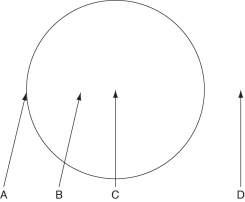
Figure 31.1 below depicts the outline of a large fairy ring that has appeared overnight in an open meadow, as viewed from above. The fairy ring represents the furthest advance of this mycelium through the soil. Locations A-D are all 0.5 meters below the soil surface. Responses may be used once, more than once, or not at all.
 -Chemicals, secreted by soil fungi, that inhibit the growth of bacteria, are known as
 (Multiple Choice)
4.7/5  (87)
(87) The following questions are based on the description below.
Rose-picker's disease is caused by the yeast, Sporothrix schenkii. The yeast grows on the exteriors of rose-bush thorns. If a human gets pricked by such a thorn, the yeasts can be introduced under the skin. The yeasts then assume a hyphal morphology and grow along the interiors of lymphatic vessels until they reach a lymph node. This often results in the accumulation of pus in the lymph node, which subsequently ulcerates through the skin surface, and drains.
-The adaptive advantage associated with the filamentous nature of fungal mycelia is primarily related to
(Multiple Choice)
4.9/5 (80)
(80) In most fungi, karyogamy does not immediately follow plasmogamy, which consequently
(Multiple Choice)
4.7/5 (79)
(79) What accounts most directly for the extremely fast growth of a fungal mycelium?
(Multiple Choice)
4.9/5 (99)
(99) Please refer to the following information to answer the following questions.
Diploid nuclei of the ascomycete Neurospora crassa contain 14 chromosomes. A single diploid cell in an ascus will undergo one round of meiosis, followed in each of the daughter cells by one round of mitosis, producing a total of eight ascospores.
-If a single, diploid G₂ nucleus in an ascus contains 400 nanograms (ng)of DNA, then a single ascospore nucleus of this species should contain how much DNA (ng), carried on how many chromosomes?
(Multiple Choice)
4.8/5 (68)
(68) Among sac fungi, which of these correctly distinguishes ascospores from conidia?
(Multiple Choice)
4.9/5 (71)
(71) You are given an organism to identify. It has a fruiting body that contains many structures with eight haploid spores lined up in a row. What kind of a fungus is this?
(Multiple Choice)
4.9/5 (67)
(67) Which of the following vary tremendously from each other in morphology and belong to several fungal phyla?
(Multiple Choice)
4.8/5 (68)
(68) Figure 31.1 below depicts the outline of a large fairy ring that has appeared overnight in an open meadow, as viewed from above. The fairy ring represents the furthest advance of this mycelium through the soil. Locations A-D are all 0.5 meters below the soil surface. Responses may be used once, more than once, or not at all.
-At which location should one find the lowest concentration of fungal enzymes, assuming that the enzymes do not diffuse far from their source, and that no other fungi are present in this habitat?
-At which location should one find the lowest concentration of fungal enzymes, assuming that the enzymes do not diffuse far from their source, and that no other fungi are present in this habitat? (Short Answer)
5.0/5 (68)
(68) The following questions are based on the description below.
Rose-picker's disease is caused by the yeast, Sporothrix schenkii. The yeast grows on the exteriors of rose-bush thorns. If a human gets pricked by such a thorn, the yeasts can be introduced under the skin. The yeasts then assume a hyphal morphology and grow along the interiors of lymphatic vessels until they reach a lymph node. This often results in the accumulation of pus in the lymph node, which subsequently ulcerates through the skin surface, and drains.
-The photosynthetic symbiont of a lichen is often a(n)
(Multiple Choice)
4.8/5 (75)
(75) Figure 31.1 below depicts the outline of a large fairy ring that has appeared overnight in an open meadow, as viewed from above. The fairy ring represents the furthest advance of this mycelium through the soil. Locations A-D are all 0.5 meters below the soil surface. Responses may be used once, more than once, or not at all.
-Which term below refers to symbiotic relationships that involve fungi living between the cells in plant leaves?
-Which term below refers to symbiotic relationships that involve fungi living between the cells in plant leaves? (Multiple Choice)
4.8/5 (70)
(70) Which process occurs in fungi and has the opposite effect on a cell's chromosome number than does meiosis I?
(Multiple Choice)
4.9/5 (65)
(65) You have been given the assignment of locating living members of the phylum Glomeromycota. Where is the best place to look for these fungi?
(Multiple Choice)
4.9/5 (86)
(86) The following questions are based on the description below.
Rose-picker's disease is caused by the yeast, Sporothrix schenkii. The yeast grows on the exteriors of rose-bush thorns. If a human gets pricked by such a thorn, the yeasts can be introduced under the skin. The yeasts then assume a hyphal morphology and grow along the interiors of lymphatic vessels until they reach a lymph node. This often results in the accumulation of pus in the lymph node, which subsequently ulcerates through the skin surface, and drains.
-Humans have immune systems in which lymph nodes are important, because many phagocytes and lymphocytes reside therein. Given that a successful infection by S. schenkii damages lymph nodes themselves, which of these is most probable?
(Multiple Choice)
4.8/5 (82)
(82) Which of the following is characterized by the lack of an observed sexual phase in its members' life cycle?
(Multiple Choice)
4.8/5 (75)
(75) The multicellular condition of animals and fungi seems to have arisen
(Multiple Choice)
4.8/5 (71)
(71) Fossil fungi date back to the origin and early evolution of plants. What combination of environmental and morphological change is similar in the evolution of both fungi and plants?
(Multiple Choice)
4.7/5 (69)
(69) Fungal cells can reproduce asexually by undergoing mitosis followed by cytokinesis. Many fungi can also prepare to reproduce sexually by undergoing
(Multiple Choice)
5.0/5 (74)
(74) 
Filters
- Essay(0)
- Multiple Choice(0)
- Short Answer(0)
- True False(0)
- Matching(0)