



 Chat with AI
Exam 31: Fungi

Exam 1: Introduction: Themes in the Study of Life66 Questions
Exam 2: The Chemical Context of Life83 Questions
Exam 3: Water and the Fitness of the Environment66 Questions
Exam 4: Carbon and the Molecular Diversity of Life68 Questions
Exam 5: The Structure and Function of Large Biological Molecules109 Questions
Exam 6: A Tour of the Cell75 Questions
Exam 7: Membrane Structure and Function75 Questions
Exam 8: An Introduction to Metabolism79 Questions
Exam 9: Cellular Respiration: Harvesting Chemical Energy103 Questions
Exam 10: Photosynthesis74 Questions
Exam 11: Cell Communication62 Questions
Exam 12: The Cell Cycle80 Questions
Exam 13: Meiosis and Sexual Life Cycles68 Questions
Exam 14: Mendel and the Gene Idea90 Questions
Exam 15: The Chromosomal Basis of Inheritance75 Questions
Exam 16: The Molecular Basis of Inheritance72 Questions
Exam 17: From Gene to Protein84 Questions
Exam 18: Control of Gene Expression101 Questions
Exam 19: Viruses38 Questions
Exam 20: Biotechnology70 Questions
Exam 21: Genomes and Their Evolution37 Questions
Exam 22: Descent With Modification: a Darwinian View of Life57 Questions
Exam 23: The Evolution of Populations84 Questions
Exam 24: The Origin of Species60 Questions
Exam 25: The History of Life on Earth85 Questions
Exam 26: Phylogeny and the Tree of Life90 Questions
Exam 27: Bacteria and Archaea78 Questions
Exam 28: Protists79 Questions
Exam 29: Plant Diversity I: How Plants Colonized Land74 Questions
Exam 30: Plant Diversity Ii: the Evolution of Seed Plants101 Questions
Exam 31: Fungi87 Questions
Exam 32: An Introduction to Animal Diversity82 Questions
Exam 33: Invertebrates98 Questions
Exam 34: Vertebrates112 Questions
Exam 35: Plant Structure, Growth, and Development77 Questions
Exam 36: Transport in Vascular Plants84 Questions
Exam 37: Soil and Plant Nutrition85 Questions
Exam 38: Angiosperm Reproduction and Biotechnology86 Questions
Exam 39: Plant Responses to Internal and External Signals111 Questions
Exam 40: Basic Principles of Animal Form and Function74 Questions
Exam 41: Animal Nutrition68 Questions
Exam 42: Circulation and Gas Exchange78 Questions
Exam 43: The Immune System85 Questions
Exam 44: Osmoregulation and Excretion49 Questions
Exam 45: Hormones and the Endocrine System71 Questions
Exam 46: Animal Reproduction85 Questions
Exam 47: Animal Development75 Questions
Exam 48: Neurons, Synapses, and Signaling52 Questions
Exam 49: Nervous Systems48 Questions
Exam 50: Sensory and Motor Mechanisms59 Questions
Exam 51: Animal Behavior74 Questions
Exam 52: An Introduction to Ecology and the Biosphere71 Questions
Exam 53: Population Ecology80 Questions
Exam 54: Community Ecology74 Questions
Exam 55: Ecosystems79 Questions
Exam 56: Conservation Biology and Restoration Ecology65 Questions
Select questions type


Figure 31.1 below depicts the outline of a large fairy ring that has appeared overnight in an open meadow, as viewed from above. The fairy ring represents the furthest advance of this mycelium through the soil. Locations A-D are all 0.5 meters below the soil surface. Responses may be used once, more than once, or not at all.
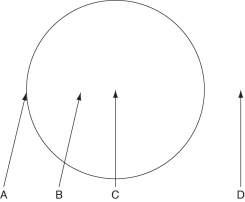 -Assume now that all four locations are 0.5 m above the surface. On a breezy day with prevailing wings blowing from left to right, where should one expect to find the highest concentration of free basidiospores in an air sample?
 (Short Answer)
4.9/5  (79)
(79) This phylum formerly included the members of the new phylum Glomeromycota:
(Multiple Choice)
4.8/5 (87)
(87) A fungal spore germinates, giving rise to a mycelium that grows outward into the soil surrounding the site where the spore originally landed. Which of these accounts for the fungal movement, as described here?
(Multiple Choice)
4.9/5 (73)
(73) Figure 31.1 below depicts the outline of a large fairy ring that has appeared overnight in an open meadow, as viewed from above. The fairy ring represents the furthest advance of this mycelium through the soil. Locations A-D are all 0.5 meters below the soil surface. Responses may be used once, more than once, or not at all.
-When pathogenic fungi are found growing on the roots of grape vines, grape farmers sometimes respond by covering the ground around their vines with plastic sheeting and pumping a gaseous fungicide into the soil. The most important concern of grape farmers who engage in this practice should be that the
-When pathogenic fungi are found growing on the roots of grape vines, grape farmers sometimes respond by covering the ground around their vines with plastic sheeting and pumping a gaseous fungicide into the soil. The most important concern of grape farmers who engage in this practice should be that the (Multiple Choice)
5.0/5 (76)
(76) Figure 31.1 below depicts the outline of a large fairy ring that has appeared overnight in an open meadow, as viewed from above. The fairy ring represents the furthest advance of this mycelium through the soil. Locations A-D are all 0.5 meters below the soil surface. Responses may be used once, more than once, or not at all.
-In both lichens and mycorrhizae, what does the fungal partner provide to its photosynthetic partner?
-In both lichens and mycorrhizae, what does the fungal partner provide to its photosynthetic partner? (Multiple Choice)
4.9/5 (92)
(92) The ascomycetes get their name from which aspect of their life cycle?
(Multiple Choice)
4.8/5 (87)
(87) Figure 31.1 below depicts the outline of a large fairy ring that has appeared overnight in an open meadow, as viewed from above. The fairy ring represents the furthest advance of this mycelium through the soil. Locations A-D are all 0.5 meters below the soil surface. Responses may be used once, more than once, or not at all.
-A billionaire buys a sterile volcanic island that recently emerged from the sea. To speed the arrival of conditions necessary for plant growth, the billionaire might be advised to aerially sow what over the island?
-A billionaire buys a sterile volcanic island that recently emerged from the sea. To speed the arrival of conditions necessary for plant growth, the billionaire might be advised to aerially sow what over the island? (Multiple Choice)
4.9/5 (76)
(76) Figure 31.1 below depicts the outline of a large fairy ring that has appeared overnight in an open meadow, as viewed from above. The fairy ring represents the furthest advance of this mycelium through the soil. Locations A-D are all 0.5 meters below the soil surface. Responses may be used once, more than once, or not at all.
-Orchid seeds are tiny, with virtually no endosperm and with miniscule cotyledons. If such seeds are deposited in a dark, moist environment then which of these represents the most likely means by which fungi might assist in seed germination, given what the seeds lack?
-Orchid seeds are tiny, with virtually no endosperm and with miniscule cotyledons. If such seeds are deposited in a dark, moist environment then which of these represents the most likely means by which fungi might assist in seed germination, given what the seeds lack? (Multiple Choice)
4.9/5 (77)
(77) Figure 31.1 below depicts the outline of a large fairy ring that has appeared overnight in an open meadow, as viewed from above. The fairy ring represents the furthest advance of this mycelium through the soil. Locations A-D are all 0.5 meters below the soil surface. Responses may be used once, more than once, or not at all.
-Which of the following best describes the physical relationship of the partners involved in lichens?
-Which of the following best describes the physical relationship of the partners involved in lichens? (Multiple Choice)
4.8/5 (80)
(80) If all of their nuclei are equally active transcriptionally then, in terms of the gene products they can make, the cells of both dikaryotic and heterokaryotic fungi are essentially
(Multiple Choice)
4.7/5 (94)
(94) If all fungi in an environment that perform decomposition were to suddenly die, then which group of organisms should benefit most, due to the fact that their fungal competitors have been removed?
(Multiple Choice)
4.7/5 (77)
(77) The functional significance of porous septa in certain fungal hyphae is most similar to that represented by which pair of structures in animal cells and plant cells, respectively?
(Multiple Choice)
4.9/5 (66)
(66) The following questions are based on the description below.
Rose-picker's disease is caused by the yeast, Sporothrix schenkii. The yeast grows on the exteriors of rose-bush thorns. If a human gets pricked by such a thorn, the yeasts can be introduced under the skin. The yeasts then assume a hyphal morphology and grow along the interiors of lymphatic vessels until they reach a lymph node. This often results in the accumulation of pus in the lymph node, which subsequently ulcerates through the skin surface, and drains.
-The answer to which of these questions would be of most assistance to one who is attempting to assign the genus Sporothrix to the correct fungal phylum?
(Multiple Choice)
4.8/5 (61)
(61) Which of the following statements is True of deuteromycetes?
(Multiple Choice)
4.7/5 (74)
(74) Figure 31.1 below depicts the outline of a large fairy ring that has appeared overnight in an open meadow, as viewed from above. The fairy ring represents the furthest advance of this mycelium through the soil. Locations A-D are all 0.5 meters below the soil surface. Responses may be used once, more than once, or not at all.
-Which of the following conditions is caused by a fungus that is accidentally consumed along with rye flour?
-Which of the following conditions is caused by a fungus that is accidentally consumed along with rye flour? (Multiple Choice)
4.8/5 (78)
(78) Figure 31.1 below depicts the outline of a large fairy ring that has appeared overnight in an open meadow, as viewed from above. The fairy ring represents the furthest advance of this mycelium through the soil. Locations A-D are all 0.5 meters below the soil surface. Responses may be used once, more than once, or not at all.
-Both fungus-derived antibiotics and hallucinogens used by humans probably evolved in fungi as a means to
-Both fungus-derived antibiotics and hallucinogens used by humans probably evolved in fungi as a means to (Multiple Choice)
4.7/5 (76)
(76) Both fungus-farming ants and their fungi can synthesize the same structural polysaccharide from the beta-glucose. What is this polysaccharide?
(Multiple Choice)
4.8/5 (75)
(75) The hydrolytic digestion of which of the following should produce monomers that are aminated (i.e., have an amine group attached)molecules of beta-glucose?
(Multiple Choice)
4.9/5 (69)
(69) Which of these paired fungal structures are structurally and functionally most alike?
(Multiple Choice)
4.9/5 (72)
(72) A chemical secreted by a female Bombyx moth helps the male of the species locate her, at which time sexual reproduction may occur. This chemical is most similar in function to which chemicals used by sexually reproducing fungi?
(Multiple Choice)
4.8/5 (86)
(86) 
Filters
- Essay(0)
- Multiple Choice(0)
- Short Answer(0)
- True False(0)
- Matching(0)