



 Chat with AI
Exam 54: Community Ecology

Exam 1: Introduction: Themes in the Study of Life66 Questions
Exam 2: The Chemical Context of Life83 Questions
Exam 3: Water and the Fitness of the Environment66 Questions
Exam 4: Carbon and the Molecular Diversity of Life68 Questions
Exam 5: The Structure and Function of Large Biological Molecules109 Questions
Exam 6: A Tour of the Cell75 Questions
Exam 7: Membrane Structure and Function75 Questions
Exam 8: An Introduction to Metabolism79 Questions
Exam 9: Cellular Respiration: Harvesting Chemical Energy103 Questions
Exam 10: Photosynthesis74 Questions
Exam 11: Cell Communication62 Questions
Exam 12: The Cell Cycle80 Questions
Exam 13: Meiosis and Sexual Life Cycles68 Questions
Exam 14: Mendel and the Gene Idea90 Questions
Exam 15: The Chromosomal Basis of Inheritance75 Questions
Exam 16: The Molecular Basis of Inheritance72 Questions
Exam 17: From Gene to Protein84 Questions
Exam 18: Control of Gene Expression101 Questions
Exam 19: Viruses38 Questions
Exam 20: Biotechnology70 Questions
Exam 21: Genomes and Their Evolution37 Questions
Exam 22: Descent With Modification: a Darwinian View of Life57 Questions
Exam 23: The Evolution of Populations84 Questions
Exam 24: The Origin of Species60 Questions
Exam 25: The History of Life on Earth85 Questions
Exam 26: Phylogeny and the Tree of Life90 Questions
Exam 27: Bacteria and Archaea78 Questions
Exam 28: Protists79 Questions
Exam 29: Plant Diversity I: How Plants Colonized Land74 Questions
Exam 30: Plant Diversity Ii: the Evolution of Seed Plants101 Questions
Exam 31: Fungi87 Questions
Exam 32: An Introduction to Animal Diversity82 Questions
Exam 33: Invertebrates98 Questions
Exam 34: Vertebrates112 Questions
Exam 35: Plant Structure, Growth, and Development77 Questions
Exam 36: Transport in Vascular Plants84 Questions
Exam 37: Soil and Plant Nutrition85 Questions
Exam 38: Angiosperm Reproduction and Biotechnology86 Questions
Exam 39: Plant Responses to Internal and External Signals111 Questions
Exam 40: Basic Principles of Animal Form and Function74 Questions
Exam 41: Animal Nutrition68 Questions
Exam 42: Circulation and Gas Exchange78 Questions
Exam 43: The Immune System85 Questions
Exam 44: Osmoregulation and Excretion49 Questions
Exam 45: Hormones and the Endocrine System71 Questions
Exam 46: Animal Reproduction85 Questions
Exam 47: Animal Development75 Questions
Exam 48: Neurons, Synapses, and Signaling52 Questions
Exam 49: Nervous Systems48 Questions
Exam 50: Sensory and Motor Mechanisms59 Questions
Exam 51: Animal Behavior74 Questions
Exam 52: An Introduction to Ecology and the Biosphere71 Questions
Exam 53: Population Ecology80 Questions
Exam 54: Community Ecology74 Questions
Exam 55: Ecosystems79 Questions
Exam 56: Conservation Biology and Restoration Ecology65 Questions
Select questions type


There are more species in tropical areas than in places farther from the equator. This is probably a result of

Free
(Multiple Choice)
4.8/5  (71)
(71) Correct Answer: Verified
B
Resource partitioning would be most likely to occur between
Free
(Multiple Choice)
4.8/5 (74)
(74) Correct Answer:Verified
VerifiedB
The oak tree pathogen Phytophthora ramorum has migrated 650 km in ten years. West Nile virus spread from New York State to 46 others states in five years. The difference in the rate of spread is probably related to
Free
(Multiple Choice)
4.8/5 (84)
(84) Correct Answer:Verified
VerifiedB
Which of the following members of a marine food chain occupies a similar tropic level to a grasshopper in a terrestrial food chain?
(Multiple Choice)
4.7/5 (77)
(77) Evidence shows that some grasses benefit from being grazed. Which of the following terms would best describe this plant-herbivore interaction?
(Multiple Choice)
4.9/5 (80)
(80) Which of the following is an example of aposematic coloration?
(Multiple Choice)
4.8/5 (76)
(76) Which of the following types of species interaction is correctly paired with its effects on the density of the two interacting populations?
(Multiple Choice)
4.8/5 (80)
(80) Community 1 contains 100 individuals distributed among four species (A, B, C, and D). Community 2 contains 100 individuals distributed among three species (A, B, and C).
Community 1: 5A, 5B, 85C, 5D
Community 2: 30A, 40B, 30C
Calculate the Shannon diversity (H)for each community. Which community is more diverse?
(Essay)
4.8/5 (76)
(76) In a particular case of secondary succession, three species of wild grass all invaded a field. By the second season, a single species dominated the field. A possible factor in this secondary succession was
(Multiple Choice)
4.8/5 (70)
(70) Use the following diagram of five islands formed at around the same time near a particular mainland and MacArthur and Wilson's island biogeography principles to answer the following questions.
 Figure 54.4
-Which island would likely exhibit the most impoverished species diversity?
Figure 54.4
-Which island would likely exhibit the most impoverished species diversity? (Short Answer)
4.7/5 (83)
(83) Use the following diagram of a hypothetical food web to answer the following questions. The arrows represent the transfer of food energy between the various trophic levels.
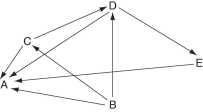 Figure 54.2
-Which letter represents an organism that could be a producer?
Figure 54.2
-Which letter represents an organism that could be a producer? (Multiple Choice)
4.8/5 (87)
(87) Which of the following studies would shed light on the mechanism of spread of H5N1 from Asia?
(Multiple Choice)
4.9/5 (78)
(78) Which of the following best describes resource partitioning?
(Multiple Choice)
4.8/5 (74)
(74) With a few exceptions, most of the food chains studied by ecologists have a maximum of how many links?
(Multiple Choice)
4.8/5 (72)
(72) Which of the following studies would a community ecologist undertake to learn about competitive interactions?
(Multiple Choice)
4.9/5 (78)
(78) During the course of the formation of a parasite/host relationship, a critical first step in this evolution would be
(Multiple Choice)
4.8/5 (77)
(77) When lichens grow on bare rock, they may eventually accumulate enough organic material around them to supply the foothold for later rooted vegetation. These early pioneering lichens can be said to do what to the later arrivals?
(Multiple Choice)
5.0/5 (80)
(80) Historically, most ecological research on the community has focused on which of the following?
(Multiple Choice)
4.8/5 (77)
(77) 
Filters
- Essay(0)
- Multiple Choice(0)
- Short Answer(0)
- True False(0)
- Matching(0)