



 Chat with AI
Exam 54: Community Ecology

Exam 1: Introduction: Themes in the Study of Life66 Questions
Exam 2: The Chemical Context of Life83 Questions
Exam 3: Water and the Fitness of the Environment66 Questions
Exam 4: Carbon and the Molecular Diversity of Life68 Questions
Exam 5: The Structure and Function of Large Biological Molecules109 Questions
Exam 6: A Tour of the Cell75 Questions
Exam 7: Membrane Structure and Function75 Questions
Exam 8: An Introduction to Metabolism79 Questions
Exam 9: Cellular Respiration: Harvesting Chemical Energy103 Questions
Exam 10: Photosynthesis74 Questions
Exam 11: Cell Communication62 Questions
Exam 12: The Cell Cycle80 Questions
Exam 13: Meiosis and Sexual Life Cycles68 Questions
Exam 14: Mendel and the Gene Idea90 Questions
Exam 15: The Chromosomal Basis of Inheritance75 Questions
Exam 16: The Molecular Basis of Inheritance72 Questions
Exam 17: From Gene to Protein84 Questions
Exam 18: Control of Gene Expression101 Questions
Exam 19: Viruses38 Questions
Exam 20: Biotechnology70 Questions
Exam 21: Genomes and Their Evolution37 Questions
Exam 22: Descent With Modification: a Darwinian View of Life57 Questions
Exam 23: The Evolution of Populations84 Questions
Exam 24: The Origin of Species60 Questions
Exam 25: The History of Life on Earth85 Questions
Exam 26: Phylogeny and the Tree of Life90 Questions
Exam 27: Bacteria and Archaea78 Questions
Exam 28: Protists79 Questions
Exam 29: Plant Diversity I: How Plants Colonized Land74 Questions
Exam 30: Plant Diversity Ii: the Evolution of Seed Plants101 Questions
Exam 31: Fungi87 Questions
Exam 32: An Introduction to Animal Diversity82 Questions
Exam 33: Invertebrates98 Questions
Exam 34: Vertebrates112 Questions
Exam 35: Plant Structure, Growth, and Development77 Questions
Exam 36: Transport in Vascular Plants84 Questions
Exam 37: Soil and Plant Nutrition85 Questions
Exam 38: Angiosperm Reproduction and Biotechnology86 Questions
Exam 39: Plant Responses to Internal and External Signals111 Questions
Exam 40: Basic Principles of Animal Form and Function74 Questions
Exam 41: Animal Nutrition68 Questions
Exam 42: Circulation and Gas Exchange78 Questions
Exam 43: The Immune System85 Questions
Exam 44: Osmoregulation and Excretion49 Questions
Exam 45: Hormones and the Endocrine System71 Questions
Exam 46: Animal Reproduction85 Questions
Exam 47: Animal Development75 Questions
Exam 48: Neurons, Synapses, and Signaling52 Questions
Exam 49: Nervous Systems48 Questions
Exam 50: Sensory and Motor Mechanisms59 Questions
Exam 51: Animal Behavior74 Questions
Exam 52: An Introduction to Ecology and the Biosphere71 Questions
Exam 53: Population Ecology80 Questions
Exam 54: Community Ecology74 Questions
Exam 55: Ecosystems79 Questions
Exam 56: Conservation Biology and Restoration Ecology65 Questions
Select questions type


As you study two closely related predatory insect species, the two-spot and the three-spot avenger beetles, you notice that each species seeks prey at dawn in areas without the other species. However, where their ranges overlap the two-spot avenger beetle hunts at night and the three-spot hunts in the morning. When you bring them into the laboratory, their offspring behave in the same manner. You have discovered an example of
(Multiple Choice)
4.8/5  (94)
(94) Please refer to the following art to answer the following question.
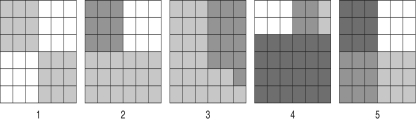 Figure 54.3
-According to the Shannon Diversity Index, which block would show the greatest diversity?
Figure 54.3
-According to the Shannon Diversity Index, which block would show the greatest diversity? (Multiple Choice)
4.8/5 (74)
(74) A species of fish is found to require a certain water temperature, a particular oxygen content of the water, a particular depth, a rocky substrate on the bottom, and a variety of nutrients in the form of microscopic plants and animals to thrive. These requirements describe its
(Multiple Choice)
5.0/5 (96)
(96) Which of the following statements is consistent with the principle of competitive exclusion?
(Multiple Choice)
4.8/5 (74)
(74) Which of the following describes a successional event in which one organism makes the environment more suitable for another organism?
(Multiple Choice)
4.8/5 (78)
(78) Which of the following is considered by ecologists a measure of the ability of a community either to resist change or to recover to its original state after change?
(Multiple Choice)
4.8/5 (81)
(81) Based on the intermediate disturbance hypothesis, a community's species diversity is
(Multiple Choice)
4.8/5 (78)
(78) The energetic hypothesis and dynamic stability hypothesis are explanations to account for
(Multiple Choice)
4.9/5 (68)
(68) According to bottom-up and top-down control models of community organization, which of the following expressions would imply that an increase in the size of a carnivore (C)population would negatively impact on its prey (P)population, but not vice versa?
(Multiple Choice)
4.8/5 (78)
(78) Use the following diagram of five islands formed at around the same time near a particular mainland and MacArthur and Wilson's island biogeography principles to answer the following questions.
 Figure 54.4
-Which island would likely have the lowest extinction rate?
Figure 54.4
-Which island would likely have the lowest extinction rate? (Short Answer)
4.8/5 (84)
(84) Approximately how many kg of carnivore production can be supported by a field plot containing 2000 kg of plant material?
(Multiple Choice)
4.7/5 (81)
(81) Monarch butterflies are protected from birds and other predators but the cardiac glycosides they incorporate into their tissues are from eating milkweed when they were in their caterpillar stage of development. The wings of a different species of butterfly, the Viceroy, look nearly identical to the Monarch so predators that have learned not to eat the bad-tasting Monarch avoid Viceroys as well. This example best describes
(Multiple Choice)
4.9/5 (77)
(77) Ecologists are particularly concerned about pathogens because
(Multiple Choice)
4.8/5 (83)
(83) Use the following diagram of Joseph Connell's study of barnacle distribution in Scotland to answer the following two questions.
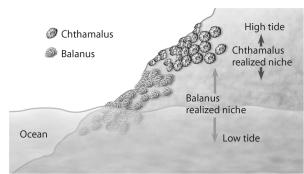 Figure 54.1
-Which of the following is a good description of an ecological niche?
Figure 54.1
-Which of the following is a good description of an ecological niche? (Multiple Choice)
5.0/5 (83)
(83) Use the following diagram of a hypothetical food web to answer the following questions. The arrows represent the transfer of food energy between the various trophic levels.
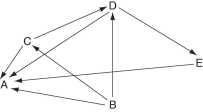 Figure 54.2
-Which letter represents an organism that could be a carnivore?
Figure 54.2
-Which letter represents an organism that could be a carnivore? (Multiple Choice)
4.9/5 (77)
(77) Community ecologists would consider which of the following to be most significant in understanding the structure of an ecological community?
(Multiple Choice)
4.7/5 (85)
(85) Of the following zoonotic diseases, which is most applicable to study by a community ecologist?
(Multiple Choice)
4.8/5 (69)
(69) Which of the following could qualify as a top-down control on a grassland community?
(Multiple Choice)
4.9/5 (88)
(88) 
Filters
- Essay(0)
- Multiple Choice(0)
- Short Answer(0)
- True False(0)
- Matching(0)