



 Chat with AI
Exam 54: Community Ecology

Exam 1: Introduction: Themes in the Study of Life66 Questions
Exam 2: The Chemical Context of Life83 Questions
Exam 3: Water and the Fitness of the Environment66 Questions
Exam 4: Carbon and the Molecular Diversity of Life68 Questions
Exam 5: The Structure and Function of Large Biological Molecules109 Questions
Exam 6: A Tour of the Cell75 Questions
Exam 7: Membrane Structure and Function75 Questions
Exam 8: An Introduction to Metabolism79 Questions
Exam 9: Cellular Respiration: Harvesting Chemical Energy103 Questions
Exam 10: Photosynthesis74 Questions
Exam 11: Cell Communication62 Questions
Exam 12: The Cell Cycle80 Questions
Exam 13: Meiosis and Sexual Life Cycles68 Questions
Exam 14: Mendel and the Gene Idea90 Questions
Exam 15: The Chromosomal Basis of Inheritance75 Questions
Exam 16: The Molecular Basis of Inheritance72 Questions
Exam 17: From Gene to Protein84 Questions
Exam 18: Control of Gene Expression101 Questions
Exam 19: Viruses38 Questions
Exam 20: Biotechnology70 Questions
Exam 21: Genomes and Their Evolution37 Questions
Exam 22: Descent With Modification: a Darwinian View of Life57 Questions
Exam 23: The Evolution of Populations84 Questions
Exam 24: The Origin of Species60 Questions
Exam 25: The History of Life on Earth85 Questions
Exam 26: Phylogeny and the Tree of Life90 Questions
Exam 27: Bacteria and Archaea78 Questions
Exam 28: Protists79 Questions
Exam 29: Plant Diversity I: How Plants Colonized Land74 Questions
Exam 30: Plant Diversity Ii: the Evolution of Seed Plants101 Questions
Exam 31: Fungi87 Questions
Exam 32: An Introduction to Animal Diversity82 Questions
Exam 33: Invertebrates98 Questions
Exam 34: Vertebrates112 Questions
Exam 35: Plant Structure, Growth, and Development77 Questions
Exam 36: Transport in Vascular Plants84 Questions
Exam 37: Soil and Plant Nutrition85 Questions
Exam 38: Angiosperm Reproduction and Biotechnology86 Questions
Exam 39: Plant Responses to Internal and External Signals111 Questions
Exam 40: Basic Principles of Animal Form and Function74 Questions
Exam 41: Animal Nutrition68 Questions
Exam 42: Circulation and Gas Exchange78 Questions
Exam 43: The Immune System85 Questions
Exam 44: Osmoregulation and Excretion49 Questions
Exam 45: Hormones and the Endocrine System71 Questions
Exam 46: Animal Reproduction85 Questions
Exam 47: Animal Development75 Questions
Exam 48: Neurons, Synapses, and Signaling52 Questions
Exam 49: Nervous Systems48 Questions
Exam 50: Sensory and Motor Mechanisms59 Questions
Exam 51: Animal Behavior74 Questions
Exam 52: An Introduction to Ecology and the Biosphere71 Questions
Exam 53: Population Ecology80 Questions
Exam 54: Community Ecology74 Questions
Exam 55: Ecosystems79 Questions
Exam 56: Conservation Biology and Restoration Ecology65 Questions
Select questions type


Which of the following is the most accepted hypothesis as to why invasive species take over communities into which they have been introduced?
(Multiple Choice)
4.7/5  (80)
(80) Two barnacles, Balanus and Chthamalus, can both survive on the lower rocks just above the low-tide line on the Scottish coast, but only Balanus actually does so, with Chthamalus adopting a higher zone. Which of the following best accounts for this niche separation?
(Multiple Choice)
4.9/5 (92)
(92) You are most likely to observe primary succession in a terrestrial community when you visit a(n)
(Multiple Choice)
4.7/5 (92)
(92) The sum total of an organism's interaction with the biotic and abiotic resources of its environment is called its
(Multiple Choice)
4.8/5 (67)
(67) Which of the following describes the relationship between ants and acacia trees?
(Multiple Choice)
4.9/5 (77)
(77) Which of the following examples best describes an ecological community?
(Multiple Choice)
4.8/5 (78)
(78) Which of the following interactions can correctly be labeled coevolution?
(Multiple Choice)
4.7/5 (62)
(62) Which of the following is an example of cryptic coloration?
(Multiple Choice)
4.7/5 (91)
(91) Which of the following treatments would most likely create a healthy, biodiverse community out of an impoverished community?
(Multiple Choice)
4.9/5 (73)
(73) Which of the following terms best describes the interaction between termites and the protozoans that feed in their gut?
(Multiple Choice)
4.9/5 (73)
(73) Keystone predators can maintain species diversity in a community if they
(Multiple Choice)
4.9/5 (81)
(81) Elephants are not the most common species in African grasslands. The grasslands contain scattered woody plants, but they are kept in check by the uprooting activities of the elephants. Take away the elephants, and the grasslands convert to forests or to shrublands. The newly growing forests support fewer species than the previous grasslands. Which of the following describes why elephants are the keystone species in this scenario?
(Multiple Choice)
4.9/5 (74)
(74) In a tide pool, 15 species of invertebrates were reduced to eight after one species was removed. The species removed was likely a(n)
(Multiple Choice)
4.8/5 (72)
(72) Use the following diagram of Joseph Connell's study of barnacle distribution in Scotland to answer the following two questions.
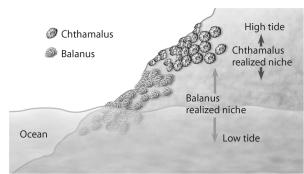 Figure 54.1
-Which of the following is the most logical conclusion about the distribution of the two species of barnacle, Chthamalus and Balanus?
Figure 54.1
-Which of the following is the most logical conclusion about the distribution of the two species of barnacle, Chthamalus and Balanus? (Multiple Choice)
4.8/5 (84)
(84) Which of the following best describes the consequences of White-band disease in Caribbean coral reefs?
(Multiple Choice)
4.7/5 (71)
(71) Dwarf mistletoes are flowering plants that grow on certain forest trees. They obtain nutrients and water from the vascular tissues of the trees. The trees derive no known benefits from the dwarf mistletoes. Which of the following best describes the interactions between dwarf mistletoes and trees?
(Multiple Choice)
4.8/5 (87)
(87) 
Filters
- Essay(0)
- Multiple Choice(0)
- Short Answer(0)
- True False(0)
- Matching(0)