



 Chat with AI
Exam 34: Vertebrates

Exam 1: Introduction: Themes in the Study of Life66 Questions
Exam 2: The Chemical Context of Life83 Questions
Exam 3: Water and the Fitness of the Environment66 Questions
Exam 4: Carbon and the Molecular Diversity of Life68 Questions
Exam 5: The Structure and Function of Large Biological Molecules109 Questions
Exam 6: A Tour of the Cell75 Questions
Exam 7: Membrane Structure and Function75 Questions
Exam 8: An Introduction to Metabolism79 Questions
Exam 9: Cellular Respiration: Harvesting Chemical Energy103 Questions
Exam 10: Photosynthesis74 Questions
Exam 11: Cell Communication62 Questions
Exam 12: The Cell Cycle80 Questions
Exam 13: Meiosis and Sexual Life Cycles68 Questions
Exam 14: Mendel and the Gene Idea90 Questions
Exam 15: The Chromosomal Basis of Inheritance75 Questions
Exam 16: The Molecular Basis of Inheritance72 Questions
Exam 17: From Gene to Protein84 Questions
Exam 18: Control of Gene Expression101 Questions
Exam 19: Viruses38 Questions
Exam 20: Biotechnology70 Questions
Exam 21: Genomes and Their Evolution37 Questions
Exam 22: Descent With Modification: a Darwinian View of Life57 Questions
Exam 23: The Evolution of Populations84 Questions
Exam 24: The Origin of Species60 Questions
Exam 25: The History of Life on Earth85 Questions
Exam 26: Phylogeny and the Tree of Life90 Questions
Exam 27: Bacteria and Archaea78 Questions
Exam 28: Protists79 Questions
Exam 29: Plant Diversity I: How Plants Colonized Land74 Questions
Exam 30: Plant Diversity Ii: the Evolution of Seed Plants101 Questions
Exam 31: Fungi87 Questions
Exam 32: An Introduction to Animal Diversity82 Questions
Exam 33: Invertebrates98 Questions
Exam 34: Vertebrates112 Questions
Exam 35: Plant Structure, Growth, and Development77 Questions
Exam 36: Transport in Vascular Plants84 Questions
Exam 37: Soil and Plant Nutrition85 Questions
Exam 38: Angiosperm Reproduction and Biotechnology86 Questions
Exam 39: Plant Responses to Internal and External Signals111 Questions
Exam 40: Basic Principles of Animal Form and Function74 Questions
Exam 41: Animal Nutrition68 Questions
Exam 42: Circulation and Gas Exchange78 Questions
Exam 43: The Immune System85 Questions
Exam 44: Osmoregulation and Excretion49 Questions
Exam 45: Hormones and the Endocrine System71 Questions
Exam 46: Animal Reproduction85 Questions
Exam 47: Animal Development75 Questions
Exam 48: Neurons, Synapses, and Signaling52 Questions
Exam 49: Nervous Systems48 Questions
Exam 50: Sensory and Motor Mechanisms59 Questions
Exam 51: Animal Behavior74 Questions
Exam 52: An Introduction to Ecology and the Biosphere71 Questions
Exam 53: Population Ecology80 Questions
Exam 54: Community Ecology74 Questions
Exam 55: Ecosystems79 Questions
Exam 56: Conservation Biology and Restoration Ecology65 Questions
Select questions type


For the following items, match the extant vertebrate groups with the descriptions.
-May have lungs, or gills, and may use skin as a respiratory surface
(Multiple Choice)
5.0/5  (80)
(80) Rank the following in terms of body-size differences that are attributed to sexual dimorphism, from most dimorphic to least dimorphic. 1. Homo sapiens
2) Chimpanzees and bonobos
3) Australopithecus afarensis
4) Homo habilis
(Multiple Choice)
4.9/5 (79)
(79) The following questions refer to the description below.
While on an intersession course in tropical ecology, Kris pulls a large, snakelike organism from a burrow (the class was granted a collecting permit). The 1-m-long organism has smooth skin, which appears to be segmented. It has two tiny eyes that are hard to see because they seem to be covered by skin. Kris brings it back to the lab at the field station, where it is a source of puzzlement to the class. Kris says that it is a giant oligochaete worm; Shaun suggests it is a legless amphibian; Kelly proposes it belongs to a snake species that is purely fossorial (lives in a burrow).
-What permits reptiles to thrive in arid environments?
(Multiple Choice)
4.8/5 (62)
(62) Mammals and living birds share all of the following characteristics except
(Multiple Choice)
4.8/5 (81)
(81) Which of these species demonstrates symbolic thought, art, and full-blown language?
(Multiple Choice)
4.8/5 (84)
(84) At least one of these has been found in all species of eumetazoan animals studied thus far:
(Multiple Choice)
4.9/5 (77)
(77) The lamprey species whose larvae live in freshwater streams, but whose adults live most of their lives in seawater, are similar in this respect to certain species of
(Multiple Choice)
4.9/5 (83)
(83) The following questions refer to the description below.
While on an intersession course in tropical ecology, Kris pulls a large, snakelike organism from a burrow (the class was granted a collecting permit). The 1-m-long organism has smooth skin, which appears to be segmented. It has two tiny eyes that are hard to see because they seem to be covered by skin. Kris brings it back to the lab at the field station, where it is a source of puzzlement to the class. Kris says that it is a giant oligochaete worm; Shaun suggests it is a legless amphibian; Kelly proposes it belongs to a snake species that is purely fossorial (lives in a burrow).
-Which characteristic should permit the class to conclude that it is probably not a snake?
(Multiple Choice)
4.9/5 (64)
(64) The following questions refer to the description below.
Terry catches a ray-finned fish from the ocean and notices that, attached to its flank, there is an equally long, snakelike organism. The attached organism has no external segmentation, no scales, a round mouth surrounded by a sucker and two small eyes. Terry thinks it might be a marine leech, a hagfish, or a lamprey.
-The feeding mode of the extinct conodonts was
(Multiple Choice)
4.8/5 (80)
(80) The following questions refer to the phylogenetic tree shown in Figure 34.1.
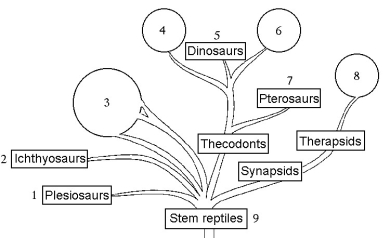 -Differentiation of teeth is observed in
 (Multiple Choice)
4.8/5 (91)
(91) Which of these hominin traits seems to have occurred before the others?
(Multiple Choice)
4.9/5 (71)
(71) Which of these traits is most strongly associated with the adoption of bipedalism?
(Multiple Choice)
4.8/5 (79)
(79) To which of these are the scales of chondrichthyans most closely related in a structural sense?
(Multiple Choice)
4.9/5 (72)
(72) This is a cluster of genes coding for transcription factors involved in the evolution of innovations in early vertebrate nervous systems and vertebrae:
(Multiple Choice)
4.7/5 (70)
(70) Which of the following statements would be least acceptable to most zoologists?
(Multiple Choice)
4.8/5 (92)
(92) A new species of aquatic chordate is discovered that closely resembles an ancient form. It has the following characteristics: external armor of bony plates, no paired lateral fins, and a suspension-feeding mode of nutrition. In addition to these, it will probably have which of the following characteristics?
(Multiple Choice)
4.7/5 (86)
(86) Which of these species was the first to have some members migrate out of Africa?
(Multiple Choice)
4.9/5 (82)
(82) The following questions refer to the phylogenetic tree shown in Figure 34.1.
-Which is characteristic of all mammals, and only of mammals?
-Which is characteristic of all mammals, and only of mammals? (Multiple Choice)
4.9/5 (82)
(82) 
Filters
- Essay(0)
- Multiple Choice(0)
- Short Answer(0)
- True False(0)
- Matching(0)