



 Chat with AI
Exam 53: Population Ecology

Exam 1: Introduction: Themes in the Study of Life66 Questions
Exam 2: The Chemical Context of Life83 Questions
Exam 3: Water and the Fitness of the Environment66 Questions
Exam 4: Carbon and the Molecular Diversity of Life68 Questions
Exam 5: The Structure and Function of Large Biological Molecules109 Questions
Exam 6: A Tour of the Cell75 Questions
Exam 7: Membrane Structure and Function75 Questions
Exam 8: An Introduction to Metabolism79 Questions
Exam 9: Cellular Respiration: Harvesting Chemical Energy103 Questions
Exam 10: Photosynthesis74 Questions
Exam 11: Cell Communication62 Questions
Exam 12: The Cell Cycle80 Questions
Exam 13: Meiosis and Sexual Life Cycles68 Questions
Exam 14: Mendel and the Gene Idea90 Questions
Exam 15: The Chromosomal Basis of Inheritance75 Questions
Exam 16: The Molecular Basis of Inheritance72 Questions
Exam 17: From Gene to Protein84 Questions
Exam 18: Control of Gene Expression101 Questions
Exam 19: Viruses38 Questions
Exam 20: Biotechnology70 Questions
Exam 21: Genomes and Their Evolution37 Questions
Exam 22: Descent With Modification: a Darwinian View of Life57 Questions
Exam 23: The Evolution of Populations84 Questions
Exam 24: The Origin of Species60 Questions
Exam 25: The History of Life on Earth85 Questions
Exam 26: Phylogeny and the Tree of Life90 Questions
Exam 27: Bacteria and Archaea78 Questions
Exam 28: Protists79 Questions
Exam 29: Plant Diversity I: How Plants Colonized Land74 Questions
Exam 30: Plant Diversity Ii: the Evolution of Seed Plants101 Questions
Exam 31: Fungi87 Questions
Exam 32: An Introduction to Animal Diversity82 Questions
Exam 33: Invertebrates98 Questions
Exam 34: Vertebrates112 Questions
Exam 35: Plant Structure, Growth, and Development77 Questions
Exam 36: Transport in Vascular Plants84 Questions
Exam 37: Soil and Plant Nutrition85 Questions
Exam 38: Angiosperm Reproduction and Biotechnology86 Questions
Exam 39: Plant Responses to Internal and External Signals111 Questions
Exam 40: Basic Principles of Animal Form and Function74 Questions
Exam 41: Animal Nutrition68 Questions
Exam 42: Circulation and Gas Exchange78 Questions
Exam 43: The Immune System85 Questions
Exam 44: Osmoregulation and Excretion49 Questions
Exam 45: Hormones and the Endocrine System71 Questions
Exam 46: Animal Reproduction85 Questions
Exam 47: Animal Development75 Questions
Exam 48: Neurons, Synapses, and Signaling52 Questions
Exam 49: Nervous Systems48 Questions
Exam 50: Sensory and Motor Mechanisms59 Questions
Exam 51: Animal Behavior74 Questions
Exam 52: An Introduction to Ecology and the Biosphere71 Questions
Exam 53: Population Ecology80 Questions
Exam 54: Community Ecology74 Questions
Exam 55: Ecosystems79 Questions
Exam 56: Conservation Biology and Restoration Ecology65 Questions
Select questions type


Which of the following is the pattern of spacing for individuals within the boundaries of the population?
(Multiple Choice)
4.9/5  (73)
(73) Natural selection has led to the evolution of diverse natural history strategies, which have in common
(Multiple Choice)
4.8/5 (92)
(92) Which of the following describes having more than one reproductive episode during a lifetime?
(Multiple Choice)
4.9/5 (86)
(86) During the spring, you are studying the mice that live in a field near your home. There are lots of mice in this field, but you realize that you rarely observe any reproductive females. This most likely indicates
(Multiple Choice)
4.7/5 (89)
(89) Based on current growth rates, Earth's human population in 2010 will be closest to
(Multiple Choice)
5.0/5 (87)
(87) Use the survivorship curves in Figure 53.1 to answer the following questions.
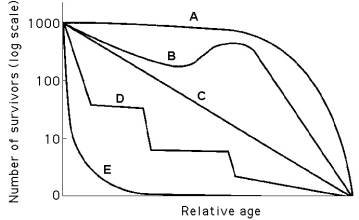 Figure 53.1
-Which curve best describes survivorship in elephants?
Figure 53.1
-Which curve best describes survivorship in elephants? (Short Answer)
4.9/5 (69)
(69) According to the logistic growth equation dN/dt = rmaxN(K - N)/K,
(Multiple Choice)
5.0/5 (71)
(71) To measure the population density of monarch butterflies occupying a particular park, 100 butterflies are captured, marked with a small dot on a wing, and then released. The next day, another 100 butterflies are captured, including the recapture of 20 marked butterflies. One would estimate the population to be
(Multiple Choice)
4.9/5 (84)
(84) The following questions refer to Figure 53.3, which depicts the age structure of three populations.
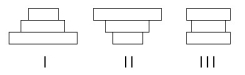 Figure 53.3
-Which population appears to be stable?
Figure 53.3
-Which population appears to be stable? (Multiple Choice)
5.0/5 (84)
(84) Use the survivorship curves in Figure 53.1 to answer the following questions.
Figure 53.1
-Which curve best describes survivorship in marine mollusks?
Figure 53.1
-Which curve best describes survivorship in marine mollusks? (Short Answer)
4.8/5 (69)
(69) Which of the following assumptions have to be made regarding the capture-recapture estimate of population size?
I. Marked and unmarked individuals have the same probability of being trapped.
II. The marked individuals have thoroughly mixed with population after being marked.
III. No individuals have entered or left the population by immigration or emigration, and no individuals have been added by birth or eliminated by death during the course of the estimate.
(Multiple Choice)
4.9/5 (81)
(81) Which of the following is a density-independent factor limiting human population growth?
(Multiple Choice)
4.7/5 (88)
(88) Why is territoriality an adaptive behavior for songbirds maintaining populations at or near their carrying capacity?
(Multiple Choice)
4.8/5 (72)
(72) 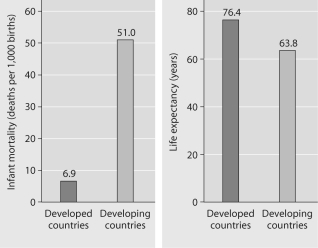 Infant mortality and life expectancy at birth in developed and developing countries. (Data as of 2005.) Figure 53.4
-What is a logical conclusion that can be drawn from the graphs above?
Infant mortality and life expectancy at birth in developed and developing countries. (Data as of 2005.) Figure 53.4
-What is a logical conclusion that can be drawn from the graphs above? (Multiple Choice)
4.8/5 (81)
(81) The following questions refer to Figure 53.3, which depicts the age structure of three populations.
Figure 53.3
-Assuming these age-structure diagrams describe human populations, in which population is unemployment likely to be a societal issue in the future?
Figure 53.3
-Assuming these age-structure diagrams describe human populations, in which population is unemployment likely to be a societal issue in the future? (Multiple Choice)
5.0/5 (78)
(78) 
Filters
- Essay(0)
- Multiple Choice(0)
- Short Answer(0)
- True False(0)
- Matching(0)