Multiple Choice
Please read the paragraph below and review Figure 53.2 to answer the following questions.
Researchers in the Netherlands studied the effects of parental caregiving in European kestrels over 5 years. The researchers transferred chicks among nests to produce reduced broods (three or four chicks) , normal broods (five or six) , and enlarged broods (seven or eight) . They then measured the percentage of male and female parent birds that survived the following winter. (Both males and females provide care for chicks.)
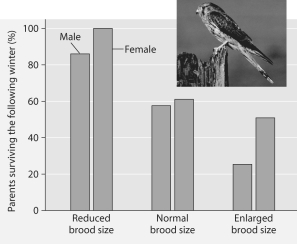
Brood Size Manipulations in the Kestrel: Effects on Offspring and Parent Survival
Figure 53.2
-Which of the following pairs of reproductive strategies is consistent with energetic trade-off and reproductive success?
A) Pioneer species of plants produce many very small, highly airborne seeds, while large elephants that are very good parents produce many offspring.
B) Female rabbits that suffer high predation rates may produce several litters per breeding season, and coconuts produce few fruits, but most survive when they encounter proper growing conditions.
C) Species that have to broadcast to distant habitats tend to produce seeds with heavy protective seed coats, and animals that are caring parents produce fewer offspring with lower infant mortality.
D) Free-living insects lay thousands of eggs and provide no parental care, while flowers take good care of their seeds until they are ready to germinate.
E) Some mammals will not reproduce when environmental resources are low so they can survive until conditions get better, and plants that produce many small seeds are likely found in stable environments.
Correct Answer:

Verified
Correct Answer:
Verified
Q63: Often the growth cycle of one
Q64: A recent study of ecological footprints (described
Q65: Which of the following examples would most
Q66: Which of the following graphs illustrates the
Q67: In which of the following habitats would
Q69: Which of the following graphs illustrates the
Q70: Consider several human populations of equal size
Q71: Your friend comes to you with a
Q72: In 2005, the United States had a
Q73: Which of the following characterizes relatively K-selected