



 Chat with AI
Exam 20: Biotechnology

Exam 1: Introduction: Themes in the Study of Life66 Questions
Exam 2: The Chemical Context of Life83 Questions
Exam 3: Water and the Fitness of the Environment66 Questions
Exam 4: Carbon and the Molecular Diversity of Life68 Questions
Exam 5: The Structure and Function of Large Biological Molecules109 Questions
Exam 6: A Tour of the Cell75 Questions
Exam 7: Membrane Structure and Function75 Questions
Exam 8: An Introduction to Metabolism79 Questions
Exam 9: Cellular Respiration: Harvesting Chemical Energy103 Questions
Exam 10: Photosynthesis74 Questions
Exam 11: Cell Communication62 Questions
Exam 12: The Cell Cycle80 Questions
Exam 13: Meiosis and Sexual Life Cycles68 Questions
Exam 14: Mendel and the Gene Idea90 Questions
Exam 15: The Chromosomal Basis of Inheritance75 Questions
Exam 16: The Molecular Basis of Inheritance72 Questions
Exam 17: From Gene to Protein84 Questions
Exam 18: Control of Gene Expression101 Questions
Exam 19: Viruses38 Questions
Exam 20: Biotechnology70 Questions
Exam 21: Genomes and Their Evolution37 Questions
Exam 22: Descent With Modification: a Darwinian View of Life57 Questions
Exam 23: The Evolution of Populations84 Questions
Exam 24: The Origin of Species60 Questions
Exam 25: The History of Life on Earth85 Questions
Exam 26: Phylogeny and the Tree of Life90 Questions
Exam 27: Bacteria and Archaea78 Questions
Exam 28: Protists79 Questions
Exam 29: Plant Diversity I: How Plants Colonized Land74 Questions
Exam 30: Plant Diversity Ii: the Evolution of Seed Plants101 Questions
Exam 31: Fungi87 Questions
Exam 32: An Introduction to Animal Diversity82 Questions
Exam 33: Invertebrates98 Questions
Exam 34: Vertebrates112 Questions
Exam 35: Plant Structure, Growth, and Development77 Questions
Exam 36: Transport in Vascular Plants84 Questions
Exam 37: Soil and Plant Nutrition85 Questions
Exam 38: Angiosperm Reproduction and Biotechnology86 Questions
Exam 39: Plant Responses to Internal and External Signals111 Questions
Exam 40: Basic Principles of Animal Form and Function74 Questions
Exam 41: Animal Nutrition68 Questions
Exam 42: Circulation and Gas Exchange78 Questions
Exam 43: The Immune System85 Questions
Exam 44: Osmoregulation and Excretion49 Questions
Exam 45: Hormones and the Endocrine System71 Questions
Exam 46: Animal Reproduction85 Questions
Exam 47: Animal Development75 Questions
Exam 48: Neurons, Synapses, and Signaling52 Questions
Exam 49: Nervous Systems48 Questions
Exam 50: Sensory and Motor Mechanisms59 Questions
Exam 51: Animal Behavior74 Questions
Exam 52: An Introduction to Ecology and the Biosphere71 Questions
Exam 53: Population Ecology80 Questions
Exam 54: Community Ecology74 Questions
Exam 55: Ecosystems79 Questions
Exam 56: Conservation Biology and Restoration Ecology65 Questions
Select questions type


Use the following information to answer the following questions.
CML (chronic myelogenous leukemia) results from a translocation between human chromosomes 9 and 22. The resulting chromosome 22 is significantly shorter than the usual, and it is known as a Philadelphia (Ph') chromosome. The junction at the site of the translocation causes over-expression of a thymine kinase receptor. A new drug (Gleevec or imatinib) has been found to inhibit the disease if the patient is treated early.
-One possible use of transgenic plants is in the production of human proteins, such as vaccines. Which of the following is a possible hindrance that must be overcome?
(Multiple Choice)
4.9/5  (84)
(84) Sequencing an entire genome, such as that of C. elegans, a nematode, is most important because
(Multiple Choice)
4.8/5 (79)
(79) Plants are more readily manipulated by genetic engineering than are animals because
(Multiple Choice)
4.9/5 (72)
(72) The major advantage of using artificial chromosomes such as YACs and BACs for cloning genes is that
(Multiple Choice)
4.9/5 (84)
(84) Yeast artificial chromosomes contain which of the following elements?
(Multiple Choice)
4.8/5 (77)
(77) What is the most logical sequence of steps for splicing foreign DNA into a plasmid and inserting the plasmid into a bacterium?
I. Transform bacteria with recombinant DNA molecule.
II. Cut the plasmid DNA using restriction enzymes.
III. Extract plasmid DNA from bacterial cells.
IV. Hydrogen-bond the plasmid DNA to nonplasmid DNA fragments.
V. Use ligase to seal plasmid DNA to nonplasmid DNA.
(Multiple Choice)
4.9/5 (73)
(73) RFLP analysis can be used to distinguish between alleles based on differences in which of the following?
(Multiple Choice)
4.9/5 (85)
(85) A student wishes to clone a sequence of DNA of ~200 kb. Which vector would be appropriate?
(Multiple Choice)
4.8/5 (71)
(71) How does a bacterial cell protect its own DNA from restriction enzymes?
(Multiple Choice)
4.9/5 (85)
(85) Figure 20.1 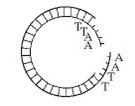 -Which enzyme was used to produce the molecule in Figure 20.1?
 (Multiple Choice)
4.8/5 (74)
(74) Use Figure 20.3 to answer the following questions. The DNA profiles below represent four different individuals.
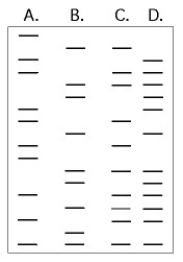 Figure 20.3
-Gene therapy
Figure 20.3
-Gene therapy (Multiple Choice)
4.9/5 (83)
(83) RNAi methodology uses double-stranded pieces of RNA to trigger a breakdown or blocking of mRNA. For which of the following might it more possibly be useful?
(Multiple Choice)
4.8/5 (84)
(84) Which of the following modifications is least likely to alter the rate at which a DNA fragment moves through a gel during electrophoresis?
(Multiple Choice)
4.7/5 (87)
(87) Use the following information to answer the questions below.
A eukaryotic gene has "sticky ends" produced by the restriction endonuclease EcoRI. The gene is added to a mixture containing EcoRI and a bacterial plasmid that carries two genes conferring resistance to ampicillin and tetracycline. The plasmid has one recognition site for EcoRI located in the tetracycline resistance gene. This mixture is incubated for several hours, exposed to DNA ligase, and then added to bacteria growing in nutrient broth. The bacteria are allowed to grow overnight and are streaked on a plate using a technique that produces isolated colonies that are clones of the original. Samples of these colonies are then grown in four different media: nutrient broth plus ampicillin, nutrient broth plus tetracycline, nutrient broth plus ampicillin and tetracycline, and nutrient broth without antibiotics.
-Bacteria that contain the plasmid, but not the eukaryotic gene, would grow
(Multiple Choice)
4.8/5 (68)
(68) Assume that you are trying to insert a gene into a plasmid. Someone gives you a preparation of genomic DNA that has been cut with restriction enzyme X. The gene you wish to insert has sites on both ends for cutting by restriction enzyme Y. You have a plasmid with a single site for Y, but not for X. Your strategy should be to
(Multiple Choice)
4.8/5 (83)
(83) A researcher has used in vitro mutagenesis to mutate a cloned gene and then has reinserted this into a cell. In order to have the mutated sequence disable the function of the gene, what must then occur?
(Multiple Choice)
4.8/5 (77)
(77) To introduce a particular piece of DNA into an animal cell, such as that of a mouse, you would find more probable success with which of the following methods?
(Multiple Choice)
4.9/5 (83)
(83) A paleontologist has recovered a bit of tissue from the 400-year-old preserved skin of an extinct dodo (a bird). The researcher would like to compare a specific region of the DNA from the sample with DNA from living birds. Which of the following would be most useful for increasing the amount of dodo DNA available for testing?
(Multiple Choice)
4.9/5 (69)
(69) Imagine you want to study human crystallins, proteins present in the lens of the eye. To obtain a sufficient amount of the protein, you decide to clone the crystallin gene. Would you construct a genomic library or a cDNA library?
What material would you use as a source of DNA or RNA?
(Essay)
4.8/5 (96)
(96) 
Filters
- Essay(0)
- Multiple Choice(0)
- Short Answer(0)
- True False(0)
- Matching(0)