



 Chat with AI
Exam 51: Animal Behaviour

Exam 1: Introduction: Evolution and Themes of Biology77 Questions
Exam 2: The Chemical Context of Life98 Questions
Exam 3: Water and Life92 Questions
Exam 4: Carbon and the Molecular Diversity of Life86 Questions
Exam 5: The Structure and Function of Large Biological Molecules131 Questions
Exam 6: A Tour of the Cell111 Questions
Exam 7: Membrane Structure and Function88 Questions
Exam 8: An Introduction to Metabolism92 Questions
Exam 9: Cellular Respiration and Fermentation128 Questions
Exam 10: Photosynthesis103 Questions
Exam 11: Cell Communication85 Questions
Exam 12: The Cell Cycle98 Questions
Exam 13: Meiosis and Sexual Life Cycles90 Questions
Exam 14: Mendel and the Gene Idea92 Questions
Exam 15: The Chromosomal Basis of Inheritance75 Questions
Exam 16: The Molecular Basis of Inheritance84 Questions
Exam 17: From Gene to Protein106 Questions
Exam 18: Regulation of Gene Expression116 Questions
Exam 19: Viruses71 Questions
Exam 20: DNA Tools and Biotechnology78 Questions
Exam 21: Genomes and Their Evolution64 Questions
Exam 22: Descent with Modification: A Darwinian View of Life68 Questions
Exam 23: The Evolution of Populations92 Questions
Exam 24: The Origin of Species76 Questions
Exam 25: The History of Life on Earth89 Questions
Exam 26: Phylogeny and the Tree of Life91 Questions
Exam 27: Bacteria and Archaea96 Questions
Exam 28: Protists82 Questions
Exam 29: Plant Diversity I: How Plants Colonized Land93 Questions
Exam 30: Plant Diversity II: The Evolution of Seed Plants119 Questions
Exam 31: Fungi105 Questions
Exam 32: An Overview of Animal Diversity93 Questions
Exam 33: An Introduction to Invertebrates111 Questions
Exam 34: The Origin and Evolution of Vertebrates126 Questions
Exam 35: Plant Structure,Growth,and Development82 Questions
Exam 36: Resource Acquisition and Transport in Vascular Plants100 Questions
Exam 37: Soil and Plant Nutrition99 Questions
Exam 38: Angiosperm Reproduction and Biotechnology107 Questions
Exam 39: Plant Responses to Internal and External Signals137 Questions
Exam 40: Basic Principles of Animal Form and Function98 Questions
Exam 41: Animal Nutrition87 Questions
Exam 42: Circulation and Gas Exchange112 Questions
Exam 43: The Immune System123 Questions
Exam 44: Osmoregulation and Excretion91 Questions
Exam 45: Hormones and the Endocrine System92 Questions
Exam 46: Animal Reproduction104 Questions
Exam 47: Animal Development106 Questions
Exam 48: Neurons,Synapses,and Signalling93 Questions
Exam 49: Nervous Systems85 Questions
Exam 50: Sensory and Motor Mechanisms106 Questions
Exam 51: Animal Behaviour91 Questions
Exam 52: An Introduction to Ecology and the Biosphere90 Questions
Exam 53: Population Ecology89 Questions
Exam 54: Community Ecology97 Questions
Exam 55: Ecosystems and Restoration Ecology98 Questions
Exam 56: Conservation Biology and Global Change90 Questions
Select questions type


Which of the following is not required for a behavioural trait to evolve by natural selection?
(Multiple Choice)
4.8/5  (92)
(92) Pair-bonding in a population of prairie voles can be prevented by
(Multiple Choice)
4.8/5 (90)
(90) Which of the following statements is true about certainty of paternity?
(Multiple Choice)
4.8/5 (61)
(61) The colour of throats of males in a population of side-blotched lizards is determined by
(Multiple Choice)
4.7/5 (69)
(69) What is the fitness benefit of polygamy in birds that rear precocious young?
(Multiple Choice)
4.8/5 (77)
(77) Although many chimpanzees live in environments containing oil palm nuts,members of only a few populations use stones to crack open the nuts.The likely explanation is that
(Multiple Choice)
4.7/5 (71)
(71) 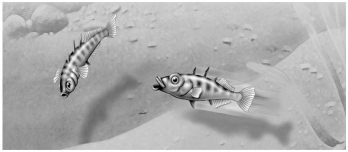 -In the territorial behaviour of the stickleback fish,the red belly of one male that elicits attack from another male is functioning as
 (Multiple Choice)
4.8/5 (68)
(68) 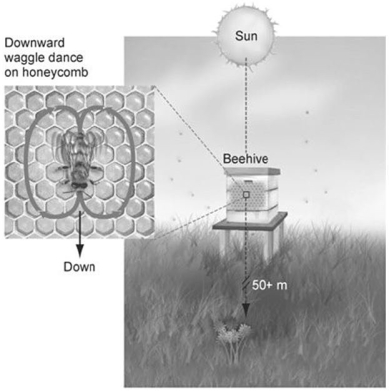
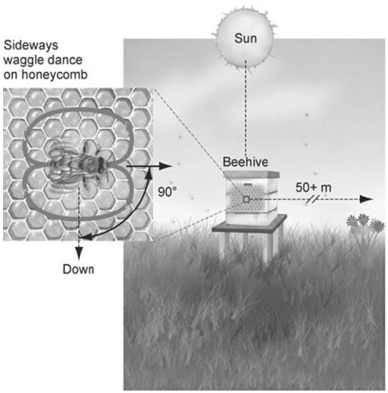 -What was the main reason the honeybees switched from the "round dance" to the "waggle dance"?
 (Multiple Choice)
4.7/5 (79)
(79) Classical conditioning and operant conditioning differ in that
(Multiple Choice)
4.7/5 (94)
(94) The proximate causes of behaviour are interactions with the environment,but behaviour is ultimately shaped by
(Multiple Choice)
4.9/5 (75)
(75) In the evolution of whelk-eating behaviour in crows,which of the following was optimized through natural selection?
(Multiple Choice)
4.7/5 (85)
(85) A stickleback fish will attack a fish model as long as the model has red colouring.What animal behaviour idea is manifested by this observation?
(Multiple Choice)
4.9/5 (92)
(92)
-From the figure above,what can we determine about the location of the food source?
-From the figure above,what can we determine about the location of the food source? (Multiple Choice)
4.8/5 (78)
(78) Every morning at the same time,John went into the den to feed his new tropical fish.After a few weeks,he noticed that the fish swam to the top of the tank when he entered the room.This is an example of
(Multiple Choice)
5.0/5 (80)
(80) A salmon returns to its home stream to spawn.What term best applies to this behaviour?
(Multiple Choice)
4.9/5 (83)
(83) Use the following information to answer the next few questions.
Imagine that your house has caught fire.It is only yourself and your full-sibling brother in the house since your parents are gone on vacation.After escaping the house,you cannot find your brother and decide he must still be inside.There is a 25% chance that you will not survive the fire,and you each will produce two offspring each should you survive.
-Hamilton's Rule predicts that
(Multiple Choice)
4.8/5 (73)
(73) After eating a brightly coloured frog for the first time and subsequently vomiting,a bird learns not to eat brightly coloured frogs.This avoidance is due to
(Multiple Choice)
5.0/5 (91)
(91) A chemical produced by an animal that serves as a communication to another animal of the same species is called
(Multiple Choice)
4.9/5 (76)
(76) 
Filters
- Essay(0)
- Multiple Choice(0)
- Short Answer(0)
- True False(0)
- Matching(0)