



 Chat with AI
Exam 47: Animal Development

Exam 1: Introduction: Evolution and Themes of Biology77 Questions
Exam 2: The Chemical Context of Life98 Questions
Exam 3: Water and Life92 Questions
Exam 4: Carbon and the Molecular Diversity of Life86 Questions
Exam 5: The Structure and Function of Large Biological Molecules131 Questions
Exam 6: A Tour of the Cell111 Questions
Exam 7: Membrane Structure and Function88 Questions
Exam 8: An Introduction to Metabolism92 Questions
Exam 9: Cellular Respiration and Fermentation128 Questions
Exam 10: Photosynthesis103 Questions
Exam 11: Cell Communication85 Questions
Exam 12: The Cell Cycle98 Questions
Exam 13: Meiosis and Sexual Life Cycles90 Questions
Exam 14: Mendel and the Gene Idea92 Questions
Exam 15: The Chromosomal Basis of Inheritance75 Questions
Exam 16: The Molecular Basis of Inheritance84 Questions
Exam 17: From Gene to Protein106 Questions
Exam 18: Regulation of Gene Expression116 Questions
Exam 19: Viruses71 Questions
Exam 20: DNA Tools and Biotechnology78 Questions
Exam 21: Genomes and Their Evolution64 Questions
Exam 22: Descent with Modification: A Darwinian View of Life68 Questions
Exam 23: The Evolution of Populations92 Questions
Exam 24: The Origin of Species76 Questions
Exam 25: The History of Life on Earth89 Questions
Exam 26: Phylogeny and the Tree of Life91 Questions
Exam 27: Bacteria and Archaea96 Questions
Exam 28: Protists82 Questions
Exam 29: Plant Diversity I: How Plants Colonized Land93 Questions
Exam 30: Plant Diversity II: The Evolution of Seed Plants119 Questions
Exam 31: Fungi105 Questions
Exam 32: An Overview of Animal Diversity93 Questions
Exam 33: An Introduction to Invertebrates111 Questions
Exam 34: The Origin and Evolution of Vertebrates126 Questions
Exam 35: Plant Structure,Growth,and Development82 Questions
Exam 36: Resource Acquisition and Transport in Vascular Plants100 Questions
Exam 37: Soil and Plant Nutrition99 Questions
Exam 38: Angiosperm Reproduction and Biotechnology107 Questions
Exam 39: Plant Responses to Internal and External Signals137 Questions
Exam 40: Basic Principles of Animal Form and Function98 Questions
Exam 41: Animal Nutrition87 Questions
Exam 42: Circulation and Gas Exchange112 Questions
Exam 43: The Immune System123 Questions
Exam 44: Osmoregulation and Excretion91 Questions
Exam 45: Hormones and the Endocrine System92 Questions
Exam 46: Animal Reproduction104 Questions
Exam 47: Animal Development106 Questions
Exam 48: Neurons,Synapses,and Signalling93 Questions
Exam 49: Nervous Systems85 Questions
Exam 50: Sensory and Motor Mechanisms106 Questions
Exam 51: Animal Behaviour91 Questions
Exam 52: An Introduction to Ecology and the Biosphere90 Questions
Exam 53: Population Ecology89 Questions
Exam 54: Community Ecology97 Questions
Exam 55: Ecosystems and Restoration Ecology98 Questions
Exam 56: Conservation Biology and Global Change90 Questions
Select questions type


In sea urchins,the "fast block" and the longer-lasting "slow block" to polyspermy,respectively,are
(Multiple Choice)
5.0/5  (73)
(73) Use the following information to answer the next few questions.
In a study of the development of frog embryos,researchers stained several early gastrulas with vital dyes and noted the locations of the dyes after gastrulation.The results are shown in the following table.
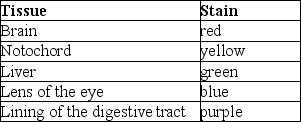 -The mesoderm was probably stained with a
 (Multiple Choice)
4.8/5 (74)
(74) The term applied to a morphogenetic process whereby cells extend themselves,making the mass of the cells narrower and longer,is
(Multiple Choice)
4.9/5 (67)
(67) What is the suggested reason for webbing between human embryonic digits?
(Multiple Choice)
4.8/5 (73)
(73) In an egg cell treated with EDTA,a chemical that binds calcium and magnesium ions,the
(Multiple Choice)
4.9/5 (93)
(93) Which of the following is an adult organism that has fewer than 1000 cells?
(Multiple Choice)
4.8/5 (74)
(74) The outer-to-inner sequence of tissue layers in a post-gastrulation vertebrate embryo is
(Multiple Choice)
4.7/5 (86)
(86) During the early part of the cleavage stage in frog development,the rapidly developing cells
(Multiple Choice)
4.9/5 (88)
(88) The structure of the Drosophila gene called Tinman is similar to a gene in humans that also
(Multiple Choice)
4.9/5 (82)
(82) The first cavity formed during sea urchin development is the
(Multiple Choice)
5.0/5 (86)
(86) In mammals,the nuclei resulting from the union of the sperm and the egg are first truly diploid at the end of the
(Multiple Choice)
4.9/5 (89)
(89) 
Filters
- Essay(0)
- Multiple Choice(0)
- Short Answer(0)
- True False(0)
- Matching(0)